

“A story is an analogy to a single human mind trying to solve a problem.”
— Chris Huntley and Melanie Anne Phillips, Dramatica: A New Theory of Story
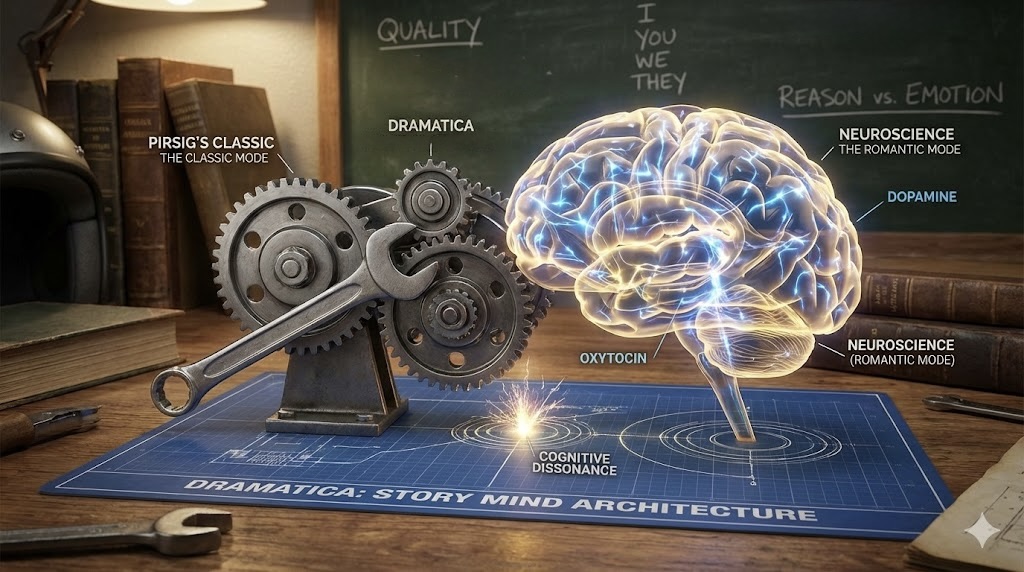
Note: This is the second part of a series. The prologue can be found here, along with chapter 1 here.
Pirsig’s Zen and the Art of Motorcycle Maintenance gave us the why of story, and Dramatica’s theory of story gives us the how. Where Prisig sought to harmonize the intuitive and the analytical to produce Quality, Dramatica mapped that harmony as an interactive model as a living architecture of the human mind.
At its core, Dramatica proposes that every complete story functions as a model of human psychology in motion as it attempts to solve a problem. In this sense, Dramatica is the architectural model of a human mind grappling with an imbalance, testing perspectives, and seeking resolution. Characters go beyond being just individuals, becoming functions of thought in action through plot. Plot, in turn, isn’t just a sequence; it’s the process of that individual’s mind forced into deliberation. Theme becomes the internal dialogue of value instead of just a message. And genre, rather than category, is the atmosphere of the problem itself, the emotional weather through which the mind travels.
In this regard, Dramatica and Pirsig are natural allies, both resting upon a foundational assumption: that meaning arises through the reconciliation of opposites. Pirsig called them classic and romantic. Dramatica calls them throughlines, four complementary vantage points representing perspective, through which a single inequity is explored.
These throughlines are:
Together, these four perspectives recreate the mind’s attempt to achieve balance, to resolve dissonance, and restore coherence. When any one of them is missing, the story as a persuasive argument feels incomplete, like an equation with a missing variable.
One thing to consider when examining Dramatica’s model is that, unlike other story paradigms, it’s less about plot and more about diagnosing motion. It reveals how meaning evolves through argument, contradiction, and transformation, the same recursive process that Pirsig identified as the rhythm of Quality. Where Pirsig saw the writer as a craftsman tuning the harmony between structure and beauty, Dramatica supplies the tool, specifically a wrench with a blueprint for navigating complexity without reducing it to formula.
In this framework, structure isn’t a cookie-cutter outline that one needs to color inside the lines with, but rather a resonance chamber, amplifying what would otherwise be inaudible to the audience. It is through structure that the ineffable gains form, that emotion becomes experience, and that the audience’s own cognitive dissonance is mirrored back to them.
The harmony between Dramatica and Pirsig lies in their shared assertion that understanding is not linear but dynamic; a recursive balancing act between order and chaos, reason and intuition, self and other. The writer, like Phaedrus on his motorcycle, must constantly shift gears between them to maintain the story’s forward motion. Users of Dramatica may recognize the pairings of those opposing elements, which reflect the dichotomy in Pirsig’s theory.
In this way, Dramatica becomes the classicist’s tool in service of the romantic’s vision, a way to tune the machinery of emotion without losing its soul.
Pirsig → Dramatica → Neurochemistry (at a glance)
If Dramatica mapped the architecture of story as a model of the mind, neuroscience gives us its anatomy, the living tissue through which story feels.
Every throughline in Dramatica, I, You, We, They, mirrors a human system of perception. Each is a function of logic, but equally important as a pattern of emotion. When viewed biologically, the model’s abstract quadrants align with the interplay of three fundamental neurochemical forces that govern engagement: dopamine, oxytocin, and cognitive dissonance.
Just as Pirsig’s “Quality” exists before definition, these chemicals act before awareness. They are pre-linguistic, pre-rational; the silent motivators that compel curiosity, empathy, and the need for resolution. Dopamine fuels the drive for discovery and anticipation. Oxytocin anchors us in empathy and connection. And cognitive dissonance, the uneasy space between them, creates the tension that keeps us leaning forward, both desiring and fearing what comes next.
Here, Dramatica shows how a story thinks; neuroscience reveals how we feel that thinking. Together, they complete the circuit, one defining the pattern and the other supplying the current.
Where Dramatica gives us the blueprint of consciousness in motion, neuroscience supplies its pulse, interlocking and forming a recursive loop between structure and sensation, between the story’s argument and the audience’s embodied experience of that argument.
It is within that loop that Quality becomes measurable. Not in metrics or formulas, but in neurochemical signatures: the dynamic oscillation between anticipation, empathy, and resolution that defines what it means to be immersed in story.
Dramatica’s archetypal characters of Reason and Emotion serve as a perfect structural manifestation of the core dualities the Unified Theory explores. They are, in essence, Pirsig’s philosophy and modern neuroscience rendered as characters within the Story Mind.
The Reason character, described as calm, logical, and focused on practical conclusions, is a direct parallel to Pirsig’s “classic” mode of understanding. This character embodies the analytical drive to see the underlying form of things, a process governed by the brain’s dopamine system, which seeks patterns and anticipates coherent outcomes.
Conversely, the Emotion character, frenetic, driven by feelings, and quick to empathize, is the embodiment of Pirsig’s “romantic” mode. This character represents the immediate, experiential reality of the story, a perspective mediated by the oxytocin system, which governs empathy and social connection.
The conflict between these two characters, which Dramatica frames as the “deliberation between intellect and heart,” is the structural engine of cognitive dissonance. When the Reason character’s well-laid plans clash with the Emotion character’s human concerns, the Story Mind is forced into the exact neurochemical standoff that the Unified Theory identifies as the tent-pole of engagement: cognitive dissonance. This makes the audience active participants in the story’s central argument, as they feel the tension between the dopaminergic desire for a logical solution and the oxytocinic need for an emotionally resonant one.
Dramatica’s concept of “Dynamic Pairs” provides a comprehensive structural map of the core tensions the Unified Theory identifies. If the Story Mind is an analogy for human psychology, then these pairs are the externalized representation of its fundamental internal conflicts. Each pair functions as a distinct axis of cognitive dissonance, forcing the Story Mind—and by extension, the audience—to deliberate between opposing but necessary drives.
These pairs align perfectly with Pirsig’s philosophy and the neurochemical model:
Ultimately, Dramatica’s Dynamic Pairs are the engine of cognitive dissonance within the story’s structure. They are the embodiment of the competing neurochemical and philosophical systems that the Unified Theory posits as the foundation of immersive experience. They ensure that the story’s argument is not a simple statement but a dynamic, felt deliberation.
Dramatica’s eight archetypal characters, when viewed as a whole, represent a complete psychological system. They are the personification of the essential functions required for a mind to fully process an inequity. Each character embodies a specific mode of thought or motivation, and together they map directly onto the classic/romantic and dopamine/oxytocin dualities.
When these eight functions are placed in conflict through their dynamic pairs, they create a complete and nuanced simulation of a mind at war with itself. The Story Mind isn’t just arguing between logic and emotion; it’s also battling faith vs. skepticism, and long-term consequences vs. immediate temptation. This is what makes a Dramatica story feel so psychologically complete—it externalizes the full spectrum of internal deliberations that define human problem-solving.
Dramatica’s four character dimensions offer a complete model of the psychological process, moving beyond static character roles to define the dynamics of how a mind confronts an inequity. These dimensions map directly onto the neuro-philosophical principles of the Unified Theory.
In this four-dimensional model, Dramatica provides the complete architecture of a thought process: the initial drive (Motivation), the goal (Purpose), the method of pursuit (Methodology), and the internal conflict over what constitutes success (Evaluation). This is a direct structural parallel to the brain’s dynamic interplay between the dopaminergic drive for coherence and the oxytocinic need for connection, all held in tension by cognitive dissonance.
NEXT: Part 3 The Domains of Conflict Dramatica’s Four Classes