

“The voyage of discovery is not in seeking new landscapes, but in having new eyes.”
— Marcel Proust
Note: This is the fifth part of a series. The prologue can be found here, with the previous chapters at the bottom of the page.
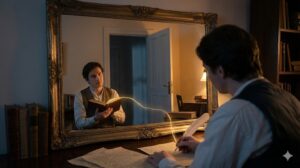
Ever notice that truly transformative stories seem to contain a moment when the audience’s mind folds back upon itself? An instance of realization? These aren’t merely plot twists; they are a type of mental model and problem-solving technique called psychological inversion in which the meaning of all that came before is re-evaluated, or, as I’ve noted in earlier essays, when the apparent story is overshadowed by the unseen structure of the real story coming into light. Like holding a mirror to another mirror, the story reflects the act of reflection itself.
Neuroscientifically, this is recursion, where the brain’s predictive model is updated with the realization of new evidence that constitutes a change in interpreting what came before. Each story revelation forces a backward review through memory, where earlier events are redefined with new emotional and logical values that may have been previously ambiguous by subtext. It is in these recursive moments when dopamine spikes as the brain replays the sequence, searching for a new understanding as the mind’s old schema falters. Oxytocin rises as this understanding deepens into empathy, resulting in a neuro-narrative loop: a feedback system where cognition and emotion harmonize into meaning.
When audiences reinterpret earlier moments, they stop being readers and become co-creators. In re-ordering the story internally, they engage the same neural processes used in imagination and memory construction. They are, in essence, writing alternate drafts within their own minds, exploring not just what was, but what could have been and what might be. This is the biological foundation of artistic participation: the reader’s brain becomes the page on which the story is rewritten.
In this reflective act, story becomes a mirror of creation itself. The recursive imagination is both a scientist (Classicist) and a poet (Romanticist), restructuring the narrative’s plot points for new meaning while discovering emotional truths that were dormant before. It transforms story from a potentially passive and linear form of entertainment into a fluid, cognitive event where the self evolves as much as the story does.
Long after the final page or frame, the loop continues, particularly with ambiguity and ambiguous endings. Residual dopamine sustains curiosity, while lingering oxytocin preserves empathy. This biochemical “afterglow” explains why great stories haunt us and why we replay scenes in our heads, debate interpretations, or dream new outcomes. The recursive imagination keeps the tent-pole of dissonance standing even after the circus has left town.
Aristotle introduced catharsis as returning the audience to equilibrium, closing the loop. What the Unified Theory proposes is Narrative Aporia: dissonance in an aporetic narrative doesn’t fail to resolve; it lingers by design.
An “afterglow,” or “haunting,” and “lingering dissonance” are all accurate ways of describing this effect of aporia, which, in Greek, literally means “without passage.” An aporetic narrative withholds passage, leaving the audience permanently at the threshold and “in suspense.”
It’s here that Colonization occurs. Because the oxytocin-driven bond prevents the audience from abandoning the open dopamine loop, the story takes up residence in the audience’s mind.
“Time is a function of memory, and space is a function of perception. Neither exists until experience divides itself to see itself.”
— after Robert M. Pirsig
Every story, consciously or not, plays with time and space. The writer constructs a sequence of events, and the audience constructs meaning from those events, which is not linear. It folds, loops, refracts. A story begins in one moment of time, yet is always experienced in two: the now of unfolding, and the after of understanding. This is a point made with Robert McKee’s analysis of Ordinary People’s inciting incident back in 2014, whereas McKee’s analysis uses a posteriori information, having viewed the movie in its entirety, to assign values that could not be possible by way of a linear “reading” of the events in real time by the audience.
In this folding, looping, and retracting, that story mirrors the structure of consciousness itself. When the brain encounters new information that contradicts expectation, it doesn’t move forward — it reaches back. Neural pathways reactivate and earlier impressions are reinterpreted through fresh context. The mind’s perception of time becomes fluid, as if rewinding and rewriting memory to preserve coherence. This is recursion as temporal elasticity, the narrative equivalent of Einstein’s relativity, played out in both thought and feeling (Classicism and Romanticism).
Space, too, undergoes a similar transformation. In immersive stories, the boundary between self and world becomes porous; the reader no longer perceives a separation between “here” and “there.” Oxytocin erodes distance, empathy collapses perspective, and story-space becomes shared-space, a landscape constructed from overlapping projections of imagination. This is why readers can feel “present” in a world that doesn’t exist, or why a writer can inhabit a character’s mind so fully that their own heartbeat syncs with the fiction’s rhythm.
In Pirsig’s language, this is the meeting point of Dynamic and Static Quality. Dynamic Quality, the living present and the experience of journeys, arise first, outside of time and space. Static patterns, narrative, structure, form, and signposts crystallize afterward, giving shape to what the moment meant. When the recursive imagination revisits the story, it moves between these two poles, re-experiencing the Dynamic moment through the Static form, collapsing the distance between them.
Thus, in story as in consciousness, time and space are not containers but consequences and the byproducts of reflection. Each re-reading or re-watching alters the temporal flow, deepening emotional resonance and expanding psychological space. The story becomes not a linear artifact, but a field where the ever-present interplay between what was, what is, and what might be coexist.
“You are never really reading me; you are reading yourself, projected through me.”
— Anonymous, marginal note in a first edition of Zen and the Art of Motorcycle Maintenance, or, more likely, an apocryphal, yet relevant, quote.
Great, immersive stories seem to have a hidden contract between writer and reader; a mutual understanding that neither can reach meaning alone. The author constructs the framework, but the reader supplies the connective tissue: imagination, empathy, inference. Together, they build the living experience of the narrative in real time through co-authorship.
This is not a metaphor. Neuroscientific studies of narrative transportation show that when readers become immersed in a story, their brains mirror the activity of the characters via mirror neurons. Motor regions fire during descriptions of movement; emotional centers synchronize with the protagonist’s distress or joy. But the most striking discovery is predictive: the brain continuously generates expectations about what will happen next, only to revise those expectations as the story unfolds. Each prediction is a creative act. Each revision is a moment of meaning-making. Thus, the reader is not merely interpreting the author’s world but co-authoring it in the mind’s eye.
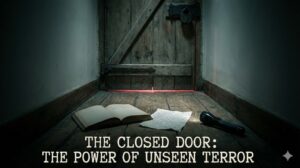
In his non-fiction treatise, Danse Macabre, Stephen King introduces the concept of ‘The Closed Door.’ This principle is the perfect operational example of meeting the reader halfway and co-authorship, wherein King uses the reader’s greatest asset: their own imagination, and fears they bring to the experience by not telling them what’s behind the door. Stephen King argues that nothing he describes can ever match the terrors lurking in the reader’s own mind. If he opens the door and reveals a ten-foot bug, the reader sighs with relief: “Thank God, I thought it was a hundred-foot bug!”
The horror wilts the moment it becomes specific, where before it bloomed in ambiguity. Breaking this down through the lens of the Unified Theory, this is an example of Static Quality killing Dynamic Quality.
The Closed Door (Dynamic Quality): When the door is closed, the monster is undefined. It exists in a state of pure potential. Because the reader’s brain is trying to predict what is there, it fills the void with the reader’s specific, personal phobias. It is Infinite Fear.
The Open Door (Static Quality): The moment the writer says “It’s a giant spider,” the potential collapses. The reader looks at it and says, “Oh, it’s just biology. I can squash a spider.”
The sigh of relief is the brain solving the prediction error. While distress (cortisol) drops, so does engagement (dopamine). The risk has been identified, the potential has collapsed into the mundane, and the narrative drive evaporates.
The takeaway here is that the audience is made up of a variety of people, whose life experiences, mental schemas, phobias, and fears all make them unique. Stephen King intuitively knew this. By using ambiguity and narrative blurring, the author is essentially creating a mirror where each projects their own individual fears or “Shadow” into the story.
In The Fourth House, many of the events are ambiguous in nature, leaving the reader to come to their own conclusion as to what is going on. The ambiguity of the ghost creates a Rorschach test for the reader. The reader with abandonment issues hallucinates a symbol of loss; the reader fearing insanity hallucinates a symptom of psychosis. The text remains the same; the monster changes.
Both readers leave satisfied because the book allowed their specific brain architecture to validate its own worldview. The “Theme” became a mirror. This does not mean that readers aren’t susceptible to changing their worldview, as that’s what great stories often do. Rather, the ambiguity allows for both readings to be correct, and for the potential of validation, or a change in the reader’s perception, just like the main character may change or remain steadfast. When a reader does embrace that shift, they are experiencing a moment of genuine neuroplasticity: the physical rewiring of neural pathways to accommodate a new, more complex reality.
This works for a story’s theme as well: instead of stating what the theme is in a story, a Static Quality point, the Unified Theory, using ambiguity, doesn’t give the reader this Static truth, forcing the reader to actively engage in resolving the pattern. This ensures the theme is not something the audience merely receives; rather, the theme is what the reader generates or discovers. Thus, the reader feels a spike of dopamine upon accomplishing this, and subsequently feels deeply connected as a result. This principle of the ‘Closed Door’ applies not just to monsters, but to the very truth of the story itself.
When a story subverts expectation, e.g., the killer wasn’t John after all, the reader experiences a neurological “error signal,” the same feedback loop that drives learning*. The mind doesn’t stop at surprise; it retroactively reinterprets prior events to reconcile the new truth. This recursive correction is both cognitive and moral: the reader confronts their own assumptions, their own readiness to judge. The story, in that instant, becomes a mirror, causing the reader to reflect upon themselves.
This, then, is the deeper function of storytelling: not to provide answers, but to create the conditions in which readers discover them for themselves. The writer’s role is not to dictate, but to design dissonance; to leave deliberate gaps where imagination must enter and fill them with possibilities. As in Pirsig’s union of classical and romantic thought, the narrative’s structure and the reader’s intuition must meet in balance. Dynamic Quality flows from the interplay between what the author provides and what the reader projects.
This collaboration is what gives story its longevity. Each reader writes a slightly different version, informed by their experiences, values, fears, and hopes. Each rereading becomes a new act of creation, the recursive imagination re-entering the field of time and space the author first opened, and so, story endures not because it is fixed, but because it is alive.
The story becomes a framework of cognitive space, offering enough familiarity to orient, enough dissonance to disrupt, and enough space to reflect. The reader’s immersion, then, is not just a matter of emotional transport; it becomes an act of experiential learning, where the brain’s narrative systems are not only engaged but reorganized in response to new understanding. In this way, the story transcends entertainment and becomes a site of active epistemological construction, the same kind of synthesis that underpins all genuine moments of insight, learning, and what Pirsig called Dynamic Quality.
*This participatory dimension of storytelling, where the reader is not simply absorbing narrative but actively reconstructing its meaning, mirrors principles found in constructivist learning theory. Just as constructivist educators design environments where learners confront ambiguity, resolve contradictions, and build their own understanding through experience, so too does the immersive narrative provoke the reader into a recursive engagement with the story’s structure, theme, and emotional implications.
NEXT: Part 6 Beyond Formula, Toward Conscious Design