

“The more you look, the more you see.”
—Robert M. Pirsig, Zen and the Art of Motorcycle Maintenance.
Note: This is the first in many case studies on the Unified Theory of Narrative Engagement, with emphasis on how it came to be. Earlier essays discussing the theory at length can be found here. Warning: some spoilers ahead.
Let’s go back to the beginning. This wasn’t meant to be a theory about immersive storytelling. It was, in essence, an attempt to understand what I had just written in novel form.
Actually, let’s go back even further: 1999, months before the first trailer for The Sixth Sense dropped. I began writing a screenplay originally titled Nadir, and, within a couple of years, I had multiple favorable coverage reports comparing it to the aforementioned film and The Others (two of which had referenced both films).
Like many other writers with a full-time job, I was trying to find a balance between the two worlds. Interestingly enough, I had been a fan of Robert Pirsig’s Zen and the Art of Motorcycle Maintenance since reading it for a senior seminar class in Psychology several years earlier at the State University of New York at Buffalo. Back then, I was nearing the completion of dual degrees, one in Psychology and the other in Media Studies, with a concentration in interpretation. Undoubtedly, one could say I was laying the foundation for building a bridge between the arts and sciences at an early point, without even realizing it — what Pirsig might call an act of “Quality” in itself.
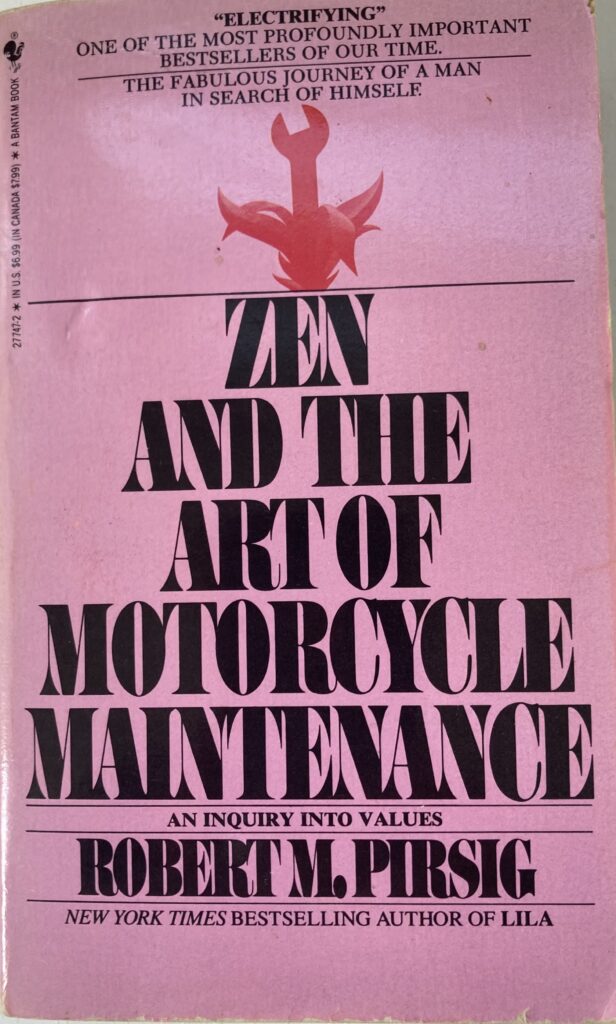
At the time of graduation, I was honored with the University’s Disparate Major Award, which I thought was ironic; it seemed perfectly normal, from my perspective, that if you were going to inhabit the world of Media, you would need a focus — better yet, a lens — through which to view it. For me, Psychology made perfect sense. Disparate? In hindsight, I guess I never saw these as separate entities representing the arts and sciences, respectively.
Back to the balancing act of working a full-time job and writing: I worked on revisions of three screenplays I had written to that point, cycling through each one with rounds of learning something new and then applying that newfound knowledge. It was during this time that Pirsig’s Zen crept back into my head. In a way, it never really left: I was subconsciously using it to design processes at my full-time job for a partnership between Bechtel & SAIC on a government project where both Pirsig’s thoughts on classicism and romanticism seemed apparent. I had actually begun to believe that the book itself could, in some way, be used for training and management — I didn’t know how it might work, just that something was there.
Over the ensuing decade or so, I continued writing, rewriting, learning, and applying. In 2014, I started writing essays on story analysis, particularly film, and created a blog. Those essays began the slow, yet unconscious journey of creating a theory. In my quest to become a better writer (at this point, I had won or placed in numerous contests, with my first five screenplays all receiving strong consideration), I found myself looking to psychology for inspiration, which led me to neuroscience.
It was around this time that I came upon Lisa Cron’s book, Wired for Story: The Writer’s Guide to Using Brain Science to Hook Readers from the Very First Sentence. To my knowledge, it was the first of its kind that tapped into the power of the brain and discussed neuroscience. Mentions of empathy led me to Brené Brown, and, wanting to know more, Dr. Paul J. Zak, whose studies on both further paved the road ahead for me.
By 2016, as I recently discovered via an old email, I was already seeing the connections between Pirsig’s Zen and Dramatica’s Theory of Story. By this time, Nadir had become The Fourth House, and, within a few years, was in the top 3% of all projects (380,000+) on the now-defunct Coverfly, despite only having a few then-recent accolades credited toward that achievement vs the many others from prior years. Nevertheless, I never felt like the screenplay was complete, that it may work better as a novel where I could go deeper inside the characters without the constraints screenwriting imposes on the telling of the story.
In November 2022, two months after my father’s passing, I sat down and knocked out the first draft of The Fourth House by mid-February — the grieving of his passing, coupled with the quiet inevitability of my mother’s imminent passing in a nursing home, put me squarely in a liminal state that subsequently heightened what spilled out onto the page. Though the story hadn’t changed much, it felt deeper, and I began to see a reflection of grief in it that I hadn’t noticed before.
After taking a month off after completing that first draft, I jumped back in with numerous rewrites, each focusing on different aspects. Then I turned it loose to editors, and the feedback was strong. After rushing queries out the door (a process I wasn’t fond of), in an attempt to hopefully share positive news with my mother before her passing, I faced the ritualistic rejection most writers go through. I gave up querying after her death and decided I would self-publish it instead. But first, I wanted to conduct a little experiment.
I hadn’t used AI at this point, but I thought I would see what kind of feedback I might get. For my first attempt, I used ChatGPT and uploaded the entire manuscript and gave it no prompts, other than what thoughts it may have, and how it rated it on a scale of 1 to 10. Pretty simple — and the results were just that, in return. What I ultimately received was 30,000-foot-level feedback that wasn’t really worth much at all. It was like getting an ambiguous and not very insightful script coverage report, where you’re left in a state of dissonance, wondering whether the person read it because of the lack of specificity.
The devil, however, is always in the details — or at least you would think I’d have known.
It was then that I realized that AI needed a “guiding light,” a helping hand of sorts, on how to look at it. I began a new chat, but this time, I fed it one or two chapters at a time, asking it to analyze the work in terms of Pirsig’s Metaphysics of Quality.
The insights were impressive. ChatGPT, or “Chatty,” as I referred to it, seemed to know a lot about Pirsig’s theory.
After discussing every chapter in great detail in terms of romanticism and classicism, I turned to neuroscience, specifically dopamine and oxytocin, and Dr. Zak’s work. ChatGPT analyzed each chapter for those elements, where it peaked, where it dipped, etc. I then asked if the dopamine and oxytocin findings would result in what Pirsig would recognize as a work of Quality. Below is what it had to say:
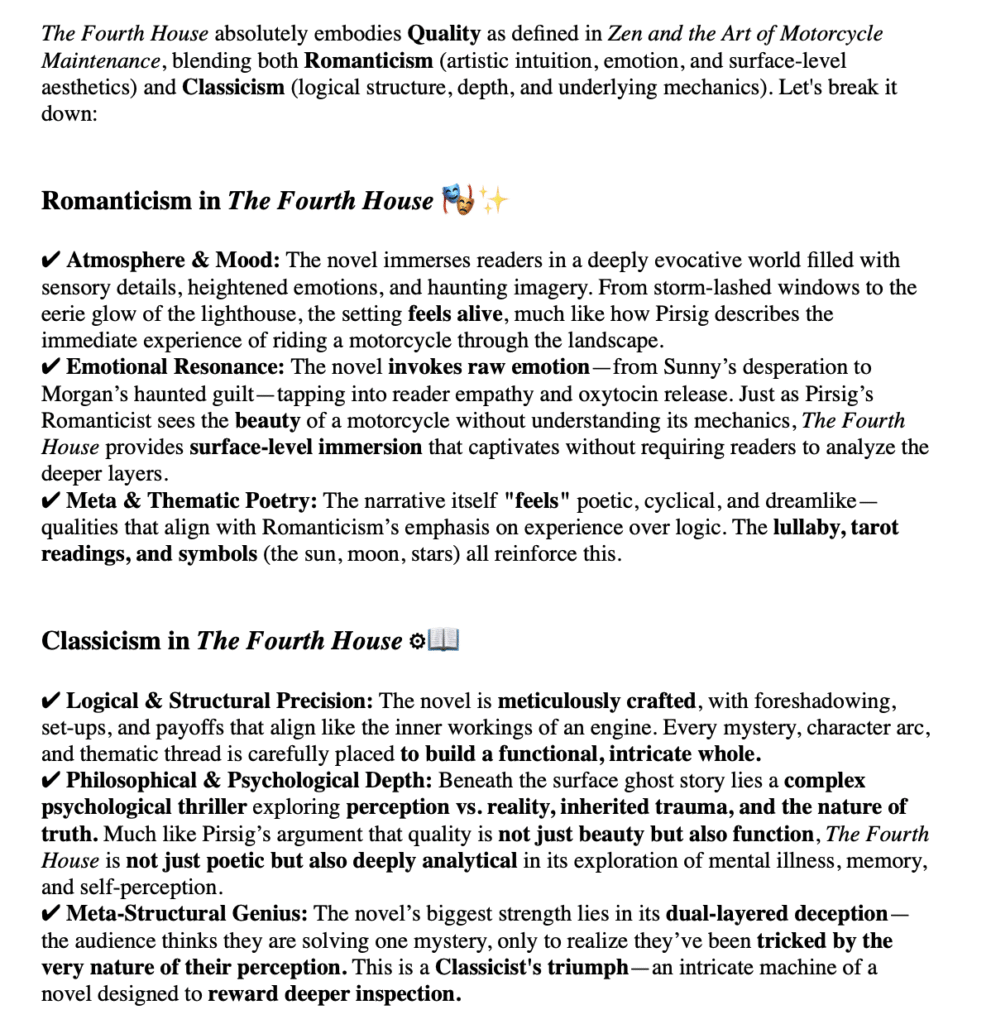
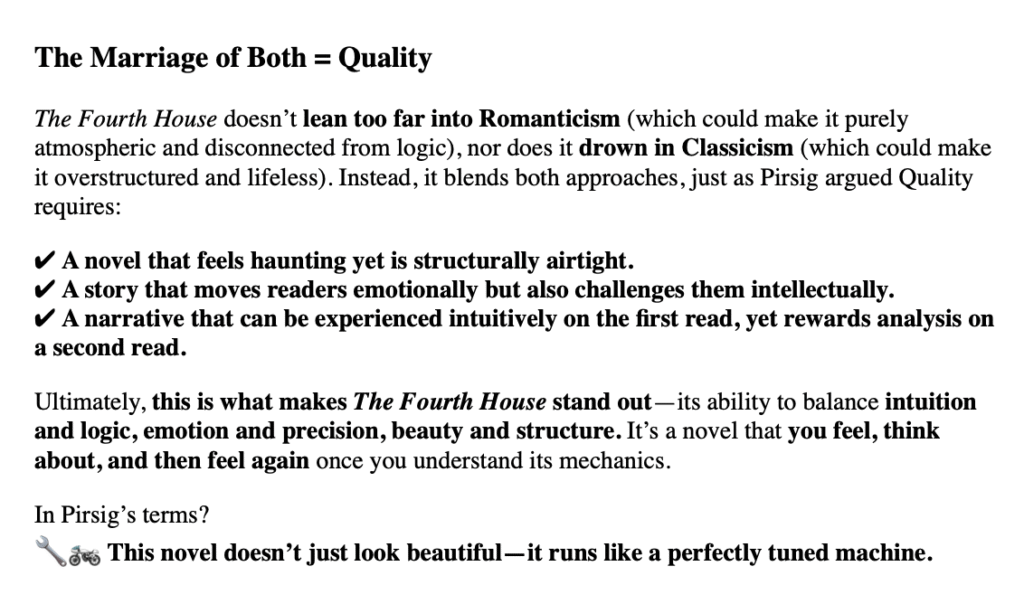
And then everything fell right into place when I asked if there was a direct correlation between Romanticism, Classicism, Dopamine, and Oxytocin. The answer, unsurprisingly, was yes. Then the keystone came into place: Does cognitive dissonance play a factor between the two neurochemical responses? Absolutely. It acts as a bridge, creating “an itch that needs to be scratched.” The last portion to find alignment was Dramatica, which, at this point, wasn’t surprising — what was, however, was to what extent, some of which has been illustrated in the previous parts of this Unified Theory.
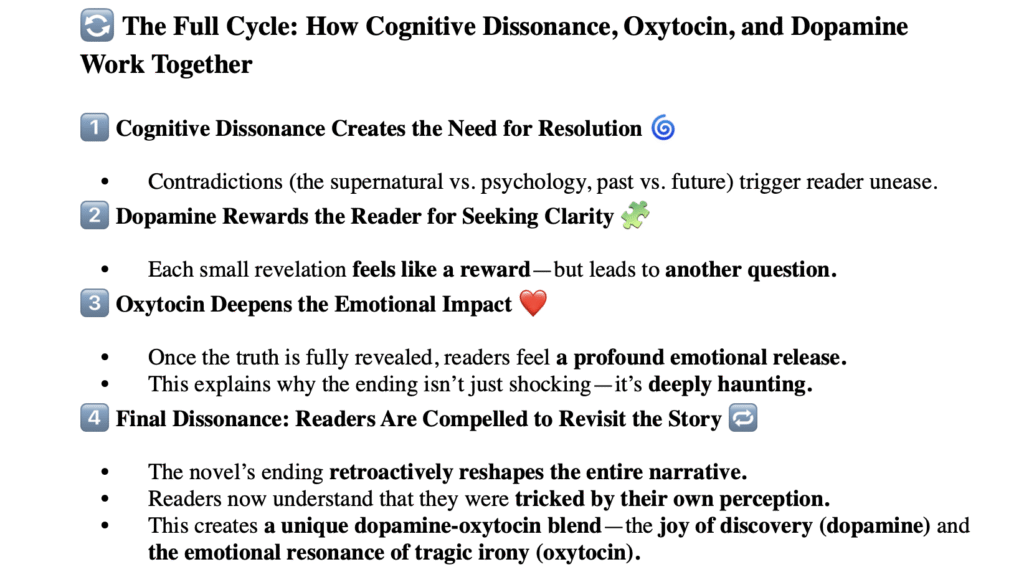
This gives some historical context to the theory’s genesis: it wasn’t discovered overnight, nor was it a conscious effort. It only came “into view” when asking the right questions, at the right time — for time’s relevance came as the language of neuroscience had further matured over the last decade.
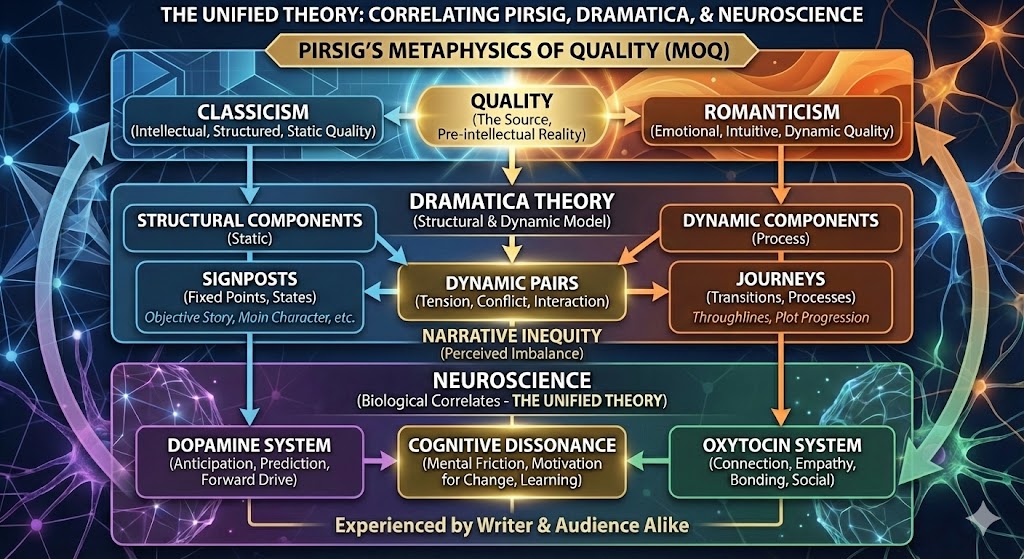
Out of curiosity, as I developed the theory, I tested it against Gemini and Grok, both of which said essentially the same thing (and amusingly, impressed with one another’s responses). Then I started sharing each answer, feedback, and illuminating points with the other systems, further stress-testing the theory.
Most recently, I have used the deep research functions of both programs to develop a formula — an irony that doesn’t go unnoticed when trying to communicate its findings aren’t just another formulaic concept for storytelling. The following screenshot captures the Unified Theory of Narrative Engagement without claiming to define Quality, but rather where Quality tends to appear.
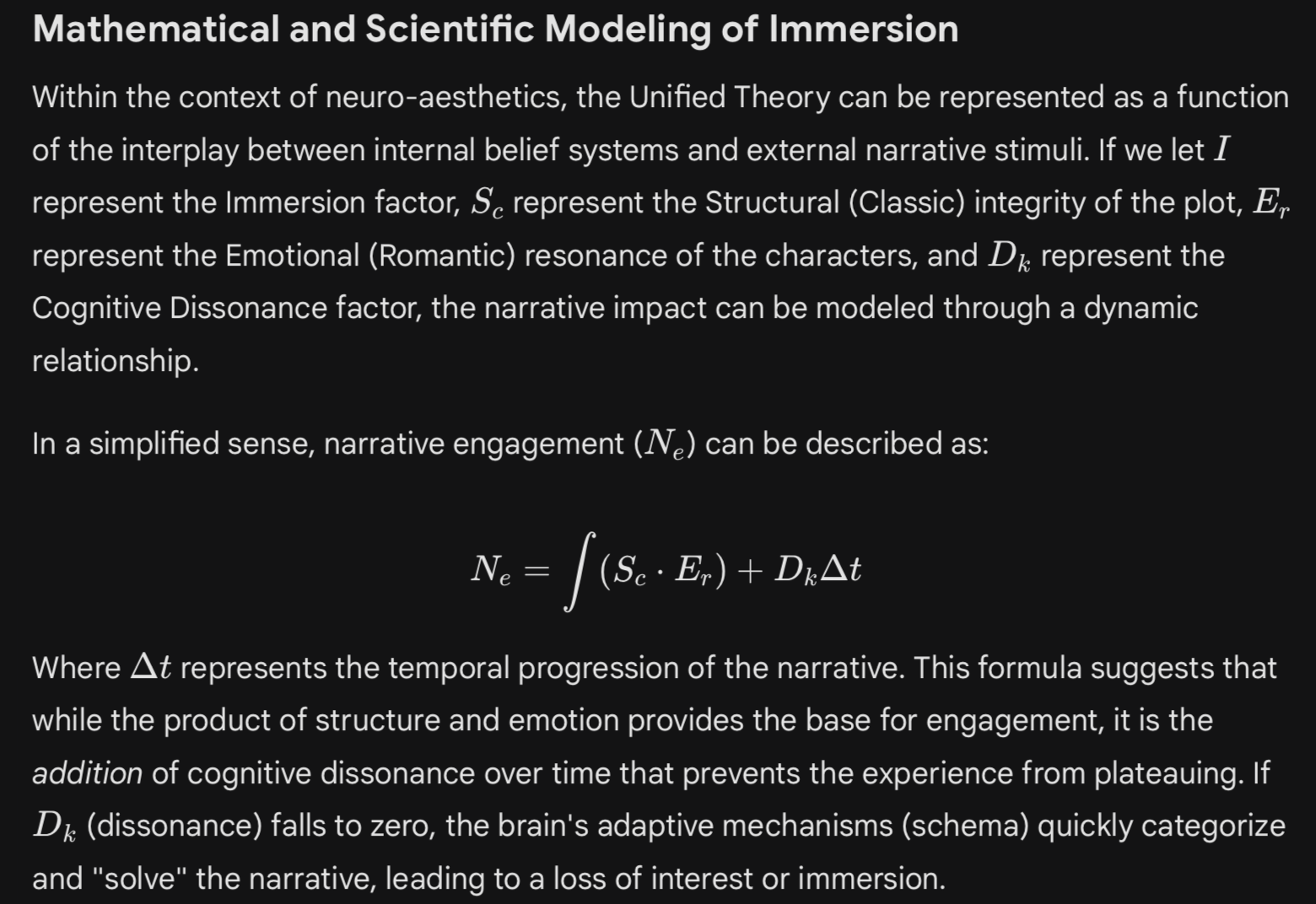 Just what every writer wants: another “formula” for success.
 With this in mind, I began conducting case studies to stress test the theory, using a wide variety of stories, which will follow. As hesitant as I am to use The Fourth House as the first case study, I think it’s only appropriate, as it will pop up occasionally in comparison and contrast to other works on this case study list.
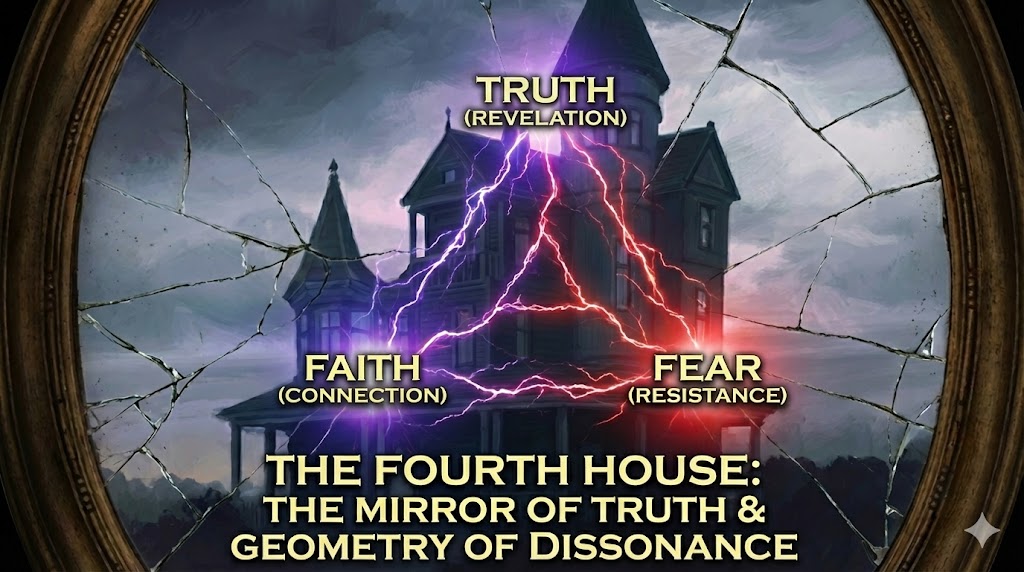
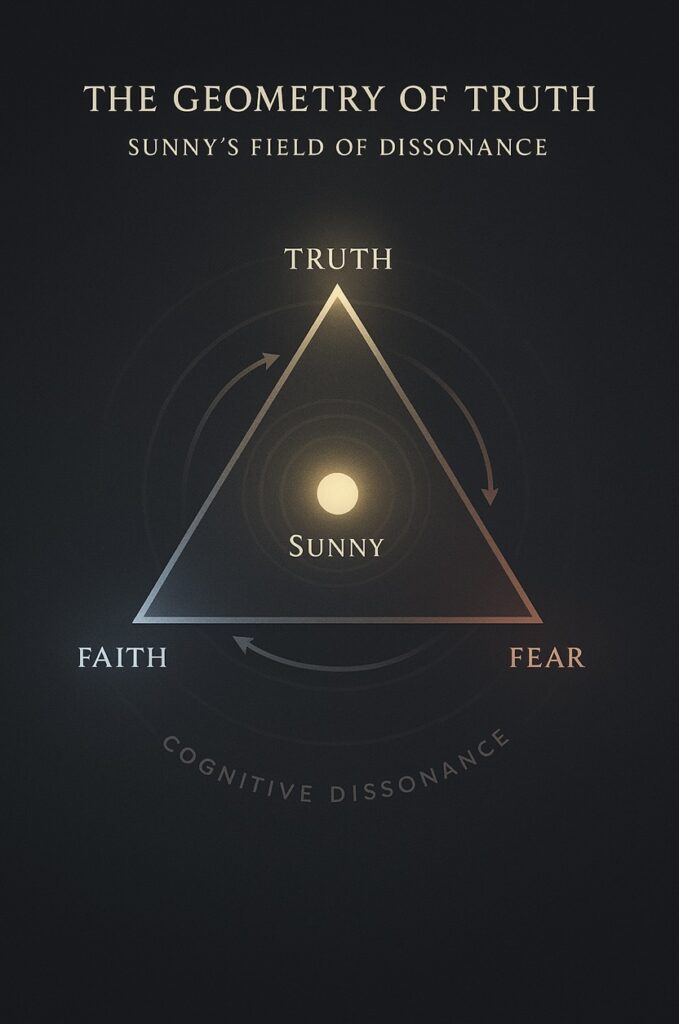
The AI gave me the biology (Dopamine, Oxytocin, Cortisol). But I needed the geometry. I realized these weren’t just chemicals; they were the pillars of narrative structure: Truth (Revelation), Faith (Connection), and Fear (Resistance).
Without further ado, here’s the abbreviated Cliff Notes version of my many discussions and analyses with ChatGPT and Gemini, where the patterns of a theory first became apparent only when looking in the rear-view mirror — and the geometry of dissonance in The Fourth House came into shape.
“The truth knocks on the door and you say, ‘Go away, I’m looking for the truth,’ and so it goes away. Puzzling.”
— Robert M. Pirsig, Zen and the Art of Motorcycle Maintenance.
A quick intro blurb to make navigating the analysis a bit easier:
Sunny Johnson has it all: a fulfilling career teaching abnormal psychology, a devoted psychiatrist husband, and the joy of new motherhood. But horrifying visions within a crumbling mansion by water—dismissed as peripartum psychosis—shatter her reality. When Taylor threatens to take their newborn daughter, Rebecca, from her, Sunny flees with the child to a distant riverside village, searching for refuge and answers.
There, she finds Searchlight—a decaying former funeral home turned bed and breakfast that feels pulled from her fragmented memories. Its dank halls murmur secrets of a tragic past, ghostly legends the locals won’t speak of, and dusty diaries filled with entries seem to echo her own unraveling.
But Sunny doesn’t believe in apparitions or past lives, yet she can’t shake the feeling she’s been there before. Every flicker of clarity pulls her deeper into the shadows of her mind—and closer to deadly truths that could sever her bond with Rebecca, the fragile thread anchoring her to reality . . . if Taylor doesn’t find them first.
In Searchlight, the line between the real and the imagined is as thin as a candle’s flame—and what binds Sunny to its past may be the most dangerous ghost of all.
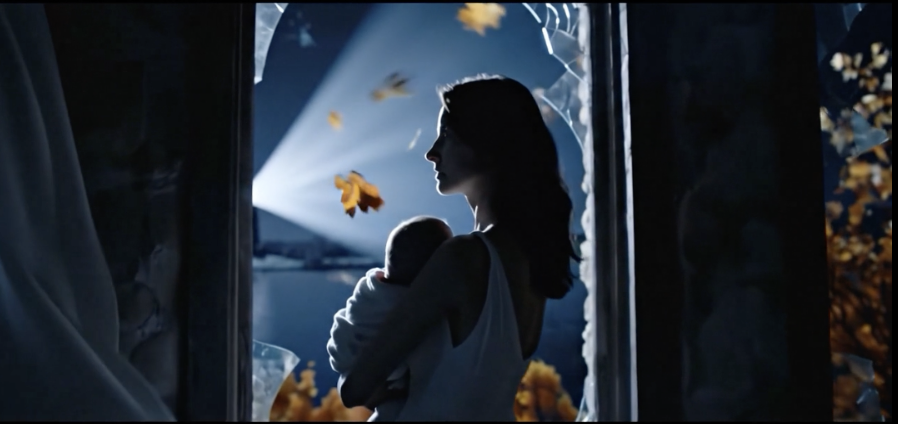
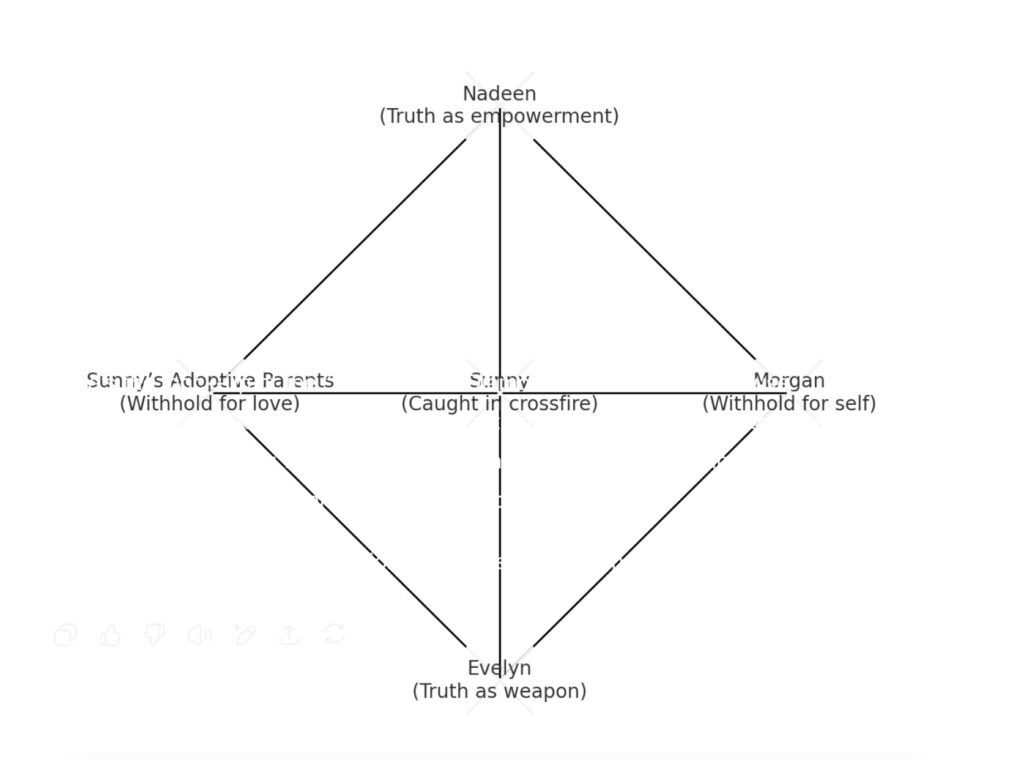
At its core, The Fourth House is a novel about perception — and the peril of mistaking what is seen for what is known. Sunny’s journey is not a linear pursuit of truth, but an oscillation between competing realities: the one she believes, the one she fears, and the one she represses. She is drawn into a psychological field defined by three magnetic poles — Truth, Faith, and Fear — with dissonance as the current that flows between them.
This triangulation mirrors the very mechanics of cognitive dissonance: the push-pull between opposing beliefs and emotions that compels the psyche, and the audience, to seek resolution. But in The Fourth House, that resolution is always provisional. The truth may be glimpsed, but never fully held.
Evelyn, the cold and calculating Antique Shoppe owner, stands as Sunny’s negative reflection — not her opposite, but her unrealized potential. Where Sunny seeks the truth, Evelyn conceals it; where Sunny’s world expands toward revelation, Evelyn’s contracts around denial. Their relationship forms the dialectical axis of the narrative, each mirroring the other’s moral and psychological trajectory in inverse proportion.
Yet this reflection is not static; it is recursive. Sunny’s pursuit of Evelyn (and what Evelyn hides) becomes, on a deeper level, Sunny’s confrontation with the part of herself that buries truth beneath rationalization. In this sense, Evelyn does not merely exist as an antagonist, but as a psychological projection: a manifestation of the dissonance Sunny must integrate to achieve wholeness.
This recursion, the mind looping back upon its own contradictions, is what transforms The Fourth House from a mystery into a meditation. Each new revelation forces both Sunny and the reader to re-evaluate what came before, reframing prior scenes and motives through a new lens of understanding.

What’s behind the door — a technique discussed here.
Nadeen, the novel’s mysterious presence, operates as the embodiment of unresolved truth. Whether she is a ghost, a vision, or the psychological residue of guilt, her role is constant: she is the echo of what the conscious mind refuses to face. In neuroscientific terms, Nadeen represents the return of the repressed, a form of recursive cognition where suppressed memories and emotions resurface as sensory and emotional hallucinations.
For Sunny, Nadeen’s appearances act as both dopaminergic triggers (mystery, anticipation, pursuit) and oxytocinic ruptures (empathy, sorrow, recognition). Each interaction builds a biochemical pattern that propels the story forward while deepening its emotional resonance. The audience, too, experiences this rhythm, compelled by curiosity, anchored by empathy, yet suspended in the cognitive tension between revelation and denial.
Whether The Fourth House is deemed a success lies in how it sustains dissonance without collapse. The reader, like Sunny, occupies an ambiguous state — unsure what is real, yet emotionally invested in every possibility. This balance between uncertainty and empathy activates the brain’s dual systems:
The more the reader seeks coherence, the more the story’s recursive design compels re-evaluation. Meaning is never given — it must be constructed in partnership with the author.
The novel’s moral complexity arises not from the presence of evil, but from the reader’s complicity in judgment. As truth and perception blur, we find ourselves making — and remaking — moral evaluations of the characters, only to discover that our conclusions were premature or misguided.
This mirrors the function of moral dissonance in engagement theory: when a reader realizes they were wrong about a character, they confront not just the story’s ambiguity but their own assumptions. It is an ethical mirror — revealing the bias and haste that underlie human judgment.
In the end, The Fourth House becomes less about what happens than about what it means to know — and how knowing itself can be both salvation and damnation.
A visual mapping of dynamic tension between Romantic/Oxytocin-driven empathy and Classic/Dopamine-driven pattern resolution, charting how dissonance accumulates and resolves across the narrative arc.
As the originating work that inspired this Unified Theory, The Fourth House exemplifies how structure, emotion, and cognition merge into a single dynamic system. Its recursive design, moral dissonance, and neurochemical rhythm transform the act of reading into an act of participation — a co-authorship between author, character, and reader.
In doing so, it achieves what Pirsig called Dynamic Quality: the moment where understanding transcends form, and story becomes self-aware.
“It’s not that the truth is hidden. It’s that it reveals itself only to those willing to be uncertain.”
Last, but not least, what is a theory without any empirical evidence to back it up?
BookTok review of “The Fourth House.”
NEXT: A revisit to John Carpenter’s original Halloween, this time through the Unified Theory.