“It’s the boogeyman.”
— Laurie Strode, Halloween (1978)
Note: This is the second in many case studies on the Unified Theory of Narrative Engagement. Earlier essays discussing the theory at length can be found here.
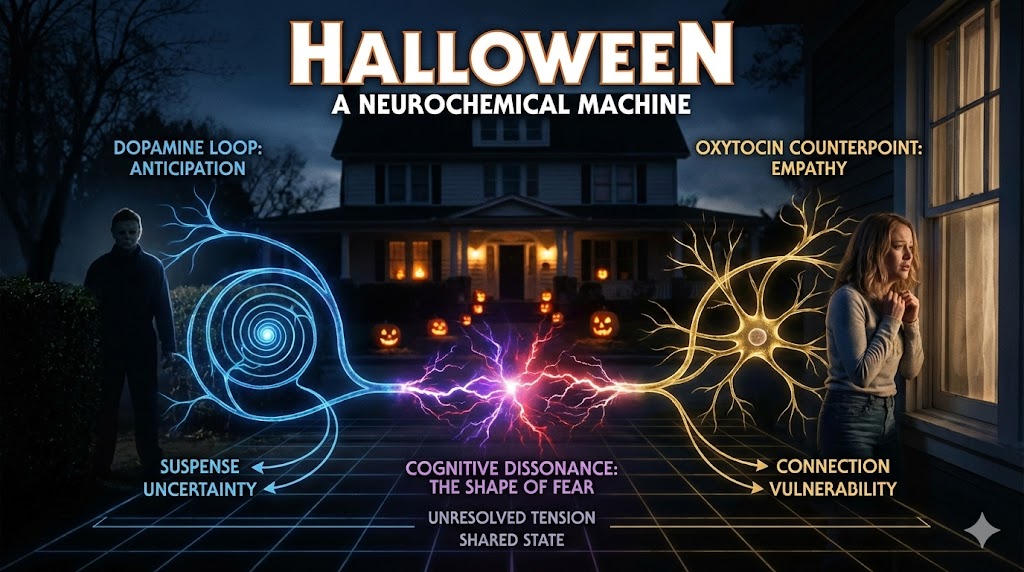
When John Carpenter directed Halloween in 1978 on a shoestring budget, the horror film he was making then can now be recognized as a neurochemical machine through the lens of the Unified theory. Every frame, sound, or absence with long beats of silence in Halloween operates with a machinist’s precision to stimulate one of the brain’s primal feedback systems: the anticipatory loop of dopamine.
The genius of Halloween is that its fear doesn’t depend on gore, monsters, or overt spectacle, attributes that were proven excesses without the same effect in its myriad of sequels, reboots, and remakes. Rather than visceral violence, it relies on expectation without resolution. By balancing what the audience sees, hears, and imagines, Carpenter crafts a sustained state of cognitive dissonance, a tension between knowing and not knowing that the mind cannot easily resolve.
This is engineered horror. The “shape” of fear is less of Michael Myers himself disappearing into the dark of night or appearing at the edges of the frame; it’s the invisible architecture of a growing uncertainty left behind in his wake, as discussed in the 2018 article I wrote here.
Dopamine, as we have clarified, is the chemical of pursuit. It is released when the brain anticipates something, whether danger, discovery, or reward, and its cycle intensifies when resolution is delayed.
In Halloween, John Carpenter weaponizes this delay, creating suspense through several techniques:
Each of these devices sustains tension by withholding closure. The audience’s brains become neurologically trapped in a loop of expectation, their reward systems primed for resolution that never arrives, or only so after an unbearable delay.
While dopamine drives anticipation, Halloween maintains emotional connection through its counter-agent, oxytocin, through Laurie Strode, who functions as the emotional anchor of the story. Her vulnerability, courage, and isolation give the audience someone to feel for amid the terror; she is the main character, after all.
Every close-up of Laurie’s trembling breath, or moments of compassion toward others engages oxytocinic response, particularly when human connection is under threat, as demonstrated by her interactions with Tommy Doyle.
The tension between Laurie’s caring and Michael’s emotional vacancy creates a neurochemical polarity: oxytocin vs. adrenaline, connection vs. annihilation. This represents the biological underpinning of horror’s moral dimension and the story’s battle: the sacredness of life against “the void.”
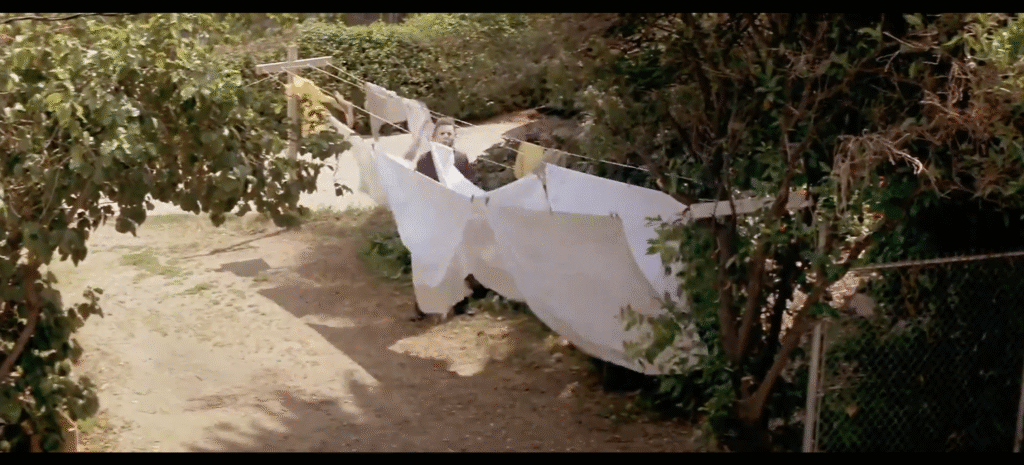
What distinguishes Halloween from many of its imitators is not merely its suspense, but its sustained cognitive dissonance. The viewer is caught between two incompatible realities: the apparent safety of suburban normalcy and the creeping recognition that this safety may be illusory.
Suspense operates along a temporal axis. It asks: What will happen? It propels the audience forward toward resolution. The “Big Suspense Question” — Will Laurie survive the night? — creates a dopaminergic pull toward an outcome.
Cognitive dissonance, by contrast, operates in the present tense. It asks: How can both of these be true at once? It is not primarily concerned with outcome, but with the friction between incompatible interpretations of reality.
In Halloween, the dissonance emerges from a structural conflict organized around a single thematic question: Does the boogeyman exist?
Each time Michael survives what should be a fatal blow, a prediction model is violated. One shot might be survivable. Two shots improbable — six gunshots, and a fall from a second-story balcony — the audience’s mental model fractures. This is not merely suspense about what will happen next. It is a schema violation. The familiar static patterns no longer hold. Dynamic Quality intrudes, not as beauty or innovation, but as rupture, and suspense pivots to dissonance: “What is he?”
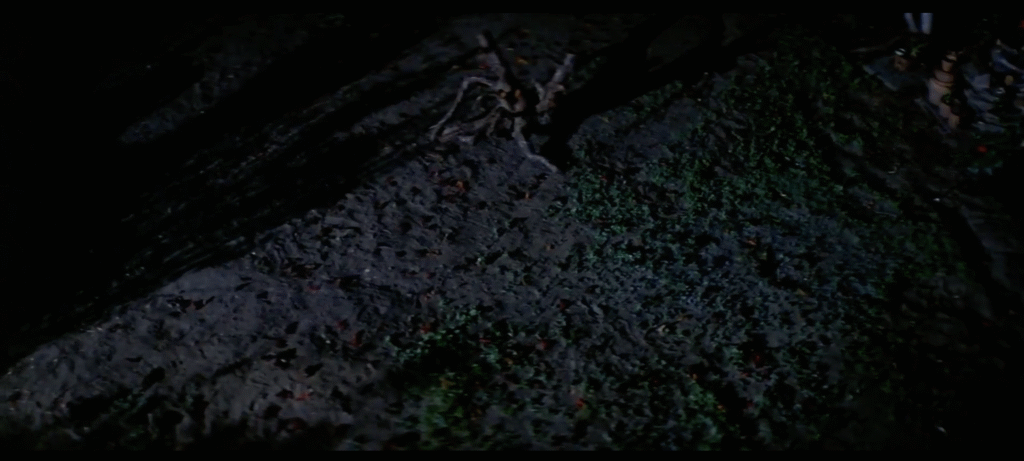
Suspense pulls the audience forward through anticipation, but dissonance pushes them inward through instability. Suspense resolves when the outcome arrives; dissonance persists when what is threatened is not merely survival, but coherence itself.
Model → Violation → Recalibration → Instability. This aligns with the formula proposed here:
Ne = ∫ (Sc · Er) + DkΔt
The boogeyman question is the Sc (structural component). The escalating violations intensify Dk over time. The unresolved ending leaves Δt psychologically open.
This is why Halloween lingers. The final shot does not answer the question of survival; it destabilizes the ontology of the world itself. Michael’s absence signals nonclosure. The loop remains open because the dissonance was not resolved—it was displaced onto the audience, left for them to resolve as they look over their shoulders on their way home from the theater.
Michael Myers, credited simply as The Shape, is more than a killer. He is the narrative embodiment of unresolved energy. With no motive, no moral reasoning, no catharsis, Michael Myers’ mask erases identity, making him a blank vessel for projection, the audience’s and the characters’ fears materialize by way of Captain Kirk. This harkens back to the co-author partnership discussed in part 5, where the audience becomes more engaged in the story when their own fears are allowed to contribute to the experience through ambiguity.
From a psychological standpoint, The Shape functions as the externalized manifestation of the mind’s repressed chaos. In Pirsig’s terms, he is Static Quality unmoored, pure form without dynamic meaning. Laurie, conversely, represents Dynamic Quality: adaptation, awareness, and moral consciousness struggling against entropy.
Their clash is just as much metaphysical as it is physical, where the living confront the void.
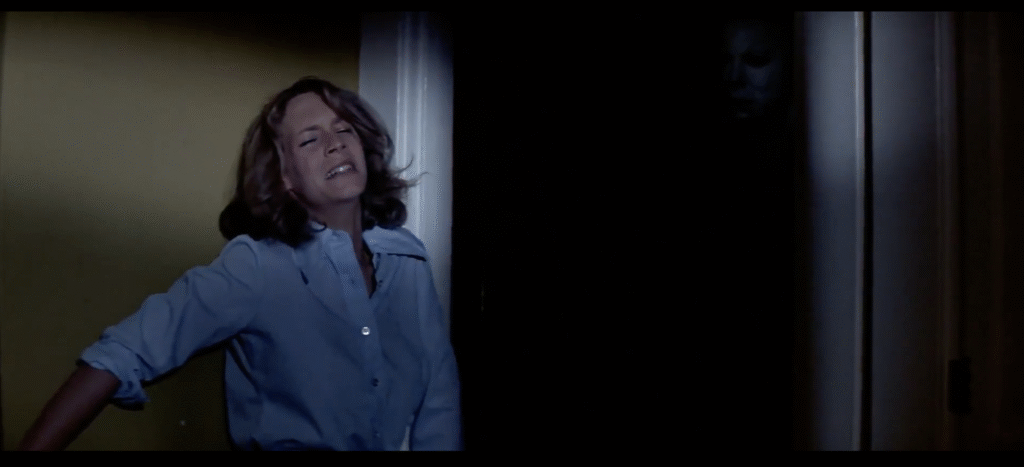
The most lasting (and haunting) aspect of Halloween is its refusal to resolve its tension. After Loomis shoots The Shape six times, the camera returns to the empty ground where he had fallen from the second-floor balcony moments before. He’s gone, but his breathing continues, echoing ambiguously over a series of locations from earlier in the film, suggesting he could be anywhere. Unlike films that end with catharsis, Halloween ends with continuation, the sound of Michael’s survival echoing into the dark, or around the corner, or behind a tree.
This is the dopaminergic afterimage, where the story leaves the anticipation loop open, forcing the brain to keep searching, imagining, projecting, and fearing. It’s why Halloween lingers long after the credits roll, denying the audience what their neurochemistry craves most: closure. Its refusal to explain or resolve is why the film succeeds to the level it does, whereas its myriad sequels and reboots fail.
Seen through the Unified Theory, Halloween is a field of cognitive modulation. Dopamine sustains anticipation, oxytocin anchors empathy, and the “friction” from dissonance electrifies the space between them.
It is, in essence, a cinematic mirror of the mind’s own survival instincts; the balance between the dynamic pairs of fear and understanding, distance and connection, and control and surrender. And in that mirror, John Carpenter lets us experience fear’s anatomy rather than letting us see its reflection.
From Psychological Dissonance to Embodied Fear
The Fourth House situates dissonance within the mind, a geometry of conflicting truths, beliefs, and denials, whereas Halloween relocates that same dissonance into the body. Where Sunny’s struggle unfolds in the interior space of cognition, John Carpenter externalizes it through motion, rhythm, and breath. In both, fear is a state of tension sustained across time.
As a result, Carpenter’s film becomes a kind of neurocinematic mirror to Sunny’s psychic architecture: anticipation (dopamine), empathy (oxytocin), and terror (dissonance) are orchestrated as sensations. The mind’s recursive loop becomes the heartbeat’s pulse, and both the unseen and the reflected become felt.
Embodied Dissonance: The Body as Story
Carpenter’s direction transforms the body itself into an instrument of narrative recursion. Laurie’s slow movements through the house, her hesitant breathing, and the film’s long silences all draw the audience inward, whereas each faint creak of a floorboard or the distant ticking of a clock is a harbinger of uncertainty.
Neuroscientifically, this pacing manipulates interoception: our awareness of our own physiological states. As Laurie’s breathing accelerates, so does ours. The line between observer and participant dissolves, as we are no longer just watching suspense, but inhabiting it. Such is the author’s intent when choosing and creating the perspective character the audience is to identify with.
This physiological mirroring is the cinematic equivalent of what occurs in The Fourth House on the psychological plane. Both stories trap the audience in recursive perception loops: Sunny between truth, faith, and fear; Laurie between skepticism, terror, and belief. In each, the protagonist’s survival depends on reconciling opposing realities that cannot be reconciled. Dissonance becomes the engine of fear instead of a symptom.
The Geometry of Fear
Structurally, Halloween mirrors the recursive triad already seen in The Fourth House:
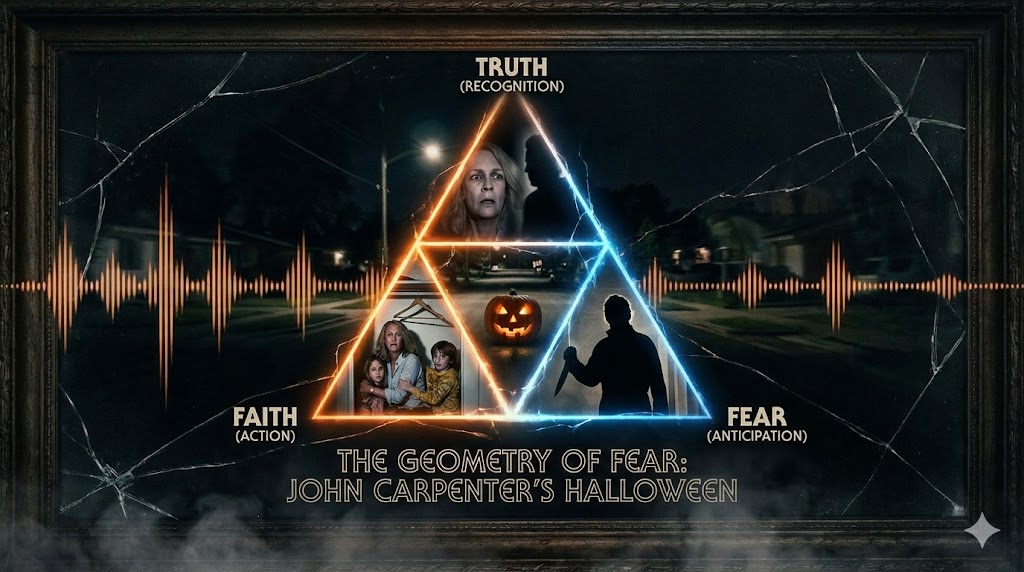
Carpenter’s visual style sustains this geometry through time and space. The camera’s long takes and static compositions create a fragile equilibrium, where every cut, jolt, and flash of violence fractures it. The iconic score functions as the brain’s metronome, a rhythmic heartbeat mirroring the body’s physiological response to anxiety. When Michael disappears at the end, leaving only his heavy breathing to reverberate, the film closes its loop without resolution, and the dissonance and the “itch that needs to be scratched” remain.
Coda: The Mirror of Survival
In The Fourth House, Evelyn, like Laurie Strode in Halloween, ultimately converges within the same psychic geography: a liminal space suspended between the rational and the supernatural, the living and the dead, both women inhabiting the aftermath of dissonance. Laurie, trembling on the floor, her survival uncertain, stares into the void Michael has left behind; Evelyn, standing within the boundaries of a reality that may or may not be real, confronts the ghost of her own making/repression. Their respective spaces, the suburban home and the antique shoppe, both seemingly normal, safe places, become architectures of the same truth: survival is not resolution.
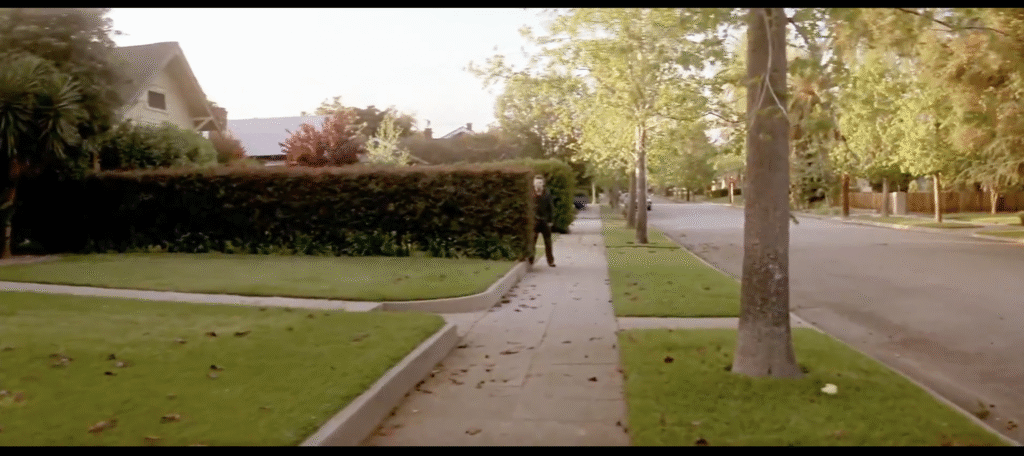
Each story concludes with its main character in a state of suspended awareness. Laurie has defeated the embodiment of fear, or so it appears, yet fear persists — its “shape” now invisible, omnipresent, and recursive. It’s the type of fear that’s not forward-direct, but rather keeps you looking over your shoulder.
Sunny, the main character in The Fourth House, too, has reached a point of revelation, yet her understanding dissolves into paradox. She has found that what she has been looking for is the very thing she is running from: the truth. Her death, though tragic, achieves meaning through recognition, becoming the final reconciliation of faith, truth, and fear, and changes the meaning of everything that came before it.
Evelyn, by contrast, remains suspended on the other side of that revelation, confronting the spectral echo of Sunny’s presence. In that moment, she crosses from hardened skeptic into belief, and from repression into trembling awareness in the present with a new understanding. Both women, though separated by life and death and connected by blood, occupy opposite ends of the same cognitive field: Sunny’s resolution becomes Evelyn’s awakening, forming a recursive loop between knowing and believing.
In this sense, The Fourth House goes beyond echoing Halloween; it inverts it. Where John Carpenter externalized the film’s dissonance, giving it body, breath, and motion, The Fourth House internalizes it, rendering the same terror as a psychological recursion of memory and repression.
Evelyn’s “space” and Laurie’s “space” are, in essence, the same: the locus where the mind meets its own shadow and must decide whether to flee or to see. Neither story releases its grip. Survival feels less like triumph and more like awakening; a heightened consciousness that the only true escape from fear is to understand its shape — and that understanding subsequently turns to a haunting which can’t be unseen.
The Collapse of Equilibrium
COMING NEXT: Where Halloween externalizes cognitive dissonance through the architecture of fear, Alfred Hitchcock’s Vertigo turns that architecture inward, spiraling into the recesses of obsession. Where Laurie’s journey culminates in equilibrium, the fusion of intellect and instinct, Scottie Ferguson’s begins with its collapse. In both, the mind becomes a spatial construct: one illuminated by flickering awareness, the other shadowed by the gravity of desire.