NOTE: This is the fourth of many case studies on the Unified Theory of Narrative Engagement, with emphasis on how it came to be. Earlier essays discussing the theory at length can be found here. This essay revisits The Other, originally discussed in another 2014 essay on Cognitive Dissonance here.
In the previous segment, we discussed Vertigo as the architecture of obsession. By comparison, Thomas Tryon’s The Other and Alejandro Amenabar’s 2001 film of no relation, The Others, are the architecture of consciousness itself: built not of stone and shadow, but of contradiction. These are stories where the house is the haunting, its structure erected by the mind to contain what it cannot reconcile. Within their walls, self and other (appropriately so), life and death, and belief and denial blur into one recursive loop of identity.
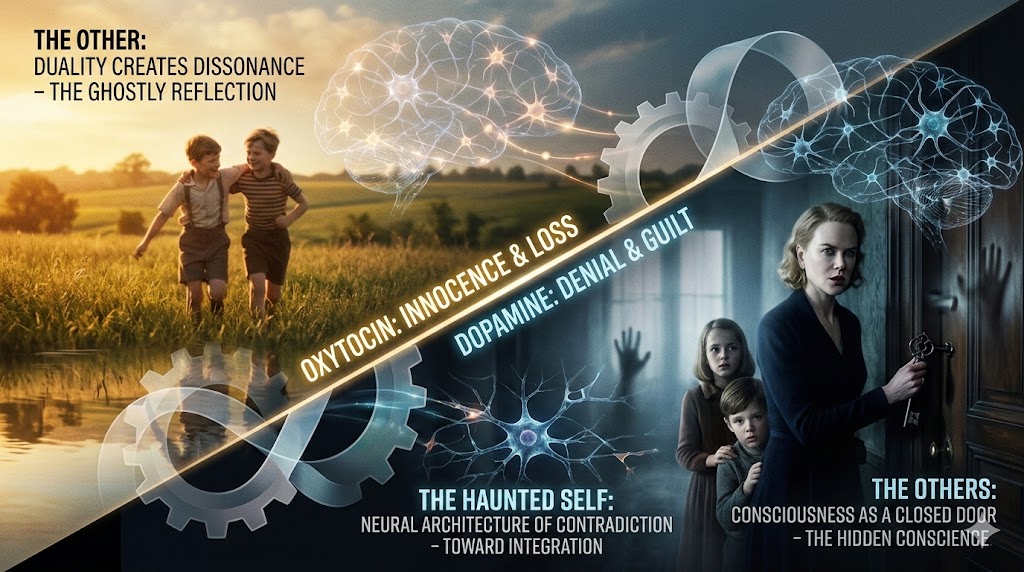
In neuropsychological terms, these narratives explore split schema, where the mind has the ability to sustain two competing self-models simultaneously. The audience, co-authoring the experience, is forced to inhabit both, which creates dissonance, the engine of the Unified Theory’s narrative engagement. This tension between what is known and what is felt harkens back to Pirsig’s Classicism vs Romanticism, and neuroscience’s dopamine vs oxytocin, and sustains the engagement, mirroring the very structure of the brain’s hemispheric dialogue: one analytic, one empathic; one seeking order, and the other meaning.
The Other: Duality creates Dissonance
Robert Mulligan’s The Other (1972), adapted from Thomas Tryon’s 1971 novel, presents an exemplary cinematic expression of cognitive dissonance as emotional architecture. Its bucolic setting of sunlit fields, children at play, and the daily life of the Great Depression era creates an oxytocinic calm filled with a sense of familial and neighborly trust and innocence. Into this tranquility seeps unease, the slow creep of dopaminergic tension: small incongruities, inexplicable accidents, and the uncanny bond between twin brothers Niles and Holland.
The revelation that Holland is dead, that Niles has projected his brother’s presence as a defense mechanism against loss, redefines the entire narrative in retrospect once revealed around two-thirds of the way through the narrative. This is a recursive realization in its purest form, a moment that forces the audience to reimagine the film, reframing every prior scene through a new lens. The dissonance between what we previously believed and what is now presented as truth becomes the very engine of meaning.
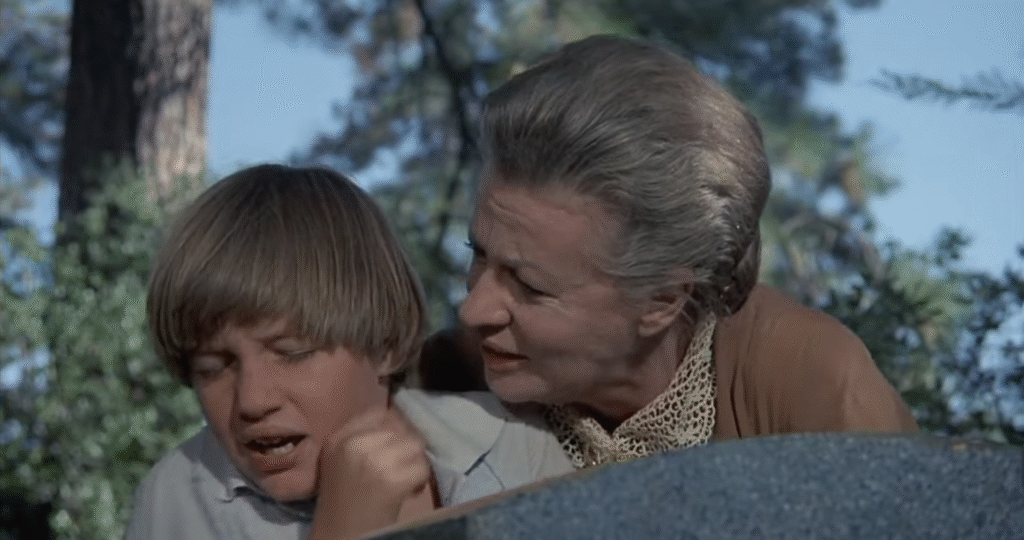
Niles’s psyche is split, fueled by dopamine and oxytocin. His imaginative “play” with Holland satisfies the anticipatory (dopamine) impulse and the illusion of agency and control, while simultaneously preserving an emotional (oxytocin) connection to love and loss. Cognitive dissonance becomes the bridge that keeps him suspended between these incompatible needs. The tragedy is that, when the illusion collapses, so too does the psyche that sustained it.
Niles is portrayed as the “good” twin—polite, sensitive, and loving. However, Jung argued that the more one-sided and “pure” the ego tries to be, the darker and more autonomous the Shadow becomes. Niles’s Jungian Shadow subsequently takes the form of his deceased brother, Holland, allowing him to do inexplicable evil, while maintaining innocence by projecting it onto Holland. His family, believing Niles is still grieving his twin’s death, plays along to tragic effect: the symbolic death of “Niles,” leaving his shadow self behind.
At least, that would be the psychological reading of the film, which maintains its ambiguity to the Narrative Aporia effect long after the credits roll.
The Others: Consciousness as a Closed Door
Alejandro Amenábar’s The Others (2001) transforms this same duality into an existential chamber piece. Grace (Nicole Kidman) and her two light-sensitive children inhabit a fog-shrouded mansion where unseen presences disturb the peace. The film’s mise-en-scène of pale light, muffled sounds, and closed doors creates a claustrophobic intimacy where every whisper feels internal.
The closed door here is more than a gothic trope; it is a manifestation of Stephen King’s ‘Closed Door,’ the ultimate barrier between the conscious ego and the hidden conscience. For Grace, the locked doors are the physical architecture of her own denial. To open them is not just to let in a ghost, but to let in the revelation of her own hand in the tragedy. This is the ‘biological Ghost in the Machine’ at its most literal: the brain locking away segments of itself to preserve the illusion of a coherent, ‘innocent’ narrative.
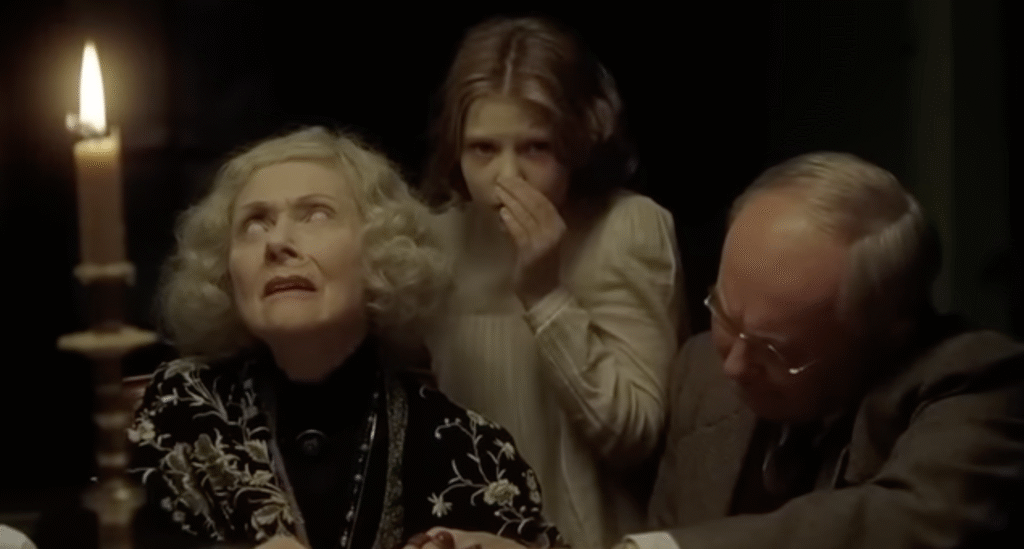
Like The Other, the story’s emotional core lies in the gradual inversion of perspective. What we think is supernatural intrusion is, in truth, revelation: Grace and her children are the ghosts and the haunting is reciprocal with the living and the dead overlapping fields of perception, each misinterpreting the other through the fog of their own denial (a great example of creating a setting that is an extension of the mind).
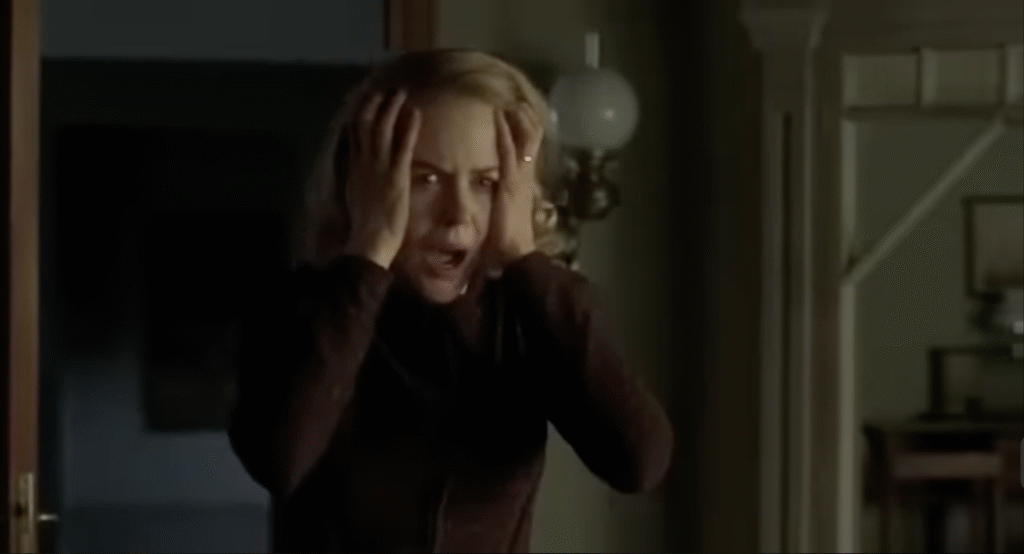
Here, cognitive dissonance functions as both dramatic structure and metaphysical thesis as the audience, positioned within Grace’s consciousness, experiences dissonance firsthand: the insistence that her world is real, even as evidence accumulates to the contrary. The final realization, the recursive collapse of her reality, is both terrifying and transcendent: she has been haunted by her refusal to see herself for what she has become.
The Haunted Self: Neuroscience of the Double
In both films, the self is not a fixed identity, but rather a field of competing perceptions. Dissonance animates it, keeping the narrative moving and the audience in suspense. The split between “I” and “you,” between self and shadow, mirrors the brain’s own analytical left hemisphere, constructing narrative coherence, whereas the empathic right hemisphere preserves emotional truth. When these hemispheres fall out of sync, dissonance arises; when they re-align, realization sets in.
This, then, is the ultimate recursion, where the self sees itself seeing. It is the same recursive loop described in The Fourth House, where Sunny’s pursuit of truth is also a pursuit of self, and where the revelation she seeks becomes inseparable from the consciousness seeking it. The haunting is not external; it is neural, a biological Ghost in the Machine. Here, the ghosts are not the dead, but the unintegrated: memories, misperceptions, and fragments of a self that has yet to reconcile its own reflection.
In Pirsig’s language, this is the moment where static and dynamic Quality intersect: the frozen architecture of belief colliding with the fluid, living awareness of truth. This is the collision of Static Quality (the lie) and Dynamic Quality (the revelation). It is the resolution of tension between dopamine’s drive for understanding and oxytocin’s drive for connection. The audience, through co-authorship, experiences the same psychic reconciliation.
Toward Integration
The Other and The Others stand as mirror reflections of the same recursive architecture, one open, one closed. In The Others, revelation restores equilibrium, and Grace’s acceptance of death resolves the dissonance between illusion and truth, allowing meaning to settle, however eerily, into peace.
In The Other, dissonance remains suspended as Niles survives within the psychic loop of his own denial. In the movie adaptation, the illusion of his twin endures, and life at the farm resumes as if nothing has changed except its tragic legacy, having grown longer and longer. The horror persists in a quiet and seemingly imminent continuation, a stark contrast to its bucolic setting, its unbroken cycle of repression that gives the story its haunting power.
Together, they form a dialectic of recursion: awareness as release, and denial as recurrence. Both, in their own way, echo The Fourth House, in that the understanding to confront one’s ghost is not necessarily to banish it, but to see and acknowledge its existence, for integration is possible only through recognition. Where that recognition fails, the loop endures.
Next: 7.5 – The Exorcist: Faith and the Feedback Loop
Where The Other and The Others externalize inner division, The Exorcist fuses it back into a single, unbearable confrontation: the mind at war with its own loss of faith. William Friedkin’s 1973 masterpiece is not a film about possession — it is a film about belief under siege, both psychologically and spiritually. Beneath its surface terror lies a structural and chemical precision: a recursive feedback loop between logic and faith, skepticism and surrender, dopamine and oxytocin.