
“I was a better man with you as a woman than I ever was with a woman as a man.”
— Michael Dorsey (Tootsie, 1982)
NOTE: This is the sixth of many case studies on the Unified Theory of Narrative Engagement. Earlier essays discussing the theory at length can be found here.
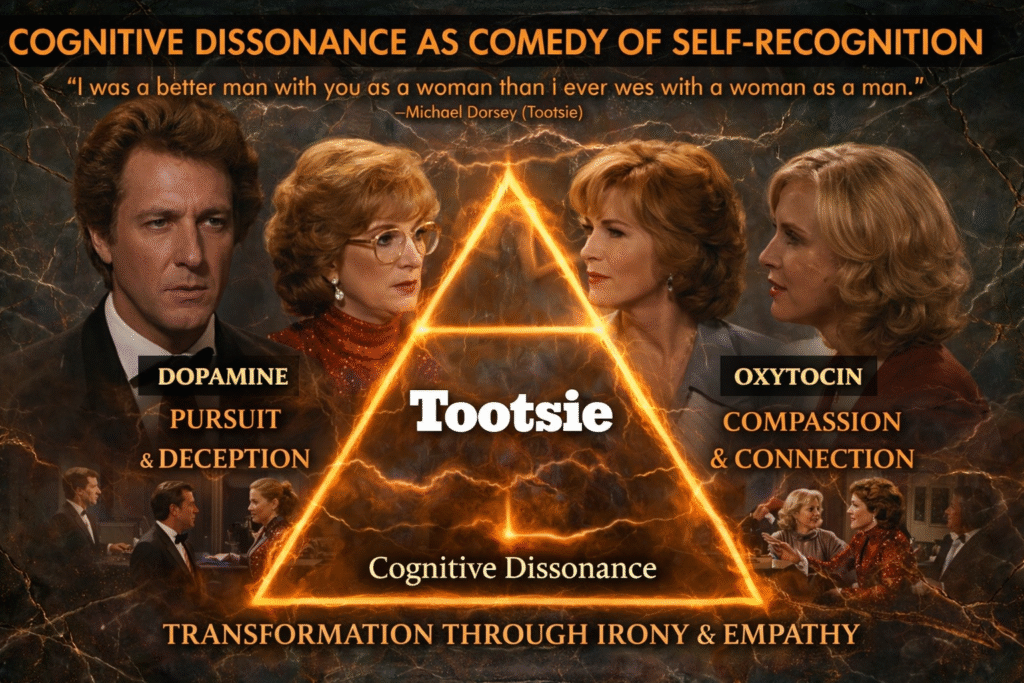
Where Halloween externalizes dissonance through fear and Vertigo internalizes it through obsession, Tootsie transforms it through irony, turning contradiction itself into the engine of empathy.
Sydney Pollack’s Tootsie transforms one of the oldest comic premises, the mistaken identity, into a study of cognitive dissonance and moral evolution. Michael Dorsey, a talented but arrogant actor whose agent informs him nobody wants to work with him because he’s too difficult, creates the persona “Dorothy Michaels” to land a role he cannot obtain as himself. What begins as deception for survival becomes a laboratory of empathy and dissonance, forcing him to confront the contradiction between his external disguise and internal truth.
Like any well-structured narrative of transformation, Tootsie runs on the same triadic current we have traced throughout this theory:
Comedy is ultimately dissonance viewed through the lens of absurdity rather than fear. Where horror stretches anticipation to its breaking point, comedy stretches contradiction until it snaps into laughter, the release valve of oxytocinic relief.
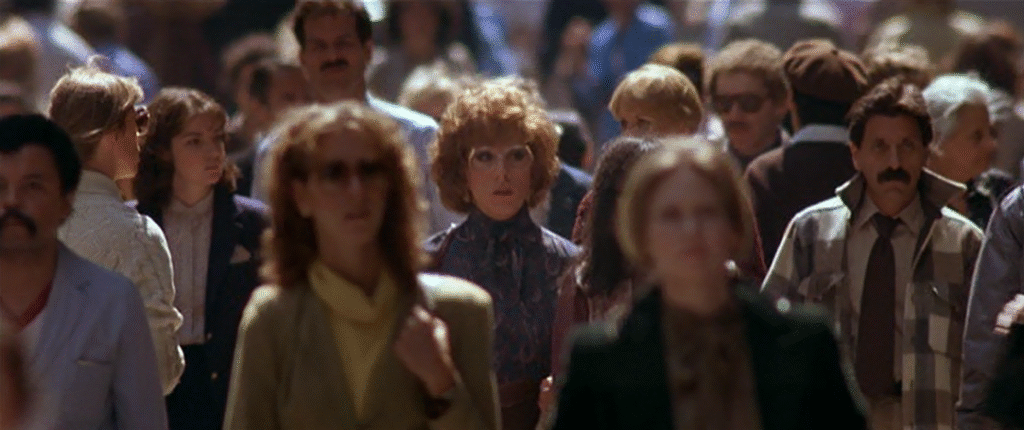
Both horror and comedy are based on perception, horror through fears and what the character is afraid of, whereas comedy can take the same exact beats and turn it into farce based on the character’s perspective. That’s because, for comedy, particularly farce, it’s not necessarily what’s happening that an audience believes to be funny. Rather, it is what the characters believe to be happening that provides the humor.
Much like Friedkin in The Exorcist, Pollack’s direction in Tootsie reinforces Michael’s transformation through rhythmic alternation. Scenes of performance and deception generate anticipation and tension, while quieter moments of connection with Julie and others deepen empathy. The film, therefore, oscillates between pursuit and intimacy, allowing the audience to experience the same internal contradiction that Michael himself must eventually reconcile.
As a side note, these same rhythmic alternations between dopamine and oxytocin appear in Little Miss Sunshine as well.
In Pirsig’s vocabulary, Michael begins the narrative in the domain of Static Quality, with a rigid self-concept; he’s ego-driven and defensive. As Dorothy, he enters the realm of Dynamic Quality, improvising moment by moment, responding with compassion instead of control.
The dress Dorothy wears becomes a mirror. Through it, Michael begins to see his own reflection in the men he encounters, particularly Ron, and recognizes how their behavior affects Julie. Experiencing this dynamic from the other side deepens both empathy and dissonance. This, in turn, increases the cognitive dissonance: how could Julie ever accept him as himself if she were to discover the truth?
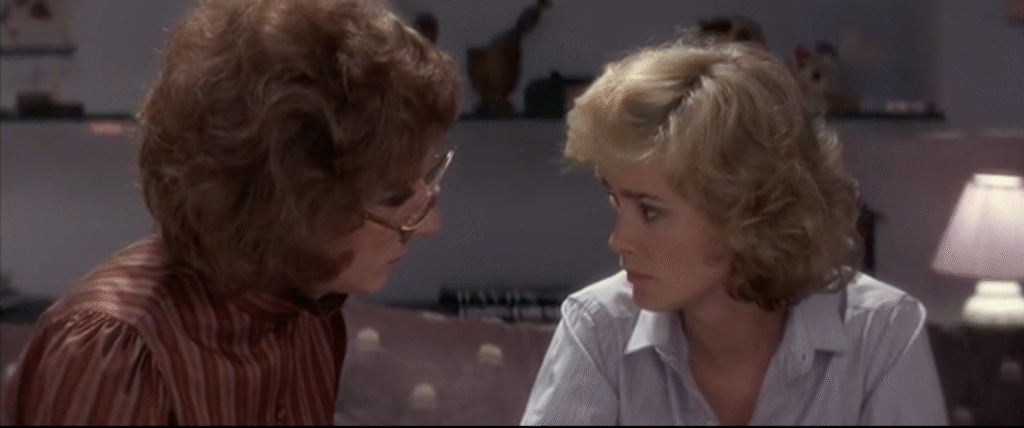
This paradox becomes creative rather than destructive, resulting in co-authorship within the audience, who, partaking in the dramatic irony on multiple levels, begin to ask not only how long Michael can keep this up, but also how the truth will play out and what will happen as a result.
When he finally confesses on live television, the collapse of dissonance is also a rebirth of integrity: understanding through exposure. Unlike many narratives of moral awakening, Michael does not merely observe another perspective; he inhabits it. By becoming Dorothy, he experiences the social dynamics he once ignored, transforming empathy from abstraction into lived reality.
The film’s closing moments enact the same neuro-pattern as tragedy or thriller, but with polarity reversed. The tension of deceit resolves into enlightenment: Michael’s laughter, Julie’s reluctant forgiveness, and the restored friendship constitute an emotional balance, where the mind returns to equilibrium.
As a farce, Tootsie demonstrates that the architecture of dissonance is independent of genre. Whether expressed through terror, obsession, or laughter, the underlying mechanics remain the same: expectation, empathy, contradiction, release. Fear freezes the mind; humor frees it. In both cases, meaning emerges when the self recognizes itself through the eyes of another.
NEXT: Part 7.7 From Mechanism to Field
Across these diverse stories, The Fourth House, Halloween, Vertigo, The Other, The Others, The Exorcist, and Tootsie,the same invisible machinery of the mind reveals itself in different guises. Fear, obsession, and laughter are not opposites, but rather oscillations within the same cognitive field, each generated by the brain’s dance between anticipation, empathy, and contradiction. What varies is only the frequency: horror sustains dissonance to the breaking point, tragedy collapses it into recognition, and comedy releases it through reintegration.
If each story demonstrates how tension and release function as neurochemical rhythms, then what remains is to step back and see the total pattern: story not as a sequence of events or emotions, but as a living field of forces; a self-regulating system where meaning arises through recursion, equilibrium, and transformation.