

“I can’t afford to hate people. I don’t have that kind of time.” — Kanji Watanabe
NOTE: This is the seventh of many case studies on the Unified Theory of Narrative Engagement. Earlier essays discussing the theory at length can be found here.
Ikiru is included here as a non-Western film using Kishōtenketsu to demonstrate whether there is any further universality to the Unified Theory beyond the typically Eastern/Hollywood formula-driven stories.
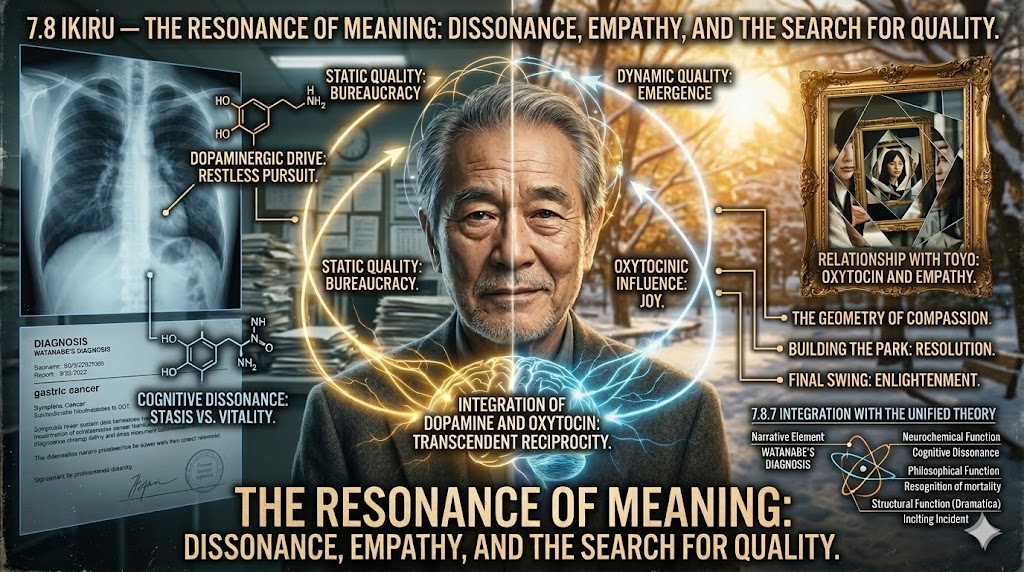
At the start of Ikiru, Kanji Watanabe is the embodiment of Static Quality. A bureaucrat living in mechanical repetition, he “lives” the kind of structural life Pirsig warned against: all form with no vitality. His life is pure order without meaning, a machine running on policy instead of purpose, and detached from community and its people. The story begins with a diagnosis, both literal (terminal cancer) and existential (the absence of Quality).
The diagnosis triggers dissonance, which forms as an unbridgeable gap between the static certainty of death and the dynamic possibility of living. The brain’s equilibrium collapses as a result, and the story’s engine from this point is not survival, but the pursuit of meaning under the pressure of mortality, which activates the familiar dopamine–oxytocin tension that drives the search for meaning.
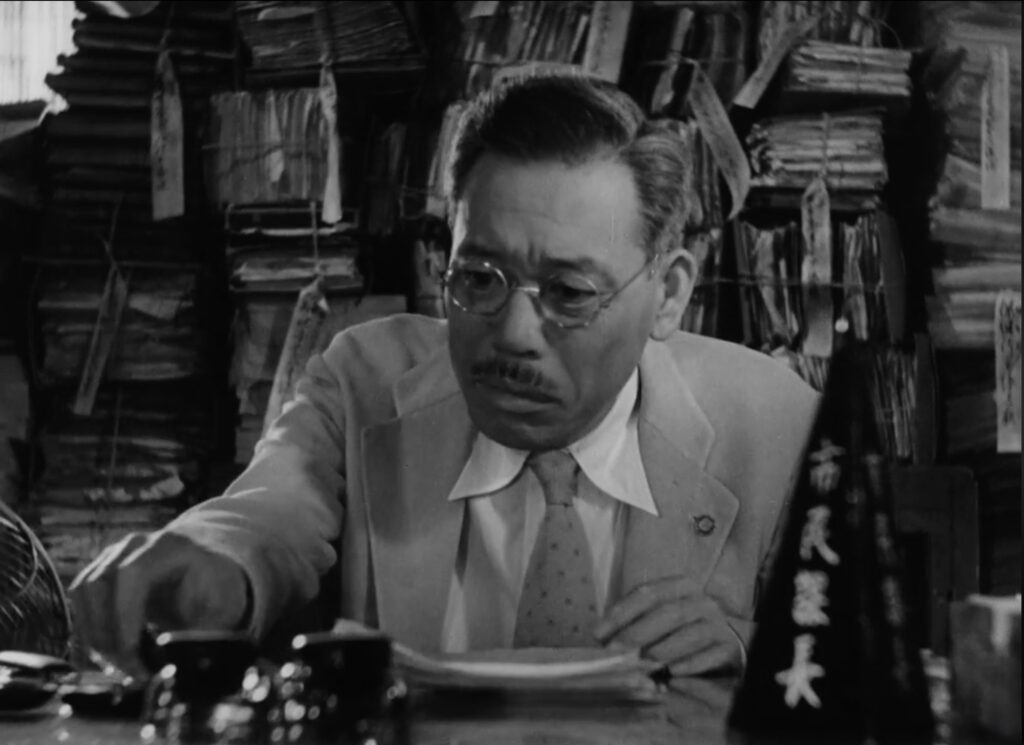
The first half of Ikiru is dopaminergic in nature, as one might anticipate upon such a diagnosis: restless, anticipatory, and compulsive. Watanabe’s actions are erratic, from drinking, wandering, pleasure-seeking, to consulting a writer for advice on how to live (the literal translation of the film’s title). Each episode is a failed anticipation loop, his brain chasing stimulation but never finding satisfaction.
Kurosawa’s direction mirrors this restless pursuit with the film’s fragmented pacing, disorienting transitions, and the camera circling Watanabe as if orbiting an unresolvable truth. This phase dramatizes dissonance unanchored by empathy, the classic state of the unbalanced field. Dopamine fires without oxytocinic counterpoint, leaving desire without connection and a feeling of emptiness.
The emotional pivot is provided by the young woman from Watanabe’s office. Her vitality, spontaneity, joy, and embodied presence, all attributes of Pirsig’s Romanticism, awaken something within him. She becomes the oxytocinic influence for him, a representation of the joi de vivre lost over the years from a bureaucratic system that has consumed him.
Despite this influence, their connection never becomes romantic or sexual, remaining existential instead. She tells him she finds joy in making toys, small things that make children happy, which becomes the catalyst for Watanabe’s transformation as he suddenly recognizes that Quality lies in dynamic participation and contribution, not the “control” of bureaucracy.
As a result, oxytocin functions as empathy that restores moral coherence, reorienting dopamine’s search for a new experience into a search for purpose. Dissonance, the “itch that must be scratched,” thus finds direction toward integration.
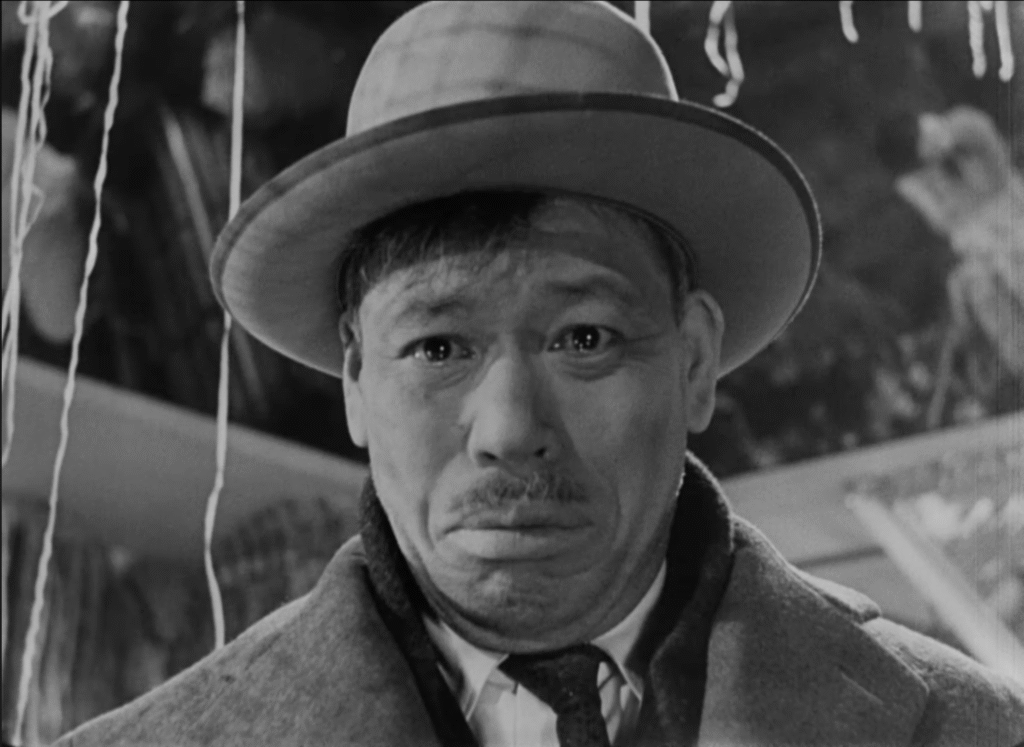
The story’s recursive core is Watanabe’s double consciousness; he is both alive and already dead. His every act from this point forward exists in paradox, the futility of effort versus the necessity of meaning. Kurosawa heightens this dissonance through narrative recursion itself as the film’s structure loops back on his life after his death, reframing his actions through multiple perspectives.
This is recursive realization in its purest cinematic form, where the audience experiences the same events twice, but with altered emotional weight: first as futile gestures, then as acts of grace. That transformation of perception is the neurochemical signature of equilibrium restored and the closing of the loop.
Neurochemically, Ikiru achieves a complete cycle:
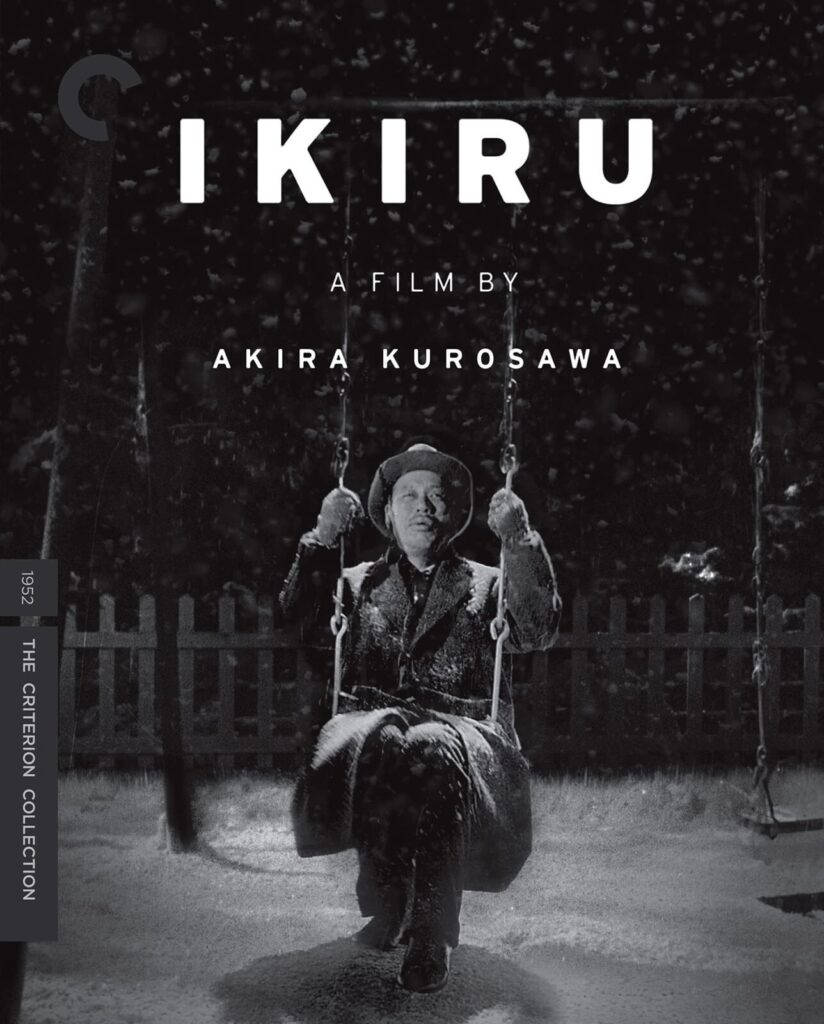
Watanabe’s final act, building the children’s park, isn’t necessarily a quest for legacy but an act of transcendent reciprocity. It resolves dissonance by fusing desire (dopamine) and empathy (oxytocin) into a field of Quality that radiates beyond the self. The image of him on the swing, singing softly in the snow, demonstrates the equilibrium of a perfect neurochemical and moral stillness.
When the film’s perspective shifts to the bureaucrats gossiping at his funeral, the audience experiences a final recursion: We now see through them what we’ve transcended with him. Their rationalizations and their cynicism are both static reactions to what was dynamic in Watanabe.
The dopamine loop reopens, not for Watanabe this time, but for the viewer. We are left suspended in our own dissonance: “Have we lived meaningfully? Are we merely alive, or truly living?”
This is Ikiru’s genius, and it perfectly aligns with the Unified Theory. Kurosawa transforms the neurochemical engine of suspense into the spiritual engine of purpose. The recursive loop transfers to the audience, and the story becomes self-aware as a living organism of Quality.
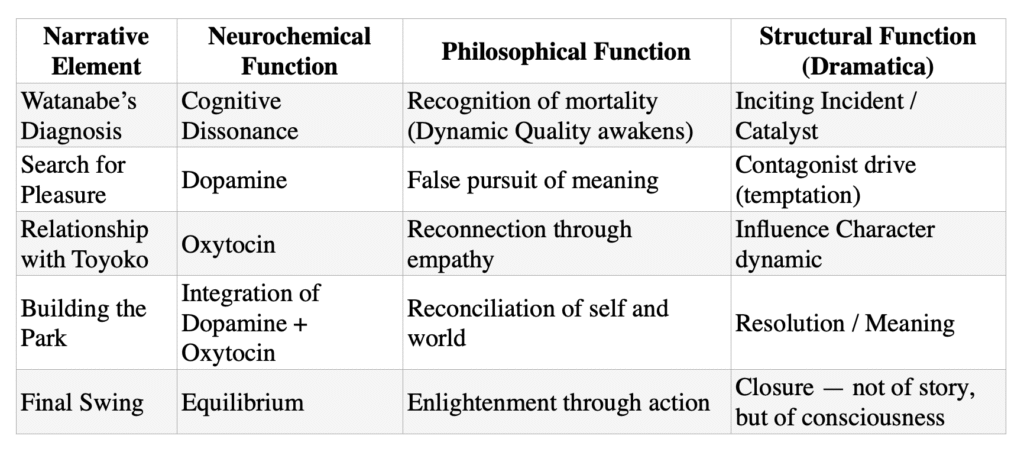
Ikiru closes exactly where the Unified Theory predicts the “field” would: in reflective resonance rather than resolution. Watanabe achieves peace, but the audience inherits the dissonance. This is continuity, the perpetual motion of Quality through awareness, rather than closure.
Where Halloween sustains fear through suspended anticipation, and The Fourth House sustains tension through psychic recursion, Ikiru sustains meaning through empathy. All three are expressions of the same architecture: the human field where dissonance births transformation and story becomes consciousness in motion.
NEXT: 7.9 – The Haunting of Hill House vs. Mexican Gothic