

NOTE: This is a continuation of a series of essays comprising The Unified Theory of Narrative Engagement. Earlier essays discussing the theory at length can all be found here.
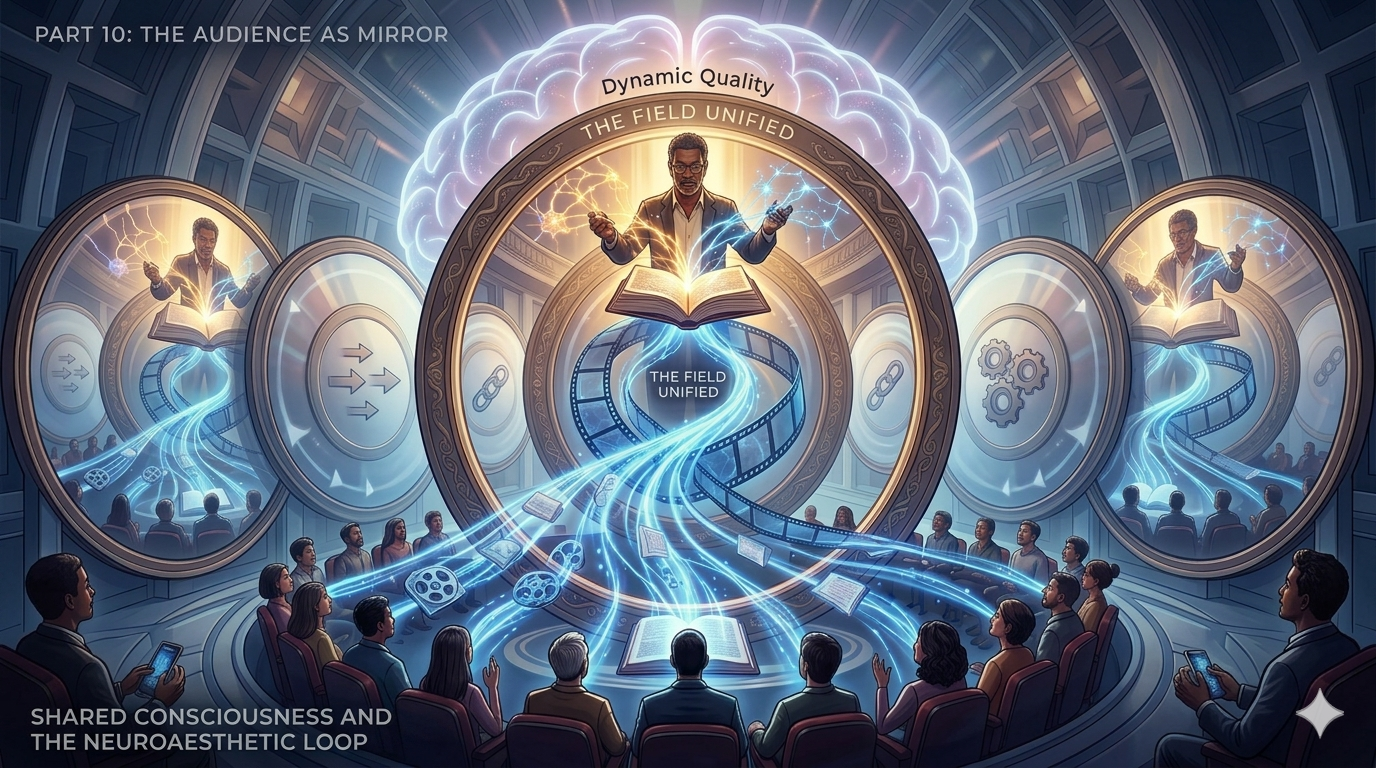
If the author is the initiator of recursive loop, and the story is the reflective medium, then the audience becomes the living surface upon which that reflection takes form. The mirror completes itself by reflecting only when looked into.
The act of reading or viewing is more than merely passive reception; it is co-creation. Each audience member completes the circuit, transforming text, language, visuals, or inert symbols into lived experience. The neural patterns that arise during immersion, anticipation, empathy, dissonance, and revelation mirror those of the author during creation.
Storytelling, in this sense, goes well beyond being a one-way transmission of meaning; it’s a shared neuroaesthetic event, a synchronized loop of consciousness. To expand on Lisa Cron’s story secret in her work, Wired for Story: The Writer’s Guide to Using Brain Science to Hook Readers from the Very First Sentence, “All story is emotion based—if we’re not feeling, we’re not reading,” which goes for the author in the work’s creation, too, as an act of transference.
Cognitive neuroscience reveals that when a person observes another’s actions or emotions, the same neural circuits activate in the observer’s brain. This mirror-neuron system forms the biological foundation of empathy, but it also forms the foundation of art. When we see a character grieve, our mirror neurons work to mirror that grief; when a character yearns, we feel the pulse of dopamine in anticipation of resolution. The story’s rhythm of emotion thus becomes our own.
This mirroring may appear like mimicry, but it’s truly transformational. It’s not a matter of merely feeling what the character feels; we interpret, contextualize, and assign meaning to those feelings within our own lived framework. The narrative, in this regard, is like a cognitive resonator: an instrument tuned by the author but played by the audience.
In The Fourth House, as the reader oscillates between Sunny’s repression and revelation, they too experience, by design, the recursion between knowing and not knowing. Each revelation forces reinterpretation, not only of the plot, but of the self, too: What would I do? What does this say about me? When the reader realizes that their earlier assumptions, perhaps their judgment of a character’s guilt, innocence, or morality, were wrong, the story holds a mirror to their own unconscious biases, serving as a type of self-revelation, as the experience becomes introspective, even moral.
This reflective process is mediated by cognitive dissonance. When a reader’s expectations are violated, when the truth turns out to be other than they imagined, the mind must reconcile two conflicting realities, and within this act of reconciliation lies growth. The same dissonance that once belonged to the character now belongs to the reader in a shared experience.
Here, the line between narrative and neurology disappears. The brain’s dopamine-driven system remains active, searching for coherence; the oxytocinic system engages as empathy deepens; and serotonin helps stabilize meaning once resolution is found. What began as the author’s inner tension from creation becomes the reader’s felt experience, a direct transfer of cognitive architecture through the language of story.
This is why morally ambiguous endings, like those in The Fourth House or Vertigo, linger. They deny the comfort of closure and instead sustain the recursive loop, forcing the audience to continue the story within themselves. The brain becomes the new stage upon which the final act unfolds, unwritten, yet co-authored, and hauntingly so — as the itch that can never be fully relieved by scratching.
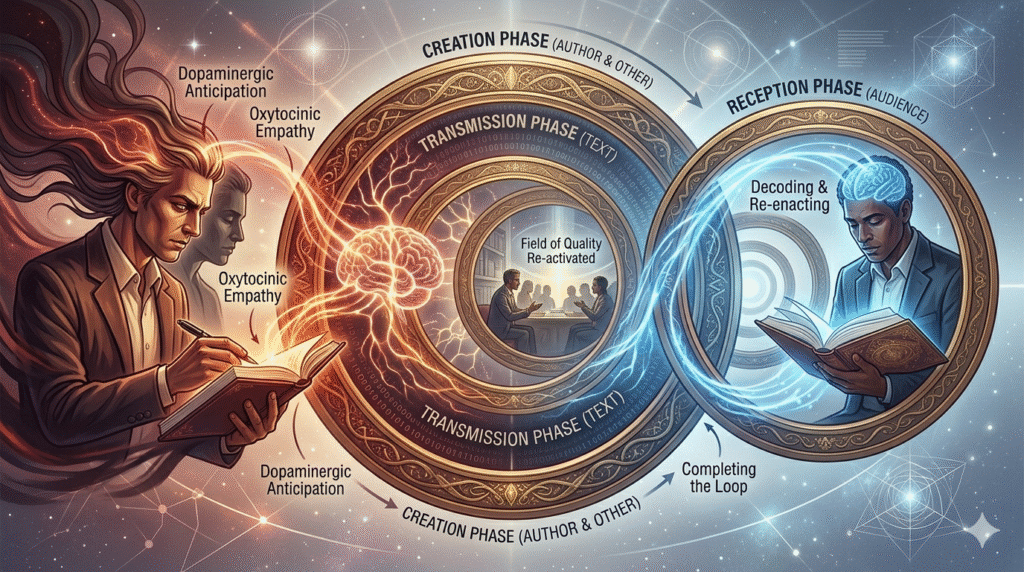
From neuroaesthetics, this feedback between author, text, and audience forms a loop of shared consciousness:
Each engagement reactivates the field of Quality that Pirsig described, a moment where perception, emotion, and awareness align. The story moves beyond a static artifact and into a living process of co-awareness, renewed each time it is read or seen.
Ultimately, this is where the distinction between reflection and revelation dissolves. The story begins as a mirror, showing us ourselves. It ends as a window, having opened by the possibility of transformation. When readers leave the final page, it’s the self that engaged it that changes; the story, however, has remained the same.
The true appreciative experience, then, is not as passive admiration but in a participatory awakening. To read deeply is to think, to feel, and to become. The mirror is the medium, but the consciousness it reflects is our own.
Every theory seeks to be complete, to be whole. But what the Unified Theory of Narrative Engagement reveals is that wholeness arises from integration, not simplification. The domains of philosophy, structure, and science are complementary expressions of a single field: the living field of consciousness itself.
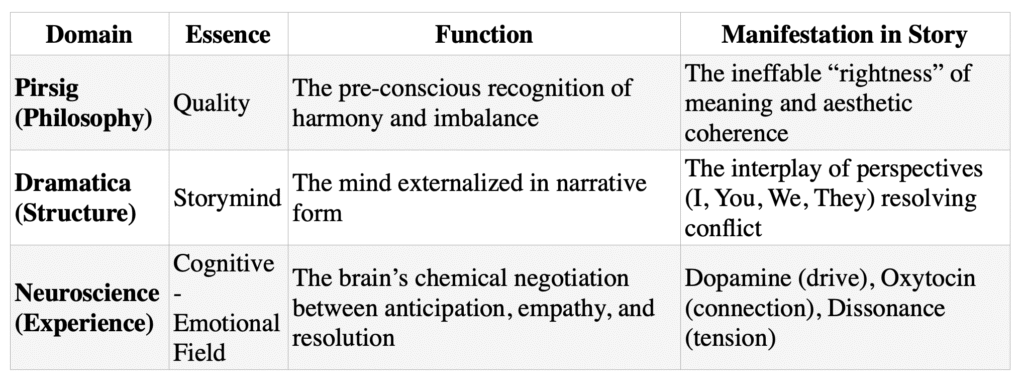
In Pirsig’s terms, this field is Quality: the pre-intellectual awareness from which both subject and object arise. In Dramatica, it is the Storymind: the modeled equivalent of a mind attempting to solve its own imbalance. In neuroscience, it is the oscillating interplay of dopamine and oxytocin, bridged by dissonance, that drives engagement, anticipation, and empathy. Each lens describes the same process through a different dialect:
Then there is Pirsig’s philosophy, where Dynamic Quality precedes definition. It is the moment of recognition before understanding, the spark that tells us something is true before we can explain why. Every creative act begins there. When The Fourth House was first written as a screenplay, for instance, intuition led toward the symbol of the Nadir, the lowest point, the house of buried truth, before I knew its cosmological meaning.
That intuitive act was Quality in motion: an unconscious resonance later verified by intellect.
The living story, therefore, moves through the same sequence the mind does:
At its highest expression, the story becomes self-aware; not just in the postmodern sense of breaking the fourth wall, but in the deeper sense of enacting consciousness itself.
A truly unified model treats story as an organism: a living, self-organizing pattern of meaning that arises wherever awareness meets representation. Each act of storytelling is both a creation and a cognition; a thought made visible.
In this light, the dopamine–oxytocin–dissonance trio functions like a neural engine:
This engine mirrors both Dramatica’s four throughlines (which are likewise relational perspectives) and Pirsig’s division between static and dynamic patterns of value. The story becomes the space where all three frameworks meet: philosophy, structure, and biology coalescing into one act of recursion.
To write with this awareness is to move beyond formula, and to compose with the understanding that story emerges, rather than being constructed. Like consciousness, it arises through the interplay of order and chaos, what’s intended and the intuitive, and finally the logic of the mind and the warmth of the heart. The author’s task, then, is to create conditions in which meaning can arise rather than necessarily be imposed, where both the character and the reader may awaken to themselves in the mirror of the narrative.
This is what Pirsig meant when he said, “Quality is the event at which the subject becomes aware of the object.” It is the moment of unity between the seen and the seer, the writer and the audience, and the mind and its reflection.
As artificial intelligence, immersive media, and neuroadaptive technologies evolve, the boundaries between author and audience will continue to blur — hence, a shared consciousness. The next frontier of storytelling will be greater in reflection vs. spectacle: stories that learn from the viewer as much as the viewer learns from them. Stories that adapt, respond, and evolve in real time, echoing the recursivity of consciousness itself.
In this future, the storyteller becomes less an architect and more a conductor of awareness or engineer of consciousness, a guide through the symphony of perception. And every narrative, whether written, filmed, or simulated, becomes a field of becoming — where mind, emotion, and matter align in the pursuit of one eternal truth: that Quality, like consciousness, is something we participate in.
NEXT: Part 11: The Road Beyond The Page – Zen and the Art and Science of Immersive Storytelling