Note:This is the third part of a series. The prologue can be found here, with the previous chapters at the bottom of the page.
The Neuroscience Link To Dramatica and Cognitive Dissonance
2.6 The Focal Points of Conflict: Dramatica’s Concerns
Dramatica’s concept of “Concerns” demonstrates how a single story problem is experienced differently from each of the four primary perspectives (I, You, We, They). Each perspective’s throughline’s Concern acts as a specific focal point for the story’s central inequity, and this multi-faceted approach is a structural blueprint for generating sustained cognitive dissonance.
These unique Concerns align directly with the neuro-philosophical model:
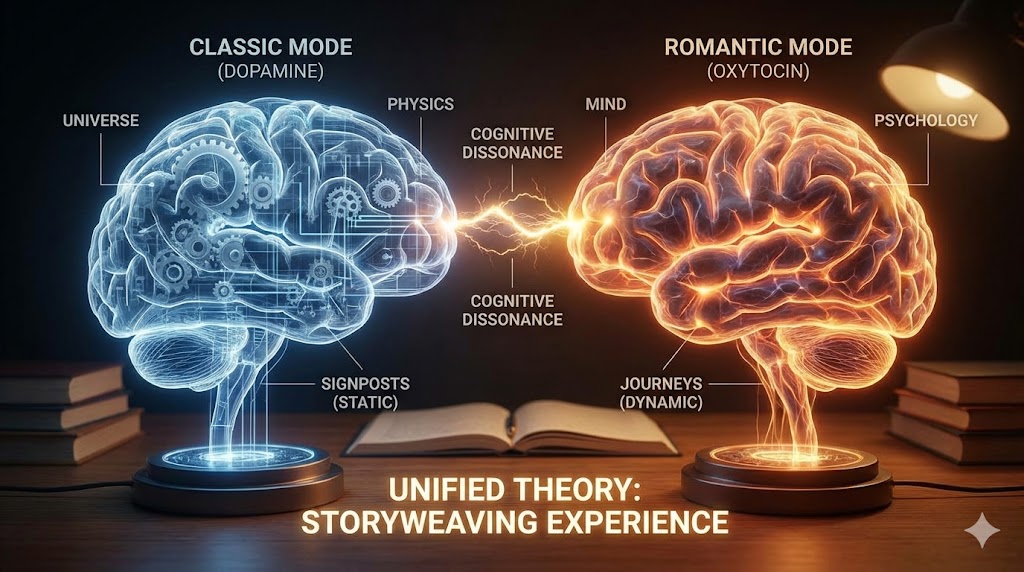
The Overall Story Concern: This is the story’s primary dopamine driver. It represents the objective, external goal or problem that all characters are grappling with (e.g., “Obtaining the treasure,” “Winning the war”). It creates the broad, forward-moving anticipation that Pirsig would label the Classic pursuit of a logical conclusion. The audience is intellectually invested in seeing how this overarching problem is resolved.
The Main Character Concern: This is the story’s oxytocin anchor. It is the personal, internal struggle that makes the audience care about the story’s events (e.g., “Obtaining self-respect,” “Remembering a lost love”) as experienced through the Main Character (think Red in The Shawshank Redemption — more on that later). This is Pirsig’s Romantic mode made manifest; it is the subjective, felt experience of the problem. It ensures the audience is not just a spectator to the plot, but an empathetic participant in the main character’s personal journey.
The Impact and Subjective Story Concerns: These are the engines of cognitive dissonance. The Impact Character’s Concern provides the counter-argument that fuels cognitive dissonance, while the Subjective (Relationship) Story Concern is the battleground where these opposing viewpoints clash. The Subjective Story Concern is the specific area where these two perspectives clash most intensely. For example, if the Main Character’s Concern is about a fixed state of “Being,” and the Impact Character’s is about dynamic “Doing,” their relationship will be defined by the tension between static principle and chaotic action. To see this in action, consider The Odd Couple. Felix Ungar is consumed by a Concern of fixed attitudes (what Dramatica calls the Preconscious); he needs his environment to be spotless and his life to be ordered. Oscar Madison, conversely, is defined by a Concern of Doing—his gambling, his sloppy eating, his physical chaos. Their entire relationship is the friction between a man trying to maintain a static state of perfection (a dopaminergic drive for order) and a man perpetually engaged in messy, dynamic activity. The audience doesn’t just watch them argue; they feel the neurochemical itch of that incompatibility. This forces the Story Mind and the audience into a neurochemical standoff, weighing the dopaminergic drive for a practical solution against the oxytocinic need for an emotionally or morally resonant one.
By ensuring that each throughline has a different Concern, Dramatica guarantees that the story’s argument is explored from multiple, often conflicting, angles. This structural design prevents easy answers and sustains engagement by keeping the audience in a state of dynamic tension, constantly weighing the logical against the emotional, and the external against the internal.
2.7 The Linchpin: The Main Character as the Bridge Between Worlds
Dramatica’s insight that the Main Character is the “linchpin” between the Overall Story and the Subjective Story is the structural key to creating a fully immersive experience. This character, serving a separate function from the protagonist, is the conduit through which the audience experiences the story’s central conflict, not just as an external problem to be solved, but as an internal, felt dilemma. This is why it’s important to choose which character you want the audience to experience the story through.
This bridging function is the perfect embodiment of the dualities the Unified Theory explores:
Philosophical Bridge (Pirsig): The Main Character is the ground where Pirsig’s Classic and Romantic modes of understanding collide. The Overall Story represents the Classic, logical world of plot, goals, and external mechanics. The Subjective Story is the Romantic, internal world of feeling, belief, and personal experience. The Main Character is forced to navigate both simultaneously, embodying the struggle to find “Quality” by reconciling the external facts of the plot with their internal truth.
Neurochemical Bridge (Neuroscience): The Main Character is also the neurochemical focal point for the audience. The Overall Story is the primary engine of the dopamine system, creating anticipation, curiosity, and the drive to see the plot resolved (“What happens next?”). The Main Character’s internal journey is the anchor for the oxytocin system, generating empathy, connection, and emotional investment (“Who does it happen to, and why does it matter to me?”).
The “Crucial Element” that Dramatica identifies within the Main Character is the precise location of the story’s core cognitive dissonance. The entire narrative argument is focused on this single point of internal conflict. The audience is compelled to lean in because their dopaminergic desire to see the plot succeed is inextricably tied to their oxytocinic need to see the Main Character’s internal struggle resolved. The final choice of the Main Character, to either change their perspective or remain steadfast in it, is the act that resolves this dissonance, providing the story’s ultimate meaning.
While standard narrative theory seeks catharsis here, the Unified Theory posits that sometimes the goal is not release, but sustained dissonance that echoes beyond the final frame—a concept we will return to later.
2.8 The Rhythm of Cognition: Signposts and Journeys
Dramatica’s model of Signposts and Journeys provides a blueprint for the story’s psychological progression, act by act. It distinguishes between the static states of the argument (Signposts) and the dynamic process of moving between them (Journeys). This duality is a perfect structural analog for the core principles of the Unified Theory, echoing Pirsig’s static/dynamic states of Quality.
Philosophical Bridge (Pirsig)
Signposts as Static Quality: The four Signposts of a throughline (e.g., Learning, Understanding, Doing, Obtaining) are the fixed, knowable checkpoints of the narrative. They are the map, the underlying form, the Classic understanding of the story’s trajectory, providing the logical framework that allows the audience to track the argument’s progress.
Journeys as Dynamic Quality: The Journeys are the experiential, in-the-moment process of traversing the ground between Signposts. They are the “knife-edge” of the present, where the story is felt and lived. This is the Romantic mode, immersing the audience in the experience of change rather than merely observing the markers.
Neurochemical Bridge (Neuroscience): The interplay between Signposts and Journeys is a mechanism for orchestrating the audience’s neurochemical state.
Anticipation and Coherence: The sequence of Signposts creates a predictable, logical path that engages the dopamine system; think of them as stopping points on a cross-country journey. The audience’s brain is rewarded with small bursts of coherence as it successfully anticipates and reaches each thematic landmark. The Journey between them sustains this dopamine release by creating a continuous state of forward motion and anticipation (are we there yet!?).
Recursion and Realization: The arrangement of the Signposts is key. A conventional linear sequence (like ‘Learning -> Understanding -> Doing’) engages the brain’s prediction systems smoothly. However, if a Throughline shifts focus to a static state like ‘The Past,’ it forces the Story Mind, and by design, the audience, into a state of recursion. The narrative structurally compels the brain to loop back, re-evaluating all prior information from a new context. This is a powerful trigger for cognitive dissonance, as the established understanding is destabilized, forcing a deeper synthesis of meaning. This is evident in the use of Dramatica itself, for which Chris Huntley has noted that writers often over-emphasize the Outcome (Success/Failure) at the expense of the Journey. In the Story Mind, the ‘Journey’ is the experience of processing the inequity, a cognitive workout that forces the brain to synthesize deeper meaning.
Dramatica’s Signposts and Journeys model the rhythm of consciousness itself. It maps the mind’s movement between stable states of understanding (Static Quality) and the dynamic, lived experience of transformation (Dynamic Quality). This process is driven by the neurochemical interplay of anticipation, empathy, and the recursive re-evaluation of memory, which is the very engine of realization.
2.9 The Art of Experience: Storyweaving as the Union of Space and Time
What Dramatica describes here is nothing less than the author’s ultimate power: to shape perception by controlling the sequence of revelation. Dramatica makes a profound distinction between the structure of the story and the experience of the story.
The “Space” of the Story Mind (Static Quality): The 28 scenes (the Signposts and Journeys of all four throughlines) exist simultaneously. Dramatica states this explicitly with its “sticky wicket”: “all four throughlines are actually happening simultaneously from a structural point of view.” This is the story as a complete, holistic psychological model; a spatial map of the mind’s argument where every perspective exists at once. This is Pirsig’s Static Quality in its purest form: the underlying, unchanging pattern, the blueprint of the whole machine.
The “Time” of Audience Experience (Dynamic Quality): The act of “Storyweaving” is the author’s process of forming these 28 spatial points into a linear sequence, creating a sense oftime. The author takes the audience by the hand and leads them through the landscape of the Story Mind, one viewpoint at a time. This is the Dynamic Quality, the “knife-edge” of the present moment where the story is felt, lived, and experienced. Here, the author goes beyond telling a story, designing an experience that unfolds through a controlled release of information, which, in turn, affects the human brain.
The Neurochemical Choreography of Storyweaving
This process of weaving is, from a neurochemical perspective, the art of orchestrating the audience’s brain chemistry. The “absolute freedom” Dramatica gives the author is the freedom to decide which neurochemical systems to activate and when.
Priming the Brain with First Impressions: Dramatica’s insight that “first impressions usually carry more weight” is a fundamental principle of neuroscience. The initial information the brain receives creates the foundational neural pathways that all subsequent information is measured against. The author’s choice of which throughline’s “Signpost 1” to present first is a critical neurochemical decision:
Start with the Main Character Throughline (“I”): You are priming the brain for oxytocin. You establish an immediate, empathetic bond, asking the audience to feel the problem from a subjective viewpoint first.
Start with the Objective Story Throughline (“They”): You are priming the brain for dopamine. You establish an analytical puzzle, asking the audience to track a mystery or a goal from an objective distance.
By advising the author to introduce the Main Character before the Influence Character, Dramatica provides a practical rule for ensuring the audience’s primary oxytocinic allegiance is correctly anchored, preventing the cognitive dissonance of rooting for the “wrong” perspective.
Weaving Throughlines to Create Cognitive Dissonance: The freedom to jump between throughlines (e.g., MC Signpost 1 -> OS Signpost 1 -> IC Signpost 1) is the primary tool for creating and sustaining cognitive dissonance. Each jump forces the audience’s brain to hold multiple, often contradictory, perspectives in mind simultaneously. The tension between the “I” (subjective emotion) and the “They” (objective logic) creates the “itch that needs to be scratched,” compelling the audience to seek a unified understanding.
Static Points as Thematic Anchors: The instruction to “pepper” the Static Story Points (like Goal, Consequence, etc.) throughout the 28 scenes is a mechanism for triggering recursive loops. Each time the Goal is mentioned, it forces the audience to re-evaluate the Journeys (the dynamic experience) in the context of the Signposts (the static map). It’s a constant reminder of the story’s “space” while the audience is moving through its “time,” deepening the resonance and ensuring the thematic argument is never lost.
Thus, Storyweaving is the author playing the role of the central nervous system for the audience. It is the conscious, deliberate act of taking the complete, static “brain” of the story and firing its synapses in a specific order to create a unique, unrepeatable, and deeply felt conscious experience. This is the final and most crucial link that connects the philosophy, the structure, and the biology. It’s the point where the theorist becomes the artist.
Dramatica gives us the blueprint of the Story Mind and its perspectives, tensions, and path of reasoning. Neuroscience gives us its pulse: the felt currents of anticipation (dopamine), connection (oxytocin), and the productive discomfort that binds them (cognitive dissonance).
When we design with both in view, we stop writing to formula and start composing experience, and, as Pirsig would say, with Quality.
Story = a mind solving an inequity (four throughlines).