“Keep doubting.” — Mademoiselle, Martyrs (2008)
NOTE: This is the ninth of many case studies on the Unified Theory of Narrative Engagement. Earlier essays discussing the theory at length can be found here.
Pascal Laugier’s Martyrs defies categorization, beginning as a revenge story, then transforming into psychological horror, and ending as a metaphysical meditation. What distinguishes it from conventional horror, aside from its brutality, which few other films have matched, is its structure: a descent through cognitive dissonance so intense it ruptures the viewer’s expectations, taking the boundaries of empathy and understanding with it.
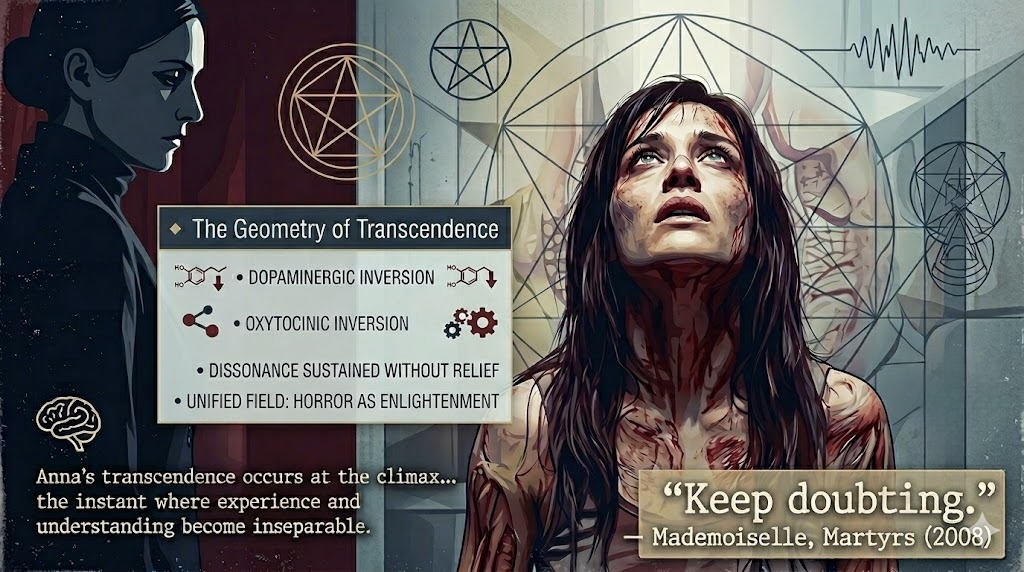
Where most horror externalizes fear through survival and resolution, Martyrs inverts the formula, inviting its audience into dissonance without the promise of relief by constructing a narrative field in which the only possible resolution is transcendence. This is where an oxytocinic and dopaminergic inversion occurs, pain becoming revelation, and horror a conduit for meaning.
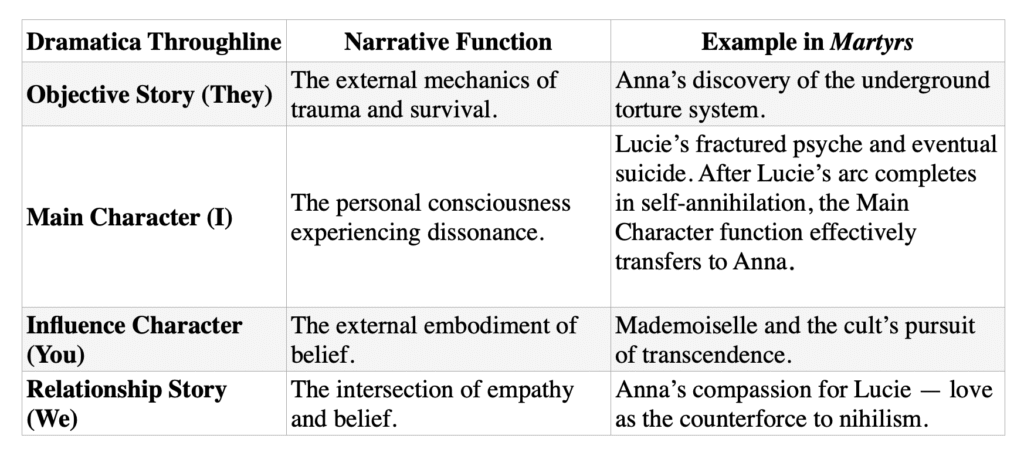
The film’s structural progression mirrors the process of philosophical inquiry: the destruction of illusion, confrontation with truth, and the annihilation of the self.
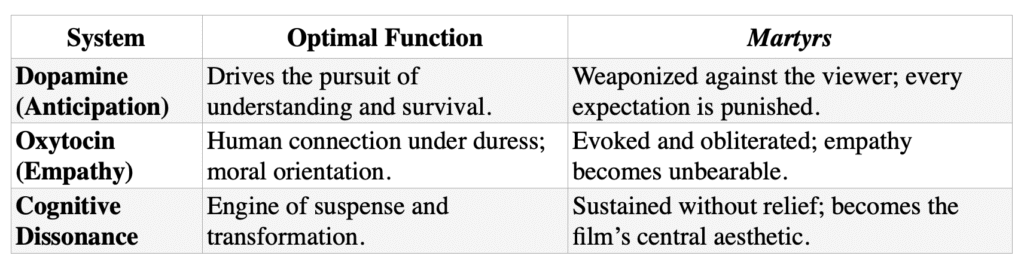
Martyrs upsets narrative equilibrium as perceived in the brain; each time the viewer anticipates catharsis, it is replaced with dissonance, and each moment of empathy becomes a wound. By its final, metaphysical act, when Anna is skinned alive, the film has effectively terminated both dopamine (anticipation) and oxytocin (connection), leaving only pure dissonance: the unbearable state Pirsig described as “Quality before comprehension.”
Anna’s transcendence occurs at the climax when she whispers to Mademoiselle. This is the narrative’s Moment of Quality, the instant where experience and understanding become inseparable, and meaning arises from the annihilation of duality rather than from closure.
Suffering and salvation, matter and spirit, self and other, all collapse under the weight of dissonance so prolonged that it triggers an oxytocinic inversion — a moment when Dynamic Quality overwhelms the Static, where the result is the event before definition, and the truth before belief.
Through Pirsig’s lens, Martyrs can be seen as a brutal exploration of the threshold between Static and Dynamic Quality.The cult represents Static Quality, the institutional attempt to systematize transcendence and to reconstruct the ineffable. Anna’s ordeal embodies Dynamic Quality, the direct, “lived-in-the-moment” encounter with reality.
Mademoiselle’s suicide, following Anna’s whisper, is the tragic recognition that Dynamic Quality cannot be captured like lightning in a bottle; it can only be experienced via suffering. Her final words, to “Keep doubting,” encapsulate the recursive principle at the heart of the Unified Theory: an awareness born through dissonance and an ending that lingers in the viewers’ minds long after the credits roll due to the lack of resolution.
The lack of closure and continuance of dissonance is what truly sets Martyrs apart from most horror films. The viewer’s brain remains locked in a dopaminergic anticipation loop with no oxytocinic restoration, and is structured by design. By denying narrative relief, it transforms pain into contemplation, forcing the audience into the same recursive field as its protagonist.
Where The Fourth House (partially) resolves dissonance into insight, Martyrs holds it open, daring us to confront the possibility that meaning itself may require annihilation.
Within the context of the Unified Theory, Martyrs stands as an extreme, yet coherent, expression of story as field. Its horror is existential in nature, rather than psychological or supernatural, the dissonance of consciousness itself seeking contact with the infinite.
Ultimately, it is not a comfortable film to experience, nor should it be. It is what happens when narrative ceases to entertain and becomes philosophy.
NEXT: 7.11 – Who’s Harry Crumb? — The Flatline of Engagement When Dissonance Collapses into Noise