

“A person isn’t considered insane if there are a number of people who believe the same way. Insanity isn’t supposed to be a communicable disease. If one other person starts to believe him, or maybe two or three, then it’s a religion.”
— Robert M. Pirsig
Note: This is the sixth part of a series on Narrative Immersion. The prologue can be found here, with the previous chapters at the bottom of the page.
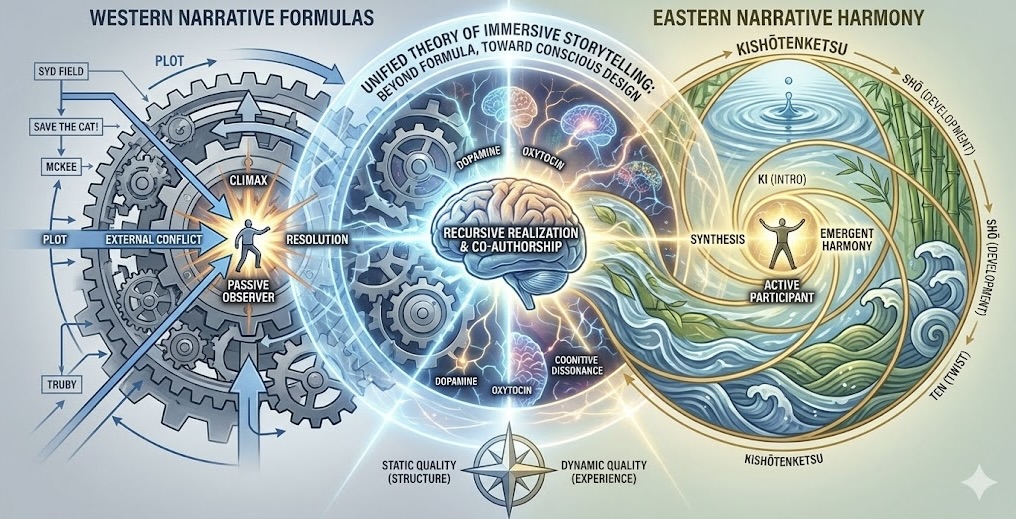
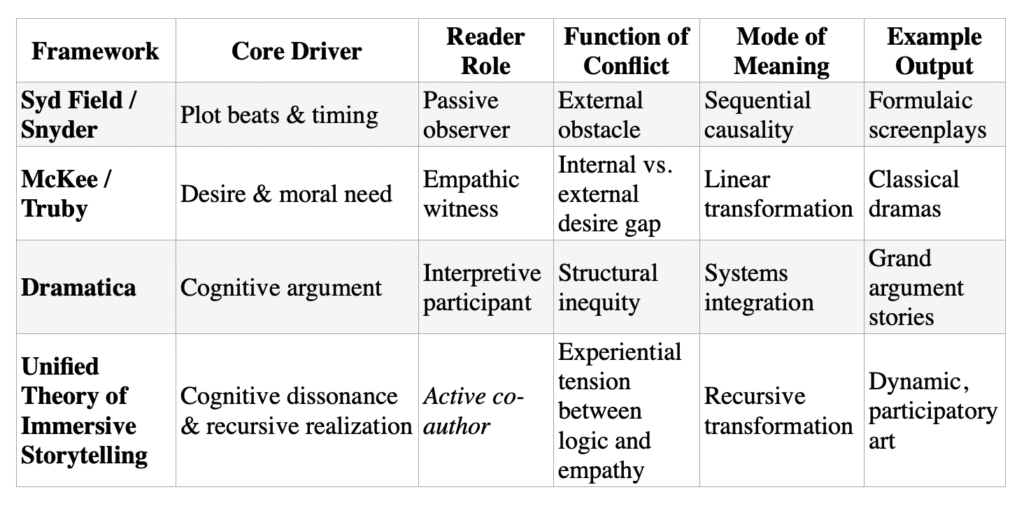
For decades, screenwriting and narrative theory have been dominated by a handful of structural models promising clarity, accessibility, and commercial viability (Hollywood wants your blockbuster!). From Syd Field’s Three-Act Structure and Blake Snyder’s Save the Cat!, to Robert McKee’s Story and John Truby’s The Anatomy of Story, these paradigms have offered practical roadmaps for aspiring storytellers.
They generally succeed in one regard: they organize chaos. That is to say, they impose a rigid order on creativity, providing a scaffolding structure where intuition falters. But the very clarity that makes them accessible also limits them; their focus remains almost exclusively on plot, or external causality, rather than internal transformation. “Beats” and “turning points” at the end of acts are structural means rather than ideas like recursive understanding, which is meant to increase immersion and engagement.
This mechanical orientation reflects what Pirsig would call the “classical” mode of thought, where the world is understood as a system (e.g., the story’s spine), but not necessarily as an experience. In these story paradigms, emotion is the byproduct of structure, not the structure itself. Characters act not to explore consciousness, but to advance plot points toward resolution. The frameworks assume an audience requires a story to be told, and subsequently “received,” rather than shared, where they become active participants.
Among what Pirsig would call “classical theorists,” McKee and Truby stand closest to the threshold of something deeper. Both recognize that story is not merely an event but an argument, a moral, psychological, or thematic struggle between competing values. McKee’s emphasis on the “gap between expectation and result” approaches the idea of cognitive dissonance, though he stops short of recognizing it as a neurochemical or experiential phenomenon.
Truby’s “moral weakness and need” echoes the interplay between logic and emotion, the dual hemispheres of classical and romantic thought, yet his system remains a linear framework of 22 steps, driven by a strong “desire line” rather than recursive awareness. His steps involving revelations provide the opportunity for recursive awareness, particularly the self-revelation, which is tied to the need and provides growth, but it frames this realization as a destination, a final structural beat (Step 20), rather than a continuous cognitive state.
In essence, both frameworks toe the line of immersion but never cross into it. They remain preoccupied with architecture, not atmosphere, with the Static Quality of form, not the Dynamic Quality of felt experience. They seek to control story from the outside, rather than allow it to emerge as a living interaction between author, structure, and audience.
Then comes Dramatica.
Where earlier paradigms treated story as a sequence of events, Dramatica reframes it as a model of the mind itself. It is here that the story’s inequity is explored through multiple simultaneous perspectives as the brain attempts to resolve it.
Dramatica’s four throughlines, I, You, We, They, mirror the cognitive architecture that neuroscience now illuminates: the brain’s recursive integration of subjective and objective realities. Dramatica’s insistence on “complete argument” anticipates the immersive theory’s notion of dynamic balance: that every great story must embody both logic (dopamine) and empathy (oxytocin), bridged by the dissonance that demands resolution.*
In this sense, Dramatica is not replaced by this Unified Theory, but complemented by it. The model provides the grammar; neuroscience provides the physics. Pirsig provides the metaphysics. Together, they form a total ecology of story: structure, psychology, and spirit operating in harmony.
*It is important to note that a ‘complete storyform’ does not guarantee a happy ending, or even a clear one. It guarantees a complete argument. One can write a story where the inequity is resolved structurally, but the emotional outcome leaves the audience in a state of high cognitive dissonance. This dissonance is what ensures the story lingers, forcing the audience’s brain to continue the recursive process long after the credits roll, or the last page is turned.
To be clear: this new theoretical framework doesn’t discard the old schools of thought; it merely reframes them. What McKee called “conflict,” Truby called “moral need,” and Dramatica called “inequity” are all manifestations of the same underlying phenomenon: cognitive dissonance.
Where previous models focus on “resolving” that dissonance to achieve a clean ending, this theory recognizes dissonance as the engine of attention. It is not just a problem to be fixed; it is the essential state of engagement that keeps the Story Mind alive.
In Pirsig’s terms, Static Quality (structure, craft, formula) is necessary, as it preserves the story’s integrity. But Dynamic Quality (intuition, insight, and the recursion that breaks the pattern) is what makes it art. The immersive storyteller, then, is not simply a “story” mechanic following schematics, but an “artful” engineer of experience, one maintaining equilibrium between both the measurable physics of the plot and the mysterious metaphysics of meaning.
“Conflict is not the only path to meaning. Sometimes the mind seeks harmony, not conquest.” -Surok, Star Trek: Discovery
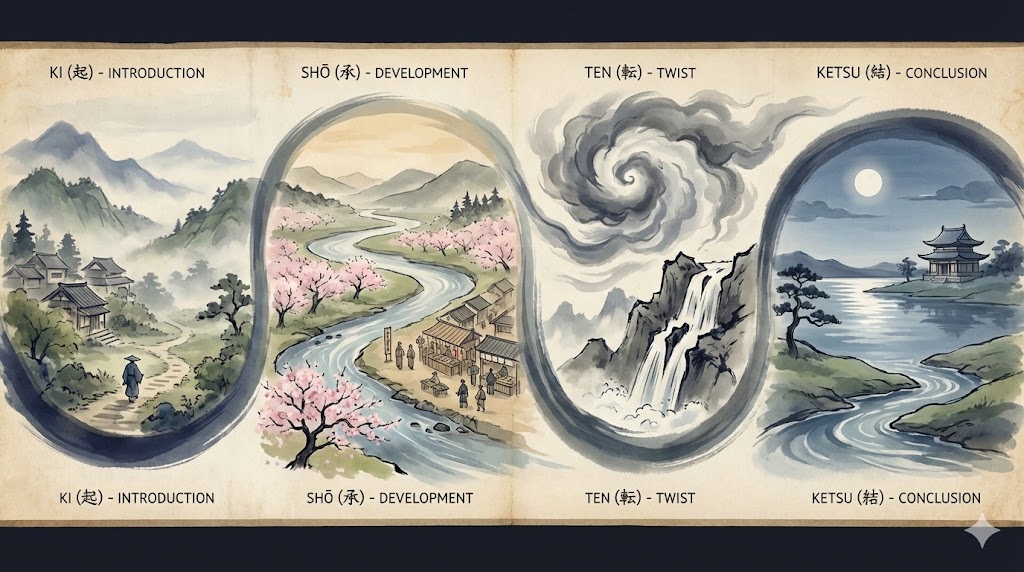
This is “Kishōtenketsu,” the four-act structure foundational to Chinese (qǐchéngzhuǎnhé), Japanese, and Korean storytelling:
Rather than advancing a plot through the friction of opposing forces, Kishōtenketsu unfolds through juxtaposition and revelation, inviting the audience to experience meaning as emergent harmony; a pattern recognized rather than a battle won.
Placed alongside Western paradigms, it represents a structural and philosophical mirror. McKee’s “Gap of Expectation,” Truby’s “Moral Argument,” and even Dramatica’s “Storyform” depend on the resolution of an imbalance or inequity. Kishōtenketsu, by contrast, absorbs imbalance into equilibrium, integrating it into the whole. It triggers the same dopamine-fueled ‘Aha!’ moment as a Western climax, but through synthesis rather than conquest.
In Pirsig’s terms, it is a narrative of Dynamic Quality: truth discovered through relation instead of conflict, where coherence arises from an emerging awareness, not the trials and tribulations of a struggle with conflict – think of many of David Lynch’s movies, particularly The Straight Story. The twist (Ten) is a revelation of pattern, a moment when the story’s field suddenly expands, and the audience perceives the parts integration as one whole.
Seen in this light, Kishōtenketsu doesn’t oppose Western models so much that it completes them. It reminds us that narrative motion need not always be driven by opposition; that, sometimes, the mind’s deepest satisfaction lies in seeing how seemingly separate things belong together (e.g., the disparate elements of this Unified Theory). The “Ten” (Twist) in Kishōtenketsu is, in essence, a massive Prediction Error that forces the brain to “loop back” (recursion) and re-evaluate the “Ki” and “Sho” without needing a villain or a battle.
As narrative theory evolves beyond formulaic tension and resolution, Kishōtenketsu offers a glimpse into what story becomes when conflict yields to coherence and meaning coalesce from what relates, rather than what conflicts.
This rhythm demonstrates that conflict is not required for dissonance. The human brain experiences reward in resolving uncertainty, whether that uncertainty comes from struggle or from reinterpretation. In Ten, the twist functions as the story’s Moment of Quality, the point where the mind stretches beyond its previous dimensions and sees a hidden order emerge.
By tracing Kishōtenketsu’s structure onto the dopamine–oxytocin–dissonance field, the Unified Theory reveals that all narrative engagement, whether from the East or West, forms from the same cognitive harmonics. Human biology is the same, regardless of where you’re from; it’s the rhythm that changes. Western stories strike the brain like a heartbeat of tension and release, whereas Eastern stories breathe like a meditation: expansion, pause, revelation, return.
Both resolve in Quality, that instant when perception, emotion, and understanding align. Yet there exists another kind of story, one whose purpose is not to balance these systems, but to dismantle them, to hold the mind in dissonance until meaning itself becomes unbearable (more on that later).
The shift from formulaic structure to immersive field represents more than an artistic preference; it’s an epistemological evolution. Where classical frameworks view story as object, this Unified Theory views story as field: a dynamic interplay between brain, text, and reader. In that field, time and space collapse, and consciousness becomes participatory. Meaning is discovered, not just delivered; alive and dynamic rather than dormant and static.
This is storytelling as living system, the mind perceiving itself through pattern and emotion, through tension and release, through the eternal interplay of dopamine, oxytocin, and the bridge of dissonance between them.