

“No live organism can continue for long to exist sanely under conditions of absolute reality.”
— Shirley Jackson, The Haunting of Hill House
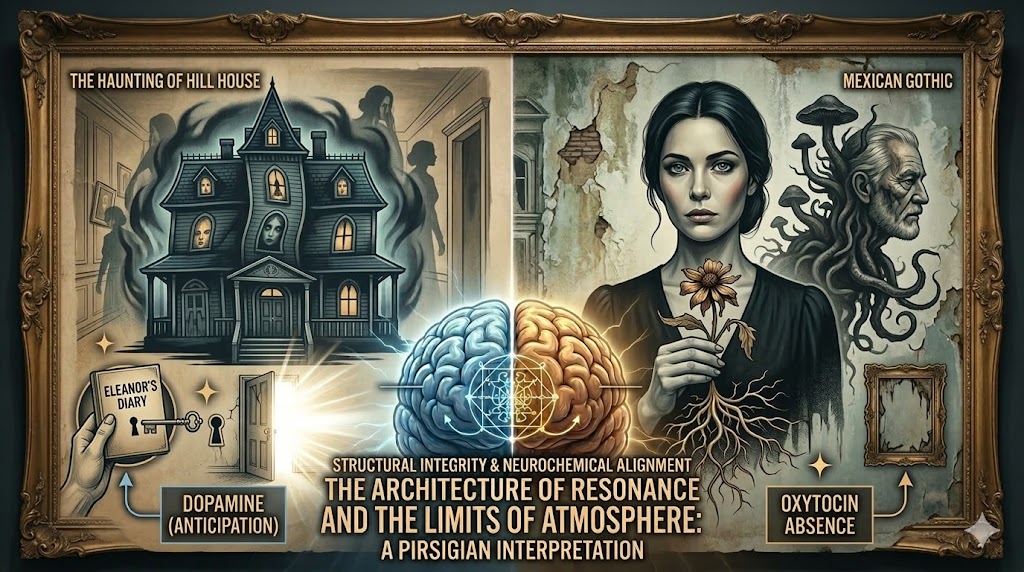
NOTE: This is the eighth of many case studies on the Unified Theory of Narrative Engagement. Earlier essays discussing the theory at length can be found here.
Preface: A Tale of Two Gothic Minds
Both The Haunting of Hill House and Mexican Gothic inhabit similar narrative terrain: a young woman entering an isolated mansion, a decaying family legacy, and a hidden corruption that reflects a deeper psychological truth. Yet their effects on the reader could not be more different.
Jackson’s 1959 classic endures as a haunting of consciousness; Moreno-Garcia’s 2020 novel fascinates in form but struggles to sustain emotional depth. Through the lens of the Unified Theory, the difference lies not in genre or prose, but in neurochemical alignment.
Interpretation:
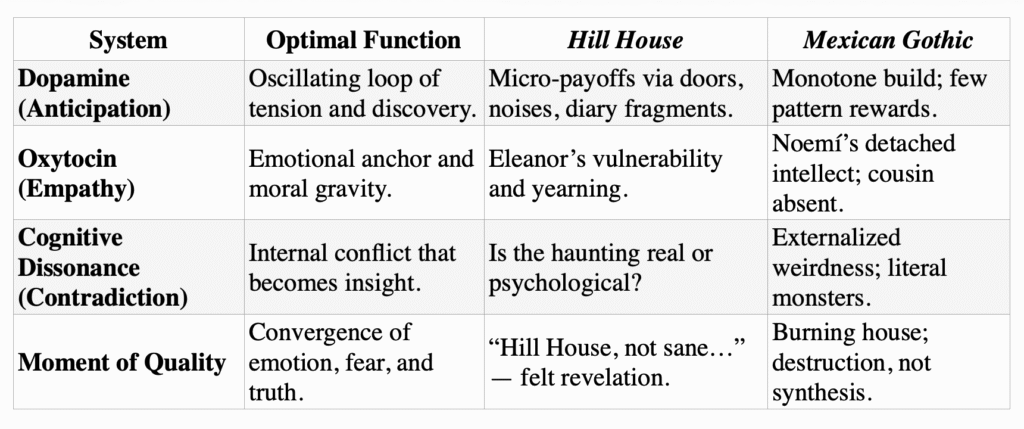
In The Haunting of Hill House, the dopamine loop is renewed by emotional empathy; anticipation and fear feed one another through Eleanor’s perception.
In Mexican Gothic, dopamine functions alone — the reader anticipates revelation, but without oxytocinic empathy or cognitive synthesis, tension devolves into aesthetic fatigue.
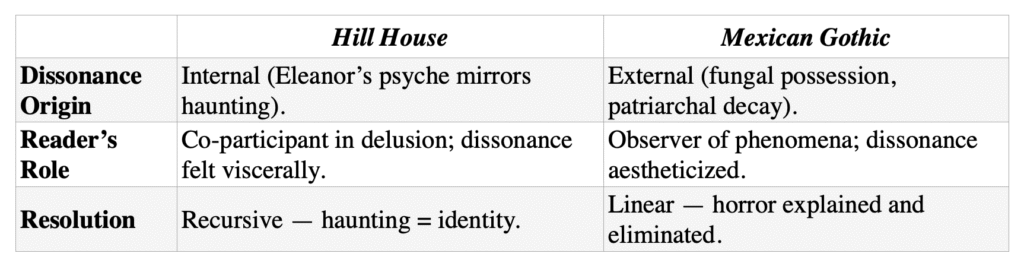
In Jackson’s story, contradiction becomes consciousness. In Moreno-Garcia’s work, contradiction becomes plot.
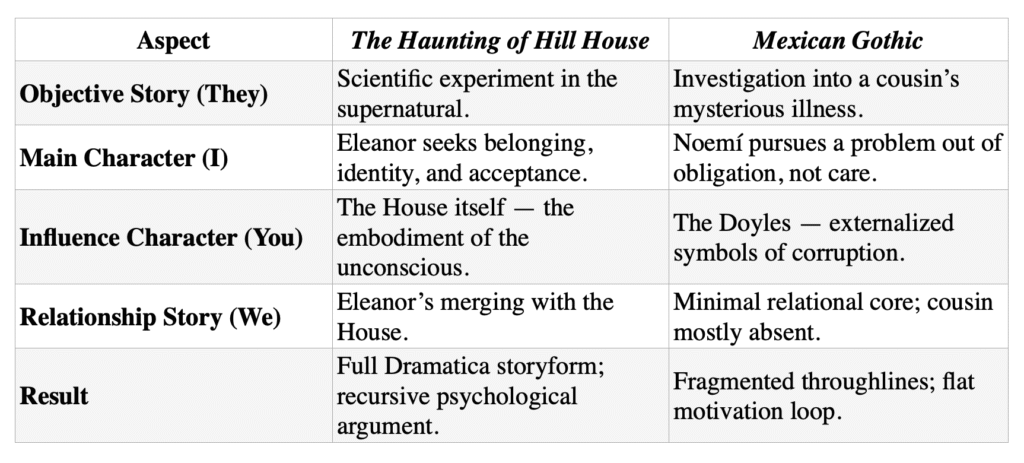
In Dramatica terms, Hill House’s four throughlines form a closed argument that produces thematic resolution even amid tragedy. Eleanor’s yearning for connection merges with the house’s hunger for possession — the psychological and supernatural entwine in a moment of Quality: recognition before comprehension.
By contrast, Mexican Gothic opens with a premise devoid of true Care. Noemí’s motivation, to secure a degree and fulfill a family obligation, provides initial justification but lacks the depth of emotional integration required to sustain the entire narrative. It is, in essence, an issue of show, don’t tell: show us why Noemí cares in a way that is integrated within the narrative.
Pirsig would say that the romantic impulse is absent from the classical structure. Without that pre-intellectual engagement, the procedures of plot become hollow, and the story’s classical scaffolding collapses under the weight of unearned drama.
Mexican Gothic’s structure also falters from static quality, with repetitive beats that don’t move the story forward, something reflecting the lack of Dramatica’s signposts, markers that provide thematic focus for each of the story’s four perspectives as represented by throughlines. While the story does have four throughlines, they are externally oriented:
Overall Story: “Ensuring Safety”
Main Character: Noemí resisting manipulation
Influence Character: Doyle patriarch/fungus
Relationship: Noemí + Francis Doyle
Structurally, this appears sound. Experientially, it is where the problem begins.
Because the overall story is about ensuring the safety of Catalina, the Doyles’ attempt to do the same for their own bloodline is reactive and passive (isolation and suppression) to Naomi’s active approach of investigating. In other words, the antagonistic method becomes gaslighting and delay, which leads to an information drought.
Furthermore, Noemí experiences revulsion, but never temptation. Without an internal collision of values, the family has nothing to exploit. Dissonance never ignites. Instead, Noemí is a steadfast character who influences Francis to change through the Relationship Throughline.
Unfortunately, the Relationship Throughline doesn’t present them as having the progressive signposts and journeys that keep the story developing forward with RS Signposts to move from Developing a relationship to Testing a relationship. Instead, the story results in repetitive beats. This, coupled with Francis being passive for much of the story, results in a weak oxytocin “pulse.”
When the antagonist’s goal is “to make nothing happen” (keep her trapped and quiet), and the protagonist is “Steadfast” (refusing to change), the Relationship Throughline has to carry the entire weight of the engagement. If the connection between Noemí and Francis doesn’t escalate quickly enough, if they just keep having the same “don’t go in that room” conversations, the Dopamine of the plot dies, and the audience is left waiting for the Oxytocin (the bond) to trigger a new plot point, which doesn’t happen until the very late reveal of the fungus’s true nature.
Whereas The Haunting of Hill House internalizes horror into identity and becomes existential, Mexican Gothic externalizes it into biology and becomes procedural. Once the mystery of the fungus is resolved, dissonance collapses into explanation. Gone is the potential for further Dynamic Quality, and recursive dread stops dead in its tracks.
Low psychological recursion results in less engagement, which may explain why the final act of Mexican Gothic feels so chaotic and detached from its preceding acts. Since the first two-thirds are static (Classical), the explosive ending feels “unearned” because the Dynamic Quality wasn’t built incrementally through the Relationship Throughline; instead, it felt added in at the end to resolve the procedure.
Looking back upon Mexican Gothic through the Unified Theory’s lens, the “solution” to its problems is already present: it exists as a thread that merely needs to be pulled and explored further than its appearance in the story’s blurb:
“She’s a glamorous debutante, and her chic gowns and perfect red lipstick are more suited for cocktail parties than amateur sleuthing.”
This observation puts Noemí at the opposite end of the spectrum from Howard, yet their foundations are the same. Howard Doyle is the hollowed husk of what the “glamorous debutante” aspires to be. The story already contained the seed of its own missing Influence Character throughline: had Howard provided temptation, positing “What is wealth without health?” while justifying it with the ideology that it’s human nature to use others for the intent of benefiting oneself — a notion that Noemí’s motivation for coming wasn’t to sincerely help her cousin, but for approval to pursue a master’s degree, would demonstrate she has at least that much in common with the Doyles.
In short, Mexican Gothic doesn’t fulfill its potential to engage the audience not because its horror is biological, but because its horror never becomes ideological. This could have been integrated without diminishing the feminist approach to subvert the damsel in distress genre trope.
Had the Doyle patriarch, Howard, functioned as a true Influence Character, he would have exploited this “Romantic Impulse.” By framing his parasitic legacy as the ultimate pursuit of an intermingling co-existence of “Wealth and Health,” he creates a mirror for Noemí’s own superficialities. Such an argument/perspective by Howard strengthens the other throughlines, particularly the Main Character, where Noemí wouldn’t be just fighting a fungus, but a version of her own desires, subsequently creating dissonance that resonates in the other throughlines.
| Structural Failure | The Unified Theory Repair | Neurochemical Result |
| Thin Motivation | Mission becomes a choice between two “selfish” ends. | ⬆️ Cortisol (Moral Stress) |
| Steadfast MC | Noemí must reject a part of herself, not just a monster. | ⬆️ Dopamine (Value Conflict) |
| Information Drought | Dialogue carries philosophical weight, not just delay. | ⬆️ Engagement (Meaning) |
| Static Biology | The “Gloom” becomes an externalization of an internal shadow. | ⬆️ Dynamic Quality |
It is here that the story also misses another opportunity to fulfill the potential of its premise to engage its audience as an allegory to Howard being not just a monster, but also the Debt of the Past personified. The “Wealth without Health” becomes justifiable from his perspective, but at the cost of cannibalizing the current generation — especially those who are attempting to achieve a similar level of success, or more, than their previous generation.
In our current sociological landscape, the younger generation often feels they are “servicing” the longevity of the previous one (economic debt, environmental collapse, and healthcare infrastructure). Howard has the Static Quality (the money, the house, the name), but he lacks the Dynamic Quality (vitality, growth, the future), and to get the latter, he must literally “digest” the youth of his descendants.
If Noemí had recognized that her own pursuit of status (the degree, the “chic” life) was the first step toward becoming a Howard — someone who values the veneer of life over the ethics of it — the Recursive Dread would have been inescapable. The bond between parent and child is the most fundamental source of oxytocin. Howard’s subversion of this bond to fuel his own stasis creates a “Biological Betrayal” that should have been the emotional core of the book — where the dissonance and the horror becomes: If I want the wealth and status of the Doyles, I must eventually become the predator.
This would have created a thematic loop, where the younger Noemí is the consumer of the glamorous life, and Howard is the consumer of the consumer and life.
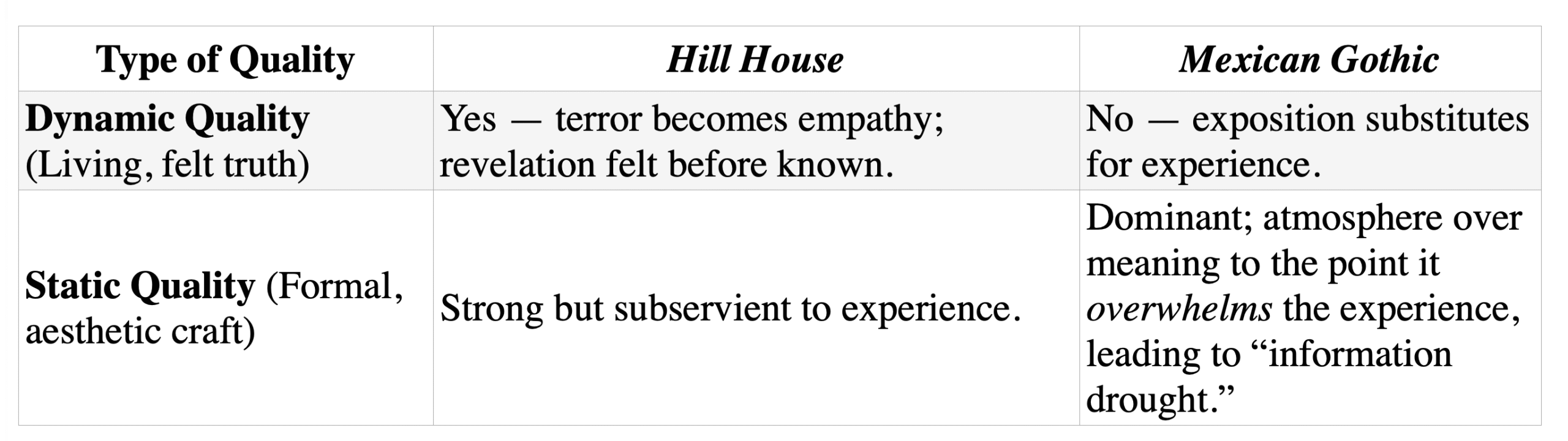
Hill House haunts because it invites us to feel dissonance until it becomes truth; Mexican Gothic decorates dissonance until it becomes texture. The dissonance is external and never posits an internal, existential crisis that Noemí is forced to reckon with.
Hill House culminates with the integration of Eleanor and the house into a single psychological system, leaving the afterglow of dissonance in the audience. Mexican Gothic ends with the house being destroyed; there is no internalization with Noemí, and therefore no dissonance left lingering within the audience.
In Pirsig’s vocabulary:
The difference is not in craft but in consciousness. Jackson’s novel feels alive because it breathes through contradiction; Moreno-Garcia’s feels designed because it resolves contradiction by explanation, the death knell for Gothic dread.
NEXT: 7.10 Martyrs — The Geometry of Transcendence and the Dissonance of Meaning