

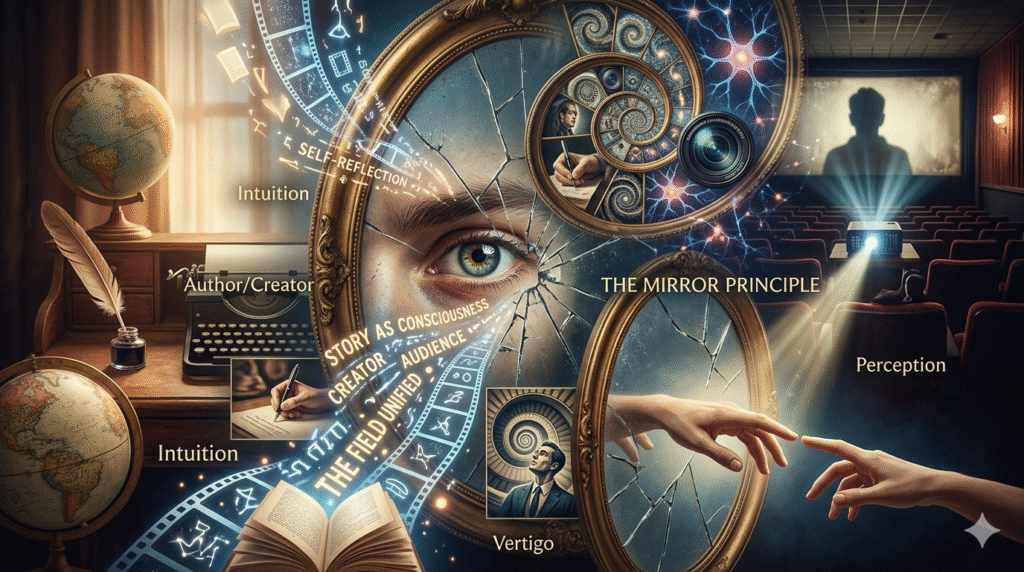
The mirror principle can be described as every story being a mirror, whether it’s reflecting the world, the mind that creates it, the one that perceives it, or the space of awareness that forms between the two. In this sense, storytelling is the most natural act of consciousness, because consciousness itself is narrative: a sequence of perceptions bound together by the illusion of continuity.
When a writer shapes a story, they are externalizing an inner process. The conflict between logic and emotion, as well as between anticipation and empathy, becomes transposed into plot and character. The field of Quality that Pirsig described, where intellect and intuition oscillate in pursuit of harmony, takes on narrative form. Each decision, each act of creation, becomes a diagnostic of the mind that made it.
But the mirror doesn’t face only the author.
Every reader or viewer who engages with a story projects themselves into it, completing the feedback loop. The experience of immersion is, at its core, an act of self-recognition. When the audience feels tension, longing, awe, or moral disquiet, they’re experiencing their own pattern of cognition reflected back at them through narrative. The story becomes a simulation of consciousness, one that both reveals and conceals the mechanisms by which meaning is made.
This recursive relationship, story as consciousness reflecting on itself, is the essence of the Mirror Principle. It is where the author, the text, and the audience occupy the same cognitive field, each perceiving and being perceived in turn. The storyteller generates the pattern; the audience animates it; together they create a third entity: a shared awareness.
In this triadic exchange, form and function become inseparable. Just as a mirror requires both light and subject to exist, story requires both creator and observer. The reflection is meaningless without the gaze that meets it. And like all mirrors, it distorts even as it reveals, bending truth through the lens of emotion, expectation, and belief. Yet this distortion, this tension between what is shown and what is felt, is not a flaw. It is the very source of engagement, the living pulse of narrative consciousness.
To tell a story, then, is to create a recursive instrument of perception, one that allows both author and audience to glimpse themselves from the outside. It is not imitation but introspection, not illusion but revelation. In the mirror of story, we meet not only our imagined others but our unexamined selves.
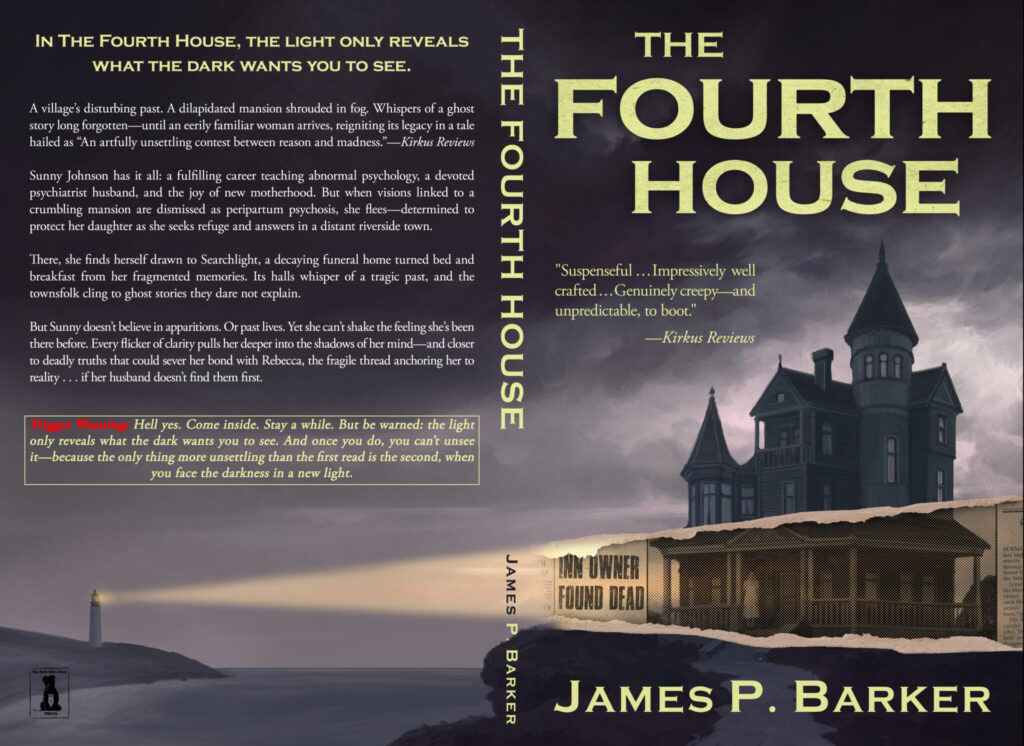
While shaping The Fourth House, the act of creation itself became a mirror for intuition. Long before its symbolic meaning was consciously understood, the story carried the essence of what astrology calls The Fourth House — the domain of the Nadir. Themes of hidden truth, buried trauma, ancestral shadow, and the haunted sanctity of home were already woven into the narrative’s fabric.
Only later, upon researching astrology, as it fit the backward and forward-looking themes of the narrative, did the full resonance become clear. The Nadir represents the deepest, most private layer of the psyche; the unseen foundation from which identity arises. The story had found its symbolic geometry first, through intuition, and the intellect caught up afterward.
This is the moment Pirsig called Dynamic Quality: when something true is recognized before it is understood. The unconscious self moves ahead of the conscious mind, shaping meaning from the inside out. In that instant, the creative act mirrors the very process it seeks to describe: the recursive loop of awareness discovering itself.
For me, this moment occurred back in 1999, when I was writing my first draft of a screenplay originally titled Nadir, only months before the release of The Sixth Sense, which it would later be compared favorably to, along with The Others, both more than once, in coverage notes. And the spark that prompted the story? Asking the question, “What if Alfred Hitchcock’s Vertigo really was a ghost story?”
If every story is a mirror, then some are mirrors facing mirrors; reflections folding endlessly inward. These are the stories that do not merely represent consciousness but embody it; that are structured according to the same recursive logic by which thought itself operates. They are stories aware of their own making, where form and content become one continuous act of perception.
In such works, the story’s architecture behaves like the brain’s own circuitry: looping, reframing, recontextualizing. Each revelation reconfigures not only the plot but the audience’s understanding of what the plot is. This is not a trick of cleverness; it’s a simulation of awareness. Just as the mind revisits memories to assign new meaning, the recursive narrative invites the viewer or reader to experience reinterpretation in real time.
Robert Pirsig would call this the meeting point of Dynamic and Static Quality: the moment when something living (intuition, emotion, experience) finds structure (form, symbol, narrative). Neuroscience would describe it as the point where anticipation, empathy, and dissonance synchronize: dopamine predicting, oxytocin connecting, cognition looping back on itself to close the gap between what is felt and what is known.
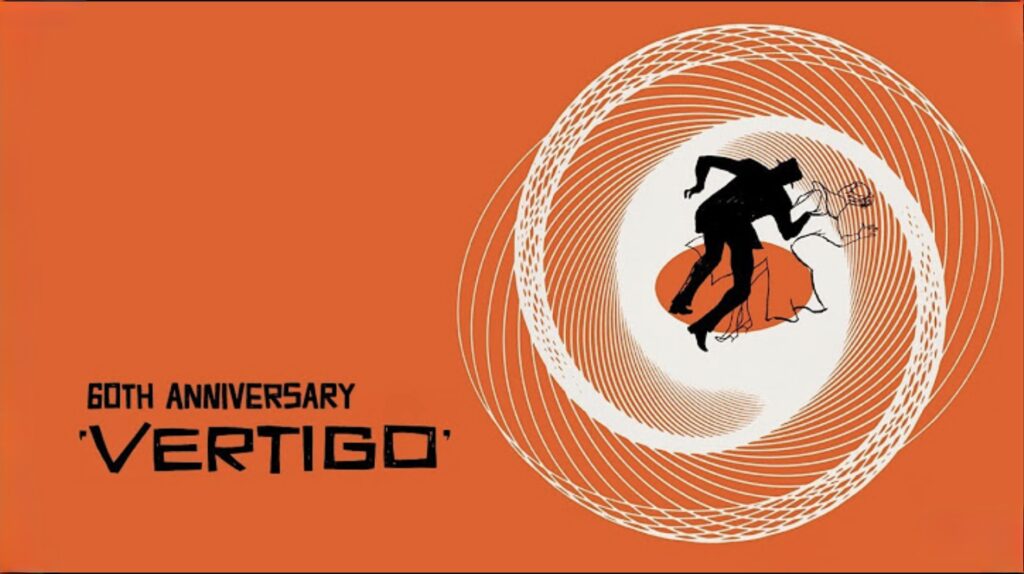
Hitchcock’s Vertigo remains the archetypal recursive story: a study in perception devouring itself. Scottie’s obsession with Madeleine goes beyond merely a romantic fixation; it is an epistemological crisis. He cannot distinguish between what is real and what is constructed, between the woman he loves and the projection his desire has made of her. When he remakes Judy into Madeleine, he is not just trying to resurrect the past; he is attempting to stabilize his fractured sense of reality.
The film’s very form mirrors this spiral of cognition. The camera’s dolly zoom visualizes vertigo as perception collapsing inward, while the narrative loops back upon itself, replaying events with new context until meaning collapses and reconstructs. Hitchcock externalizes the mind’s recursive structure, the way it revisits and revises its own understanding. Vertigo thus becomes cinema’s most elegant demonstration of how form can mimic the mind’s geometry.
Spike Jonze and Charlie Kaufman’s Adaptation makes that geometry explicit. The film begins as an adaptation of The Orchid Thief, then mutates into a film about its own failure to adapt The Orchid Thief. The screenwriter becomes both protagonist and author; his struggle to capture truth becomes the truth itself.
This meta-recursion is phenomenology: Kaufman externalizes the very act of creative cognition, the self-observing mind caught between inspiration and self-doubt, logic and emotion, intellect and impulse. The story builds its own neural network in narrative form, showing how thought transforms into art by turning its gaze inward.
In The Fourth House, recursion takes on an emotional and metaphysical dimension. The story’s architecture mirrors the process of psychological awakening: as Sunny confronts hidden truths, the narrative itself bends, refracts, and loops — forcing both character and reader to reinterpret prior meaning.
Each act of revelation, whether Nadeen’s haunting diary, Rebecca’s rediscovered presence (or absence), or the uncovering of buried family secrets, causes the story’s geometry to shift. The external plot (the search for truth) becomes the inner one (the search for self). This is recursive storytelling, not as a trick but as truth: the structure of consciousness manifest as narrative form.
Thematically, The Fourth House and Vertigo share a haunting symmetry. Both turn desire into an epistemic spiral; both fuse space, memory, and identity into a single recursive field. And yet, where Vertigo ends in tragic collapse, awareness devouring itself, The Fourth House ends on the brink of reconciliation: the moment before cognition resolves into meaning. It is the point where reflection becomes revelation.
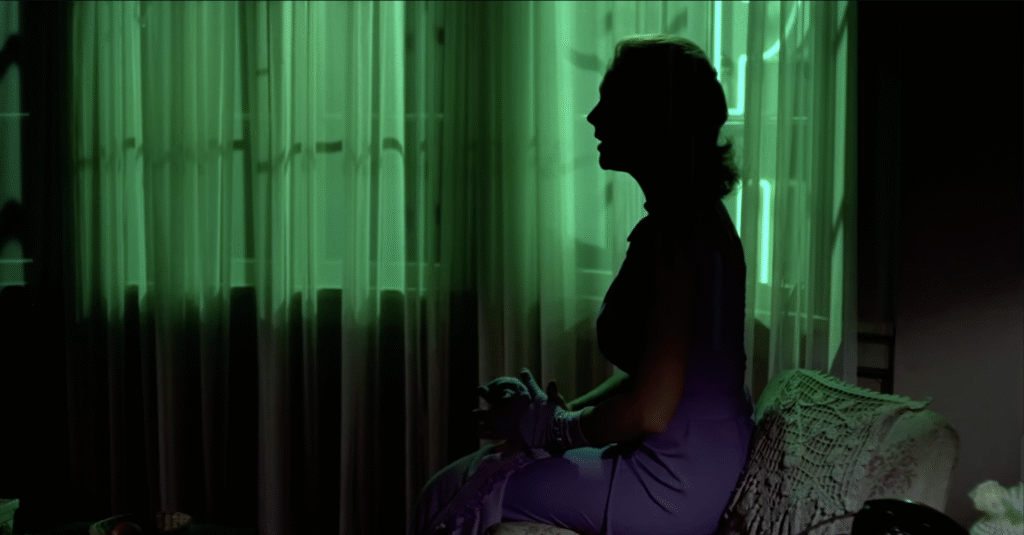
All three works, Vertigo, Adaptation, and The Fourth House, demonstrate that recursion in storytelling is not a postmodern indulgence but a fundamental expression of how consciousness experiences reality. The mind is recursive. It loops back on memory, reframes its perceptions, and creates coherence where none exists. When story mirrors that process, it ceases to be entertainment and becomes revelation, a mirror through which the self perceives its own reflection in motion.
In that moment, form and function collapse into unity. The story is not about consciousness. It is consciousness. And that, in the truest Pirsigian sense, is Quality.
NEXT: Part 10: The Audience as Mirror — Shared Consciousness and the Neuroaesthetic Loop, The Field Unified, and Toward the Future of Story.