
“Quality is not a thing. It is an event.” — Robert Pirsig
In the preceding chapters, we have mapped the anatomy of story, its philosophical, structural, and neurochemical underpinnings, and now the time has come to put those insights into practice. What follows is not another formula to follow, but a framework: a set of tools designed to help engineer dissonance, shape recursion, and sustain immersion with intention rather than instinct.
Where traditional guides tell writers what to include, this toolkit, like the Unified Theory itself, explores why audiences respond the way they do and how to align story architecture with the brain’s own architecture of meaning. Each principle here draws directly from the Unified Field we’ve established:
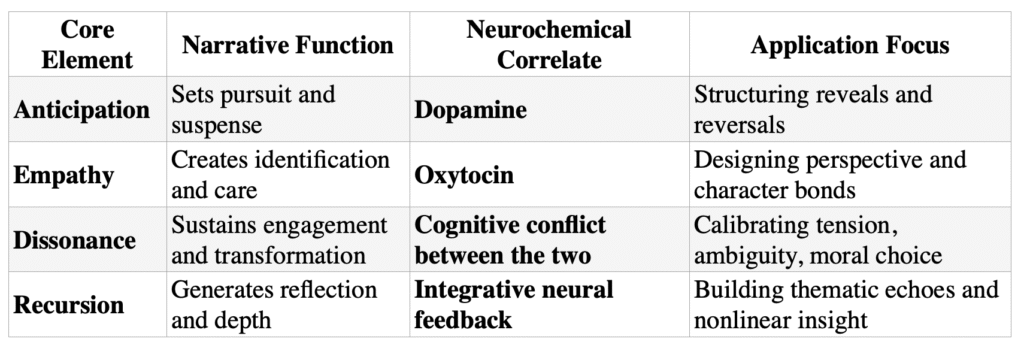
This part of the essay explores three applied domains:
As we proceed, the theory turns practical; the question is no longer “What is Quality?” but “How can we build for it?” All art manipulates to one degree or another. Storytelling, uniquely, does so through chemistry. Every sentence, plot twist, or reveal adjusts the mind’s internal circuitry, raising or lowering levels of dopamine, oxytocin, and tension. The result isn’t “metaphorical immersion” but a literal biological event, where readers and viewers feel what the story engineers.
Traditional structure charts plot the rise and fall of conflict; this model plots the rise and fall of neurochemical states, resulting in engagement. In this way, story design becomes neuro-architecture, a choreography of curiosity, empathy, and unease through dissonance.
To visualize this chemical choreography, we can adapt the traditional beat sheet into a neuro-narrative map. This framework plots the story’s progression not just as a series of events, but as a sequence of targeted emotional and cognitive states.
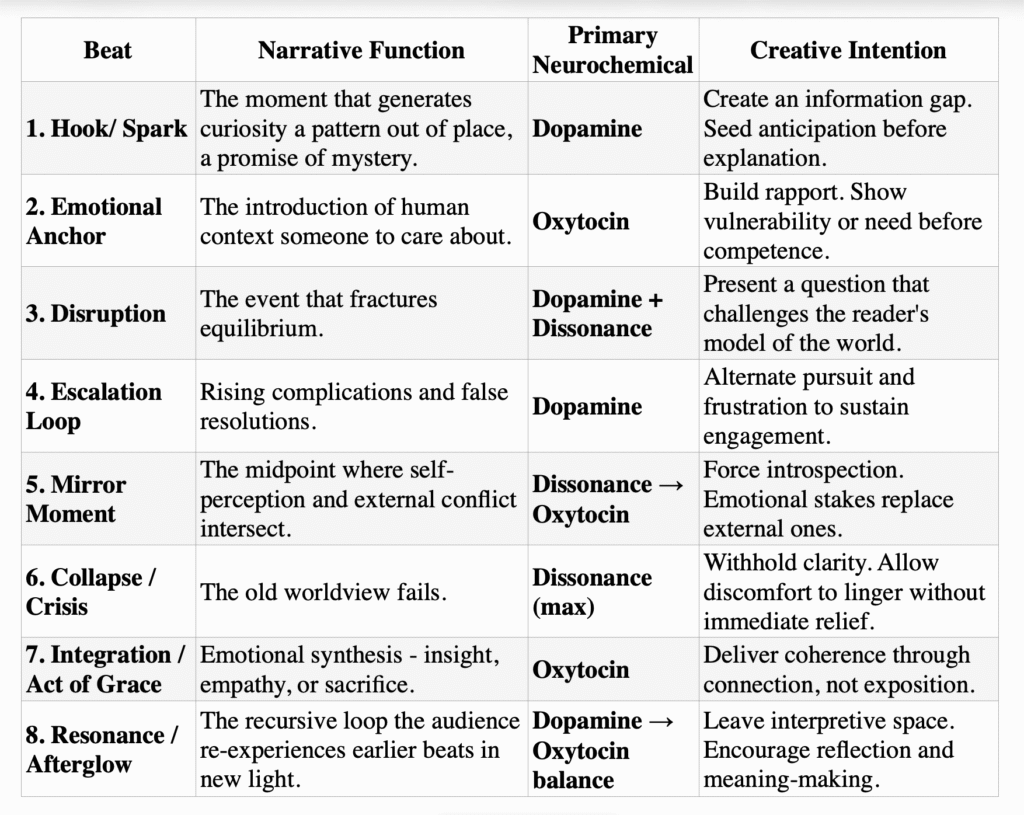
To note, these aren’t necessarily linear, or need to be implemented in an order like most story paradigms, though certainly the Emotional Anchor, Integration, and Afterglow have their specific spots. The Hook could, and should, be replicated throughout the narrative. This happens when the answer to one mystery becomes the hook for the next. For example, A new Dopamine Spike (mystery) can arrive just as an Oxytocin Surge (connection) resolves. The overlap forces the audience to reinterpret what they thought they understood.
This prevents the “Narrative Plateau” where the audience feels they have “figured out” the story’s structure. It can be compounded with Disruption, Escalation, etc., to make the “answer” to the first mystery all the more Dynamic (Quality). Resonance, as opposed to Afterglow, can occur numerous times; the more the story events call for this, the greater the chance for Quality and engagement. Going back to our “Narrative Marketplace” analogy, The Sixth Sense banks its entire house of cards on its one big revelation. It succeeds in creating recursion for the audience, forcing them to go back and reinterpret multiple events. Now imagine if that recursion happened not once, but repeatedly throughout the story.
The key lies in rhythm. Stories that sustain engagement maintain a steady oscillation between the pursuit of knowledge (dopamine) and the experience of connection (oxytocin). Cognitive dissonance, the third force, acts as a phase shifter, resetting the system whenever equilibrium is reached, ensuring the narrative never plateaus into predictability. Just as music uses tension (discordant notes) and release (resolution), the storyteller becomes a composer of chemistry. The structure is not fixed; it feels like a symphony of neural responses that moves from curiosity through empathy toward catharsis and reflection.

Frank Darabont’s The Shawshank Redemption, adapted from Stephen King’s novella, is often cited as one of the most emotionally resonant films ever made. But its power isn’t merely narrative, it’s neurological. The film orchestrates a precise balance between anticipation (dopamine), empathy (oxytocin), and dissonance (cognitive tension) to sustain engagement and deliver catharsis.
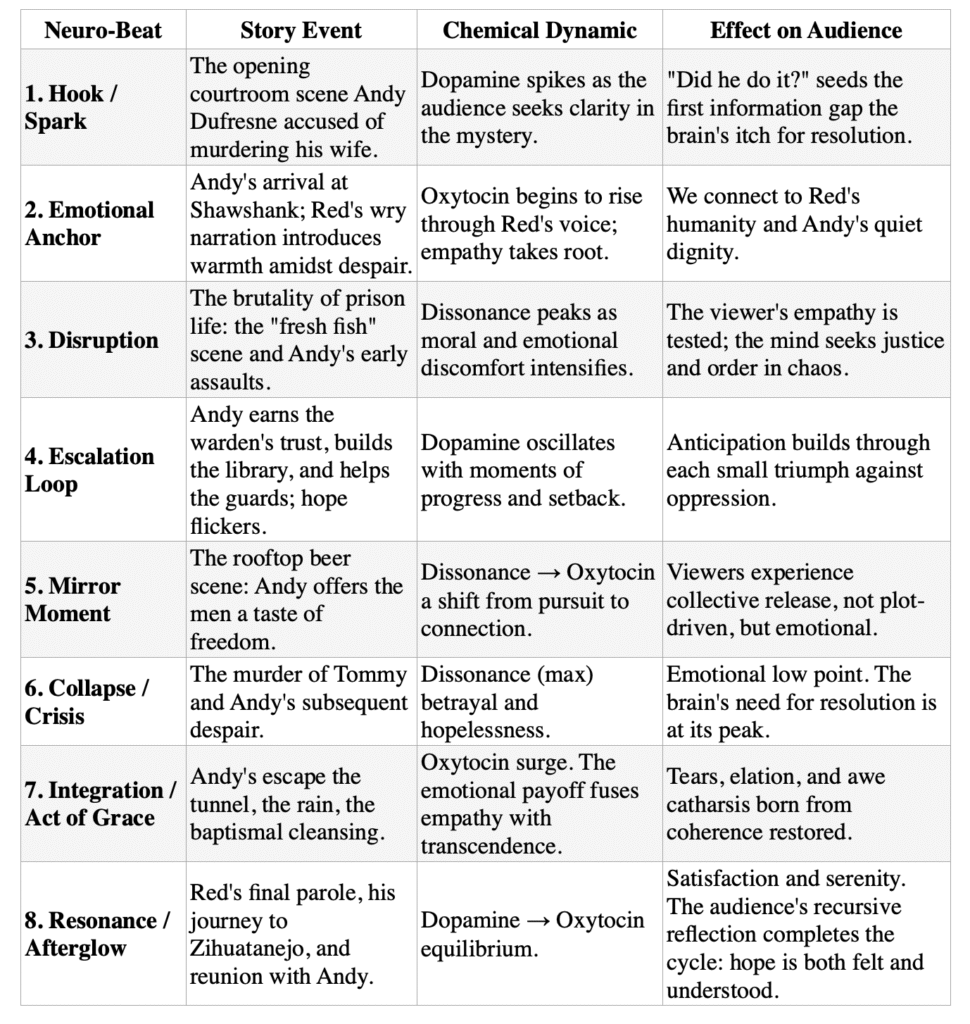
The Shawshank Redemption exemplifies dynamic equilibrium. Each moment of despair heightens anticipation for deliverance, while each flicker of kindness deepens emotional investment. Hope, the film’s thematic core, is not a static ideal but a continuous neurochemical interplay between yearning (dopamine) and connection (oxytocin) regulated by the dissonance of injustice.
The film’s lasting power lies in its recursive structure: on rewatch, every line and gesture resonates differently once the ending is known. The audience re-experiences anticipation in retrospect, reinterpreting dissonance as design. That’s not just good storytelling, it’s neuro-recursion in action.
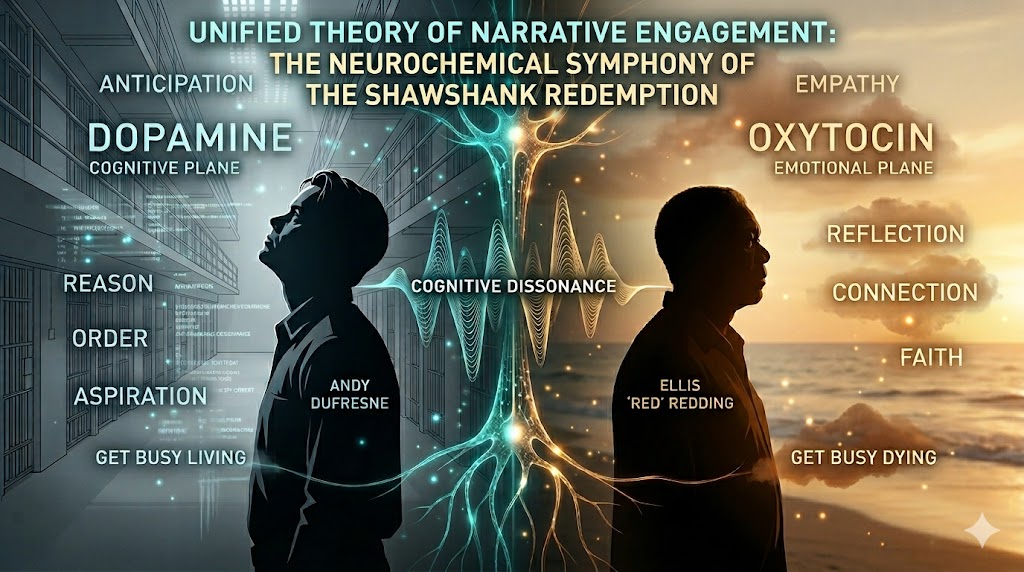
It’s one of the great ironies of The Shawshank Redemption: Andy Dufresne drives the plot, but Red drives the experience. This deliberate split between protagonist and main character between the doer and the feeler is what allows the story to work as a neurological symphony rather than a mere narrative.
Andy represents the unreachable ideal: self-contained, stoic, and operating with quiet conviction in a world stripped of justice. He is the story’s object of pursuit both for the characters and for the audience’s understanding. But because Andy is emotionally opaque by design, a fact that some critics missed, the viewer cannot merge with him; we can only project toward him.
Enter Red, our neurochemical bridge.
Through Red’s voice-over narration, the film establishes the oxytocin pathway that Andy himself cannot provide. Red is empathy incarnate, observant, wounded, and fallible. He experiences the full range of emotional dissonance: cynicism, curiosity, awe, and finally, transformation. By aligning the viewer’s perceptual lens with Red, the story creates a kind of dual-channel engagement:
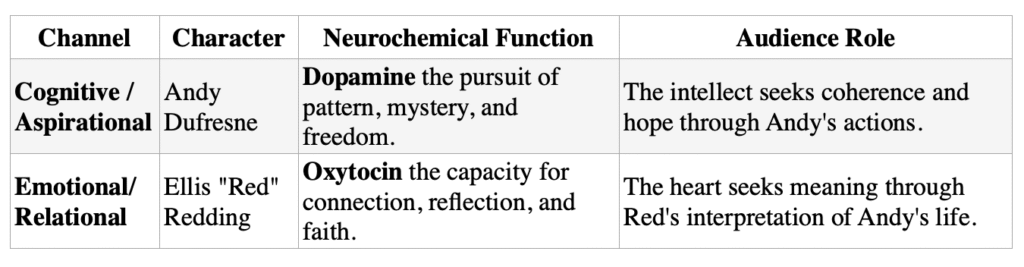
It is precisely because Andy is emotionally reserved that Red’s narration becomes essential. Without Red, the story would risk becoming sterile, too classical, too dopaminergic. Without Andy, it would collapse into despair, too romantic, too oxytocin-driven. Together, they embody Pirsig’s dynamic equilibrium between the classical and the romantic modes of Quality.
This structure, where empathy and aspiration are housed in separate characters, is what gives the film its profound resonance. When Andy escapes, we don’t simply cheer for him; we experience his freedom through Red’s emotional awakening. The final scene on the beach isn’t a dopamine reward; it’s an oxytocin release, a communion earned through years of dissonance and reflection.
Film critics who found Andy “cool” or “detached” weren’t wrong; they were simply looking through the wrong lens. Andy’s purpose isn’t to invite identification, but inspiration. He is the embodiment of hope, an externalized ideal that Red, and by extension the audience, must learn to believe in.
That’s why the film’s most famous line, “Get busy living, or get busy dying,” is not Andy’s transformation; it’s Red’s. The story’s emotional catharsis doesn’t occur when Andy escapes; it occurs when Red finally steps into the unknown, embodying the faith he once lacked.
It’s in that moment, boarding the bus, unsure of what lies ahead, that the audience’s own neurochemical arc completes its cycle. The anticipation that began in the courtroom finds resolution not in Andy’s logic, but in Red’s heart. Through Red, we escape.
The separation between protagonist and main character, between the agent of change and the vessel of empathy, is not unique to The Shawshank Redemption. It’s a narrative pattern that recurs across masterworks because it aligns with how the human brain processes story: through mirrored empathy and observational projection.
In neurological terms, this structure engages both the dopaminergic and oxytocin-driven systems simultaneously, creating a sustained loop of curiosity and identification. The audience pursues understanding through one character while feeling that pursuit through another — a “pairing” that has long been recognized by Dramatica. Let’s look at three examples that demonstrate how this dual-channel architecture manifests across very different stories.
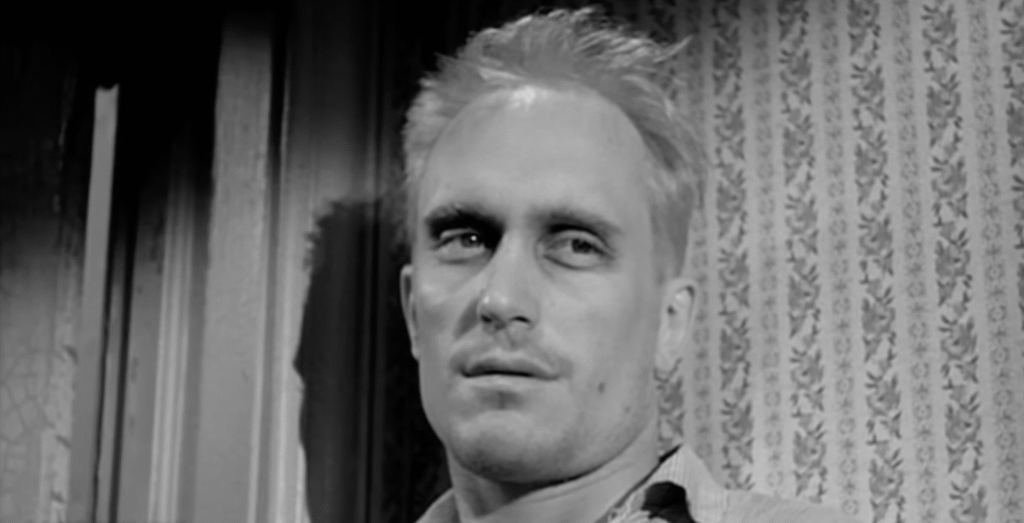
In Harper Lee’s To Kill a Mockingbird, Atticus Finch is often perceived as the moral and intellectual center, but Scout Finch is the heart’s interpreter. The story’s emotional resonance emerges because we experience Atticus’s courage through Scout’s innocence.
The same applies to Boo Radley, whose presence is mostly off-screen until the end. He is, for much of the story, a projection of mystery, the town’s dopaminergic focus, an enigma waiting to be understood. Scout, meanwhile, represents oxytocin-driven perception: the process of humanization through empathy.
When Boo finally appears, the story’s moral and emotional loops collapse into alignment: the unknown becomes known, but more importantly, the feared becomes felt. That closing image of Scout standing on Boo’s porch, seeing the world through his eyes, is the very embodiment of recursive realization. She not only reinterprets Boo’s past actions, but her own prior judgments are a mirror for the reader’s own transformation.
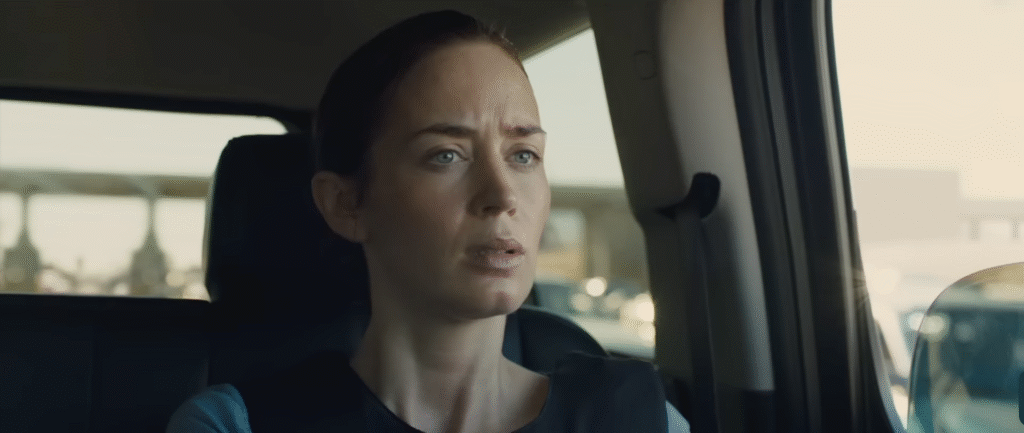
Denis Villeneuve’s Sicario weaponizes this structure with surgical precision. Like Shawshank, it splits the story’s engine (Alejandro and the task force) from its moral compass (Kate Macer).
Kate is our access point, rational, idealistic as a “book thumper,” and driven by justice. She embodies oxytocin-driven alignment, allowing us to feel the moral unease of the war on drugs. But the film’s dopamine driver, the character whose actions propel the plot, is Alejandro, the ghost of vengeance, existing in a moral grey zone beyond Kate’s comprehension.
As the narrative unfolds, Kate’s worldview fractures under the weight of dissonance. Her belief in institutional justice collapses, replaced by the chilling realization that morality has become a currency, not a compass.
By the film’s end, when she’s forced to sign the falsified report at gunpoint, her oxytocin-driven empathy implodes into despair. The dopamine loop of “What’s really happening?” gives way to the hollow clarity of “This is how it works.”
The audience, like Kate, is left chemically unsettled — denied resolution, but forced into irreversible awareness. It’s not catharsis; it’s confrontation. In the Unified Theory, Sicario stands as a textbook case of dissonance without relief and engagement maintained through unresolved recursion.
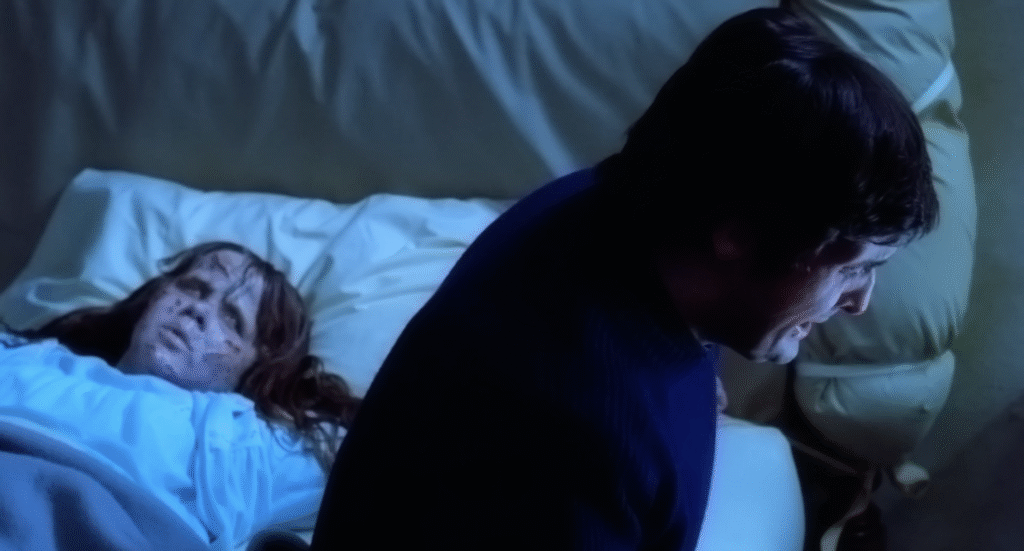
In The Exorcist, the titular exorcism is not the film’s true center; Father Karras’s crisis of faith is. As discussed earlier, we do not feel the demonic conflict through Karras’s intellect, but through his breakdown. Regan’s possession functions as the dopaminergic mystery, an externalized problem, while Karras’s loss and rediscovery of belief carry the oxytocin-driven arc.
The power of the story’s ending, Karras’s self-sacrifice, lies in its perfect alignment of both channels: logic and faith, intellect and surrender, dopamine and oxytocin. When he leaps from the window, the audience’s internal conflict resolves into a profound equilibrium not through comprehension, but through compassion.
These various examples reveal a consistent pattern, where the story’s cognitive and emotional elements are often distributed across different characters, creating a richer, more complex experience for the audience. This allows the narrative to explore themes from multiple angles simultaneously.
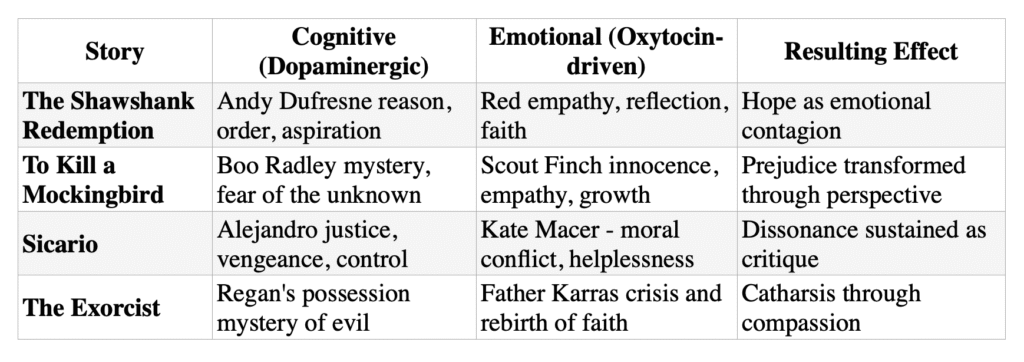
What unites these examples is the split narrative consciousness, a doubling of perspective that mirrors the human mind’s own duality. We think one way and feel another; we rationalize while we empathize; we seek answers even as we resist them. Story, then, becomes not just a reflection of consciousness, but a reenactment of its architecture.
This dual-character lens embodies the very process of thinking and feeling our way toward truth.
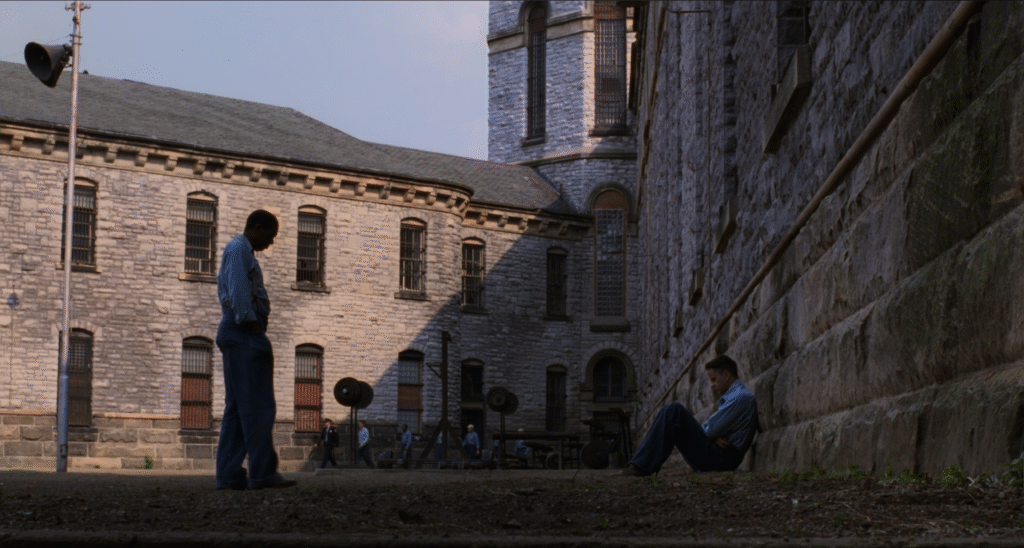
Long before the neurochemical vocabulary entered the discussion, the “two-hander” framework I explored in a 2014 essay, “The Two-Hander Approach,” captured the essence of story as dialectic: two consciousnesses locked in tension, forcing transformation through contradiction.
In traditional story structure, the two-hander appears whenever two central figures share roughly equal dramatic weight — Red and Andy in The Shawshank Redemption, Cole and Malcolm in The Sixth Sense, Luke and Obi-Wan in Star Wars, Wallace and Robert the Bruce in Braveheart. But what defines the form isn’t just dual protagonism; it’s dual perception, the friction between opposing worldviews that dramatizes a philosophical argument. One believes; the other doubts. One hopes; the other despairs. One acts; the other reflects.
From a Dramatica standpoint, the two-hander fulfills the roles of Main Character and Influence Character, the I and the You perspectives of the mind’s internal debate. Their interaction produces the We (the relationship throughline), where emotion and reason collide, and eventually, the They (the story’s objective world).
From a neuro-narrative standpoint, these same dynamics map cleanly onto the brain’s emotional circuitry:
The Main Character (the I) activates dopaminergic pursuit, the drive for resolution, logic, and control.
The Influence Character (the You) activates oxytocin-driven empathy, the pull toward connection, faith, and surrender.
The relationship between them generates cognitive dissonance, the energetic tension that demands synthesis, the “itch that must be scratched.”
In other words, the two-hander is not merely a narrative structure; it is the psychological geometry of transformation. Each character embodies one pole of a mental field, and the story itself becomes the space in which the human mind learns to reconcile them.
In The Shawshank Redemption, Andy Dufresne represents active faith and imaginative freedom, the romantic ideal. Red, by contrast, is the skeptical empiricist, tethered to the pragmatic and institutional. Their relationship forms a moral bridge from doubt to belief. When Red finally admits, “I hope,” the oxytocin-driven circuit completes.
Thus, the two-hander is the operating system of empathy. It invites readers to inhabit multiple consciousnesses to feel two truths at once until their friction becomes illumination. Where the single-POV story mirrors perception, the two-hander mirrors awareness.
At the beginning of that early essay, I quoted David McCullough, “Writing is thinking. To write well is to think clearly. That’s why it’s so hard.” In that sense, a true two-hander is the mind learning to think through feeling and to feel through thought.
The most emotionally powerful stories don’t rely on a single protagonist to do all the work. They distribute experience across two psychological planes, the Cognitive Plane (Dopamine) and the Emotional Plane (Oxytocin) – allowing tension (Cognitive Dissonance) to sustain the bridge between them. This dual-character lens isn’t just a stylistic choice; it’s a neurobiological design.
1. Define Your Two Poles
Choose two characters who embody opposing yet complementary modes of perception.

Example: In Sicario, Alejandro (Cognitive) drives the plot; Kate (Emotional) embodies the cost of truth. In Shawshank, Andy (Cognitive) inspires hope through action; Red (Emotional) experiences hope through transformation.
2. Build the Dissonance Bridge
Once you’ve established your poles, create friction between them. This is the story’s living tension, the mind’s yearning for coherence.
Ask:
This dissonance becomes the tent-pole that holds up your entire emotional architecture. Without it, your story risks equilibrium too soon; meaning dies when tension resolves prematurely.
3. Align the Audience with the Emotional Plane
The audience’s entry point should almost always be through the emotional character, not the cognitive one. We are wired for empathy first and analysis second.
Let the audience watch the cognitive character but feel through the emotional one. This mirrors how the human brain processes conflict: affective systems (limbic) interpret before rational systems (prefrontal) make sense of it.
4. Calibrate the Arc of Integration
By the climax, both planes must converge even if momentarily. That’s where meaning is born: when logic and empathy, anticipation and connection, resolve into a single pulse of understanding.
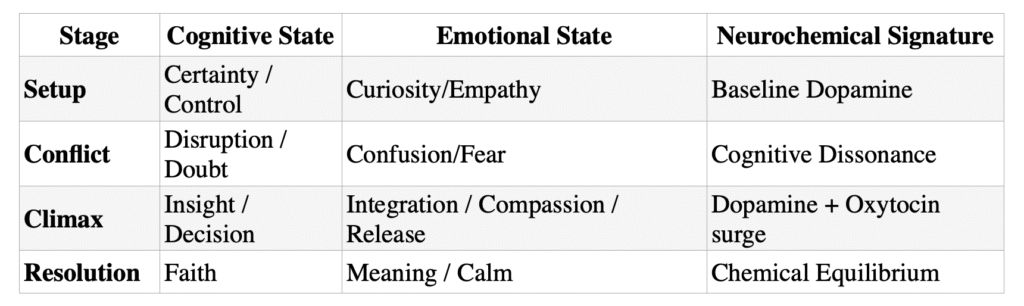
This is the moment of recursion: both characters, and by proxy the audience, reinterpret everything that came before through a new lens of coherence.
If you want to increase emotional complexity, manipulate narrative distance between the two characters.
These oscillations mirror the brain’s own feedback loops, creating recursive engagement long after the story ends.
In Short: “The dual-character lens is not two stories. It is one story told through two hemispheres of the mind, one thinking, one feeling, searching for balance.”
In literary circles, the use of multiple viewpoints has long carried a kind of stigma, a fear that shifting perspectives will “confuse the reader” or fragment the story’s emotional core. But this criticism often mistakes disorganization for design. There is a critical difference between head-hopping and conscious duality.
Head-hopping occurs when the reader’s cognitive anchor is abruptly broken within a scene, leaving them uncertain whose emotions they’re inhabiting. The neural effect is dissonant in the wrong way — disrupting continuity of empathy rather than deepening contradiction; it disrupts empathy rather than deepening it. By contrast, a dual-character lens is a deliberate alternation of consciousness. It mirrors the mind’s own oscillation between logic and feeling, observer and participant. The goal is not to fragment experience, but to refract it to show two sides of the same truth, each illuminating the other.
From a neuro-narrative standpoint, this design sustains engagement by toggling between the dopaminergic and oxytocin-driven systems. One perspective feeds curiosity and pattern-recognition; the other grounds empathy and moral reflection. When balanced correctly, the reader does not feel divided; they feel complete.
The key to maintaining that integrity is containment: Each viewpoint must own its scene or chapter entirely. The reader should never feel pushed out of one mind mid-thought, but invited to inhabit another between breaths. This rhythmic alternation creates a kind of narrative respiration, an inhale of cognition, an exhale of emotion.
In The Fourth House, for instance, Sunny and Nadeen are two halves of a single psychological equation. Each chapter functions like a shift between hemispheres of the same mind. The result is not confusion, but coherence, a living model of how human consciousness itself toggles between knowing and feeling in the search for truth.
Multiplicity, handled with integrity, does not divide the reader’s attention; it expands their awareness.
In this way, the Story Architect does not construct events alone, but experiences. Not plots, but oscillations. Not characters, but cognitive fields. The craft of storytelling becomes the deliberate shaping of perception itself — an alignment of structure, emotion, and dissonance across time.
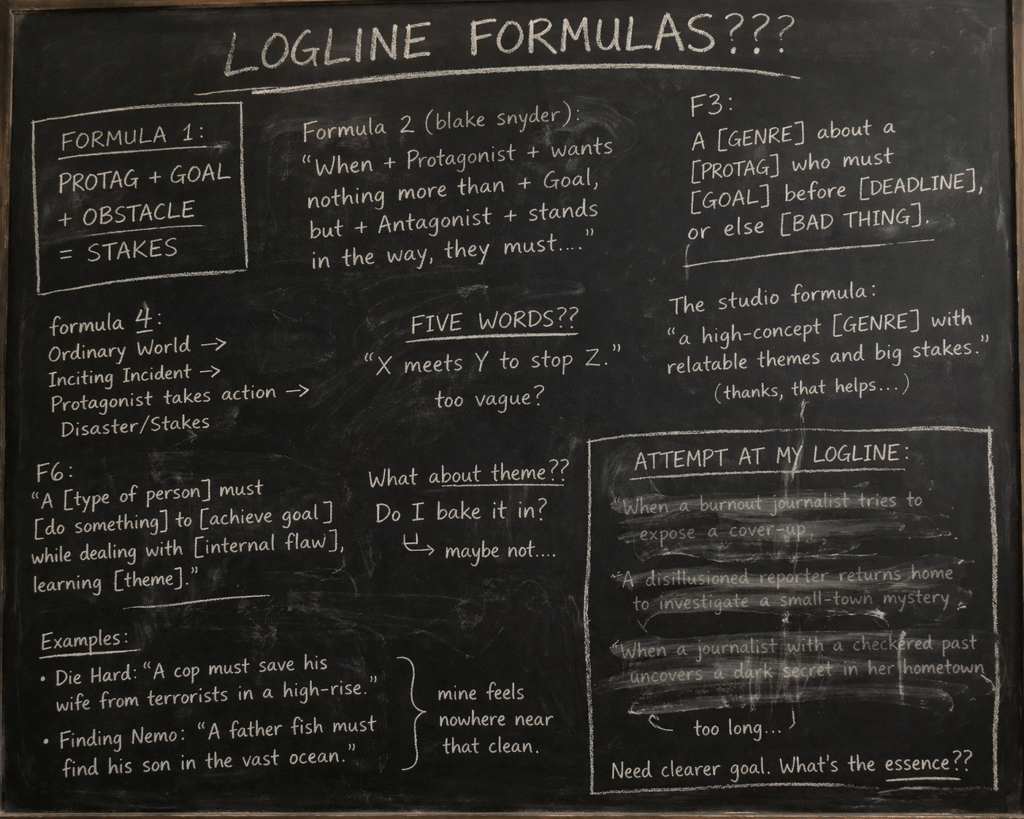
One of the most challenging aspects for a writer is to summarize their work in an attention-grabbing logline. A quick search turned up the following formula from Masterclass.com:
[protagonist] + [inciting incident] + [protagonist’s goal] + [central conflict]
If it sounds like a grocery list or incomplete recipe, that’s because it is. It’s linear, mechanical, and what Pirsig would call “static.” It suggests that things happen in a sequence: “A happens, so the Hero wants B, but C gets in the way.”
It’s supposed to be engaging and dynamic, hinting at the full potential of your concept. But instead, it’s a roadmap for causality that doesn’t necessarily equate to engagement.
The Unified Theory’s formula, using the stock market analogy in Part 8.11, is a reflection of Pirsig’s idea of Dynamic Quality:
LQ=(O+D)+ΔDk
Where:
That “Information Gap” is what you want the reader to experience as it becomes the field in which co-authorship happens. In this case, the field is a vortex of tightly wound values, and the reader is left imagining the possibilities implied by the gap, creating a Speculative Hook on their behalf; the more Oxcytocin and Dopamine converge into Dissonance, the higher the potential engagement.
The 3-Step Audit for your Logline:
1. Establish the “Asset” (Oxytocin: The Bond)
Who is the “Emotional Proxy” and what is their “Social Capital”?
2. Launch the “Market Volatility” (Dopamine: The Drive)
This is the kinetic “Pulse” of the story.
3. The Margin Call (Dissonance: The Irony)
This is the “Itch” that requires the script to scratch. The Unified Formula: [Goal]+[The Paradox that makes the Goal a Liability]
NOTE: If your logline does not contain a paradox, it does not yet contain a story — only a situation.
The Final Comparison: One Script, Two Markets
The “Masterclass” Style (Static):
“A former pilot leads a team across a post-apocalyptic wasteland to find a cure for a virus while being hunted by infected survivors.”
The Unified Theory Style (Dynamic):
“A bomber haunted by failed attempts to stop a pandemic is forced to shepherd scientists through a landscape of biological horror — only to discover the ‘incomplete cure’ contains the virus currently consuming his wife, which requires the sacrifice of the others.”
By using the Unified Theory, we have created a Structural Coherence because the “Cure,” the “Wife,” and the “Squad” are now tightly wound and more engaging as a result.
NEXT: Part 9 — The Mirror Principle — Story as Self-Reflection