
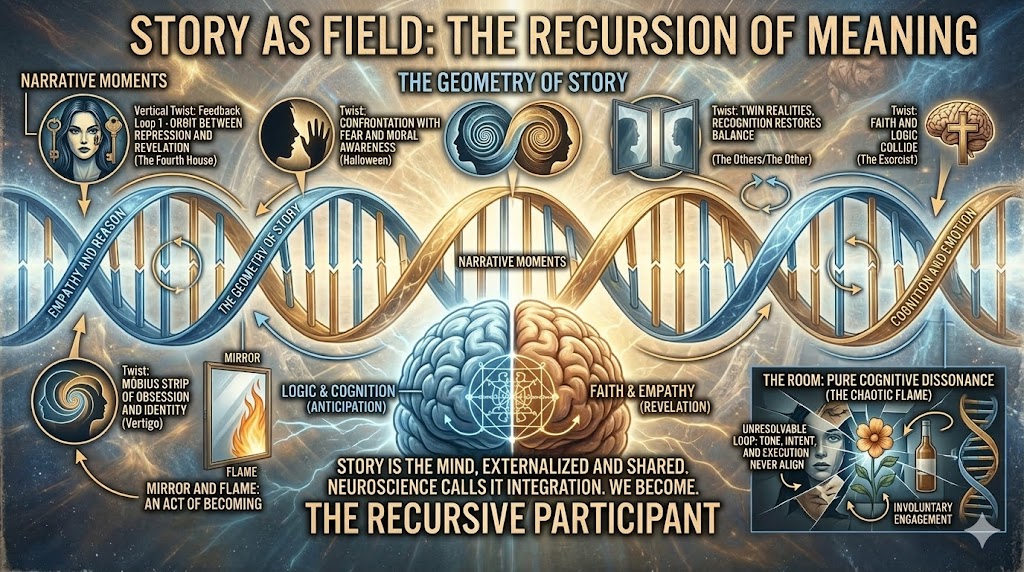
Across The Fourth House, Halloween, Vertigo, The Other, The Others, The Exorcist, and Tootsie, one truth stands out: story is often misperceived as being a linear construct, when in reality, it is a living field that exists between author and reader.
Story appears linear because it has a beginning, middle, and end, and on the page. This, however, does not address its temporal structure, as it merely exists there as a static pattern of language, structured and shaped by the author. Yet when that pattern enters a reader’s mind, it becomes something far more dynamic: a living field of perception, emotion, and expectation, where meaning emerges through the balancing of anticipation and experience.
Each of these narratives demonstrates, in its own way, how dissonance sustains engagement, and how resolution, when (and if) it arrives, restores coherence, or, when withheld, how it leaves a resonance that haunts the mind. Through this process, recursion transforms comprehension into reflection.
These stories are variations of the same universal pattern of Quality that Pirsig identified as the foundation of art and science: the movement from division toward unity, as well as from knowing to understanding.
The Geometry of Story
This field would appear as a double helix, with two intertwined strands. One strand represents cognition and emotion, the other empathy and reason, circling each other in a spiral of discovery. Each twist represents a feedback loop, a moment in the narrative where expectation collides with revelation, generating a new awareness. The result is that the narrative’s impact becomes less about the events themselves than about their timely recalibration in the audience’s mind. Each recursion subsequently deepens our sense of connection to both the character and ourselves.
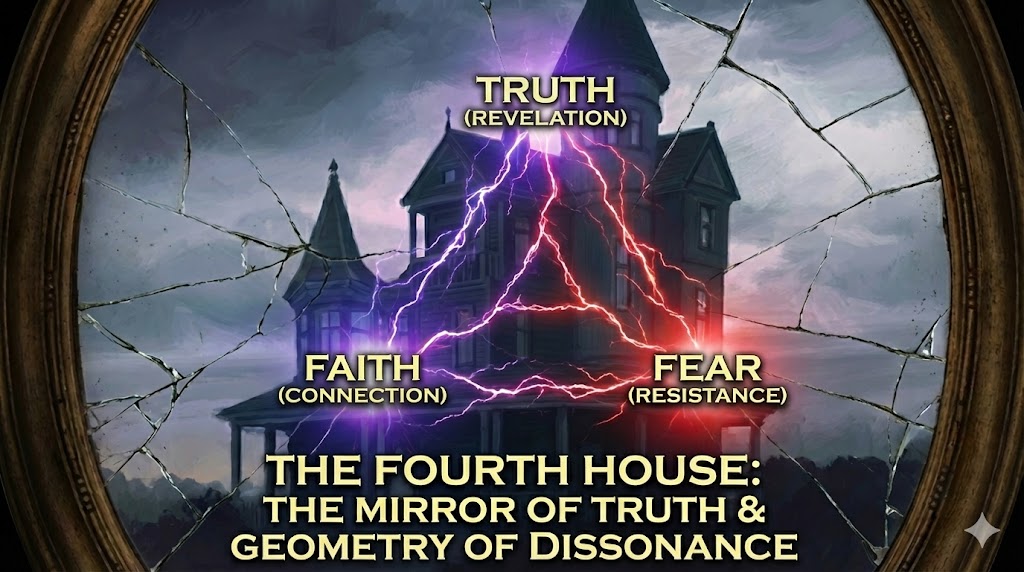
In The Fourth House, this geometry manifests as Sunny’s search for truth as she orbits between repression and revelation.
In Halloween, it takes the form of Laurie’s confrontation with fear and the dissonance between survival instinct and moral awareness.
In Vertigo, perception turns upon itself, creating a Möbius strip of obsession and identity.
In The Other and The Others, the self splits into twin realities, each shadowed by denial until recognition restores balance (or annihilates “the other”).
In The Exorcist, the loop closes through faith, logic surrendering to comprehension that exceeds its reach.
The Recursion & The Participant
In every case, the audience completes the circuit. Suspense, empathy, and meaning do not exist on the screen or the page; they exist in the recursion between the story and the mind experiencing it. As cognitive neuroscience now confirms, narrative comprehension is not passive reception but active simulation; our brains mirror the emotions, decisions, and revelations we witness.
Thus, the story becomes a self-organizing system, a collaborative act between creator and perceiver. The author provides the field, whether it’s a page or screen, and the reader or viewer becomes the current that animates it. Every interpretation, every moment of uncertainty or moral reckoning, is a point of energy within that field, like light refracting through glass.
The Closing of the Loop
Understanding story, then, is to understand consciousness itself as both recursion and structures designed to transform dissonance into meaning. The same process that drives a character toward realization drives the mind toward understanding, as both are acts of pattern recognition and reconciling what is seen with what is felt.
In that sense, story is the mind, externalized and shared. It is the mirror in which the universe comes to recognize its own awareness.
Whereas Pirsig might have called this the “moment of Quality,” neuroscience calls integration. Nevertheless, the feeling is the same: the subtle alignment of truth, perception, and purpose, and, even though the narrative has ended, something continues to hum — a low, resonant vibration in the psyche that whispers: You have not just read or watched. You have become.
Coda: The Mirror and the Flame
Every story is, in its essence, an act of becoming — a flame sparked between perception and meaning. It is both mirror and fire, reflecting the mind even as it transforms it. From each of these stories, we have seen how narrative acts as a living system, a feedback loop between cognition and emotion, logic and faith.
But not all flames burn with equal clarity. Some flicker, twist, and sputter unpredictably. In their chaos, we glimpse another form of beauty. If great stories reveal the harmonious structure of narrative engagement, failures can reveal the same structure through distortion. Such is the case with The Room, Tommy Wiseau’s infamous 2003 enigma, often regarded as one of the worst films committed to celluloid.
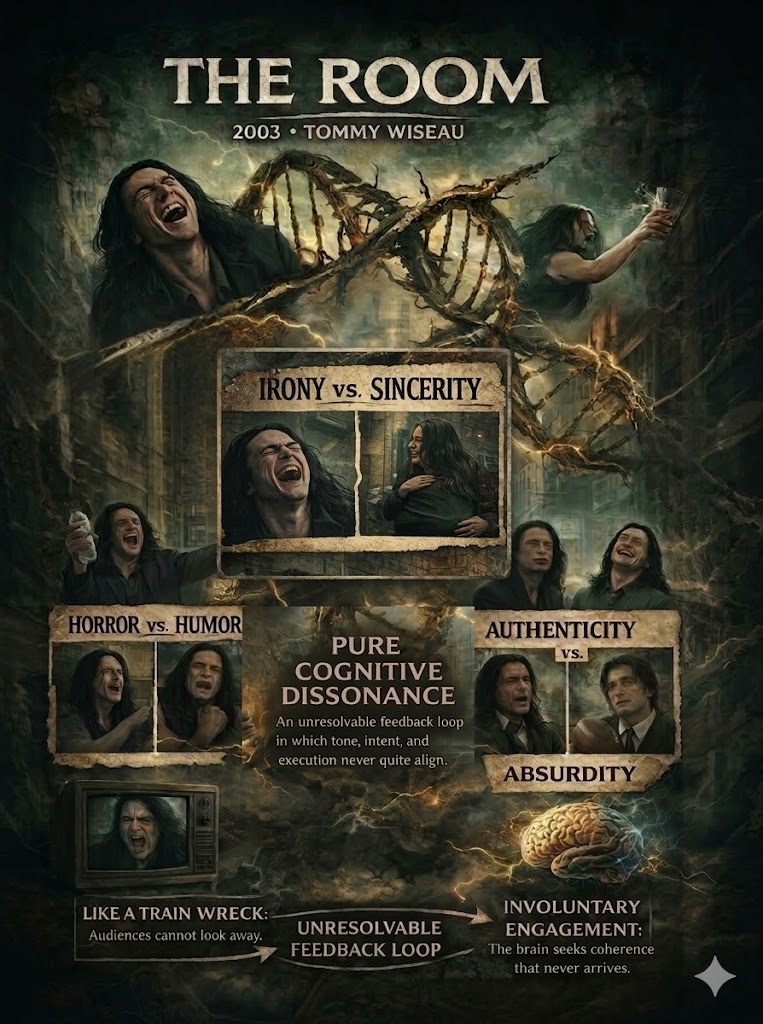
Studying The Room to understand story structure is like a doctor studying a virus to understand the immune system. By every classical measure, it fails; plot, performance, and structure all collapse under their own incongruent weight. Yet, strangely enough, it endures and even fascinates, because it occupies the psychological limbo between comprehension and confusion, leaving us wondering what was just watched.
What Wiseau created, however unintentionally, is pure cognitive dissonance: an unresolvable feedback loop in which tone, intent, and execution never quite align, resulting in what might be defined as involuntary engagement. Like a train wreck, audiences cannot look away; their minds are caught between competing frameworks of irony and sincerity, horror and humor, and authenticity and absurdity — sometimes all within the same scene. The itch to understand is never scratched, so the film lives on indefinitely in the brain’s dopaminergic circuitry, seeking a coherence that never comes.
In its strange way, The Room reveals a truth about storytelling: that coherence is not the only path to meaning. Even though the mind strives to seek harmony, sometimes, it is drawn to the thrill of discord. Even failure can illuminate Quality, not as perfection, but as presence.
The mirror of story, then, reflects both the crafted and the chaotic, the deliberate and the accidental, and the flame that lights it burns in the same place where art and mind meet, the field of dynamic dissonance. There, truth, like fire, dances but never holds still.
NEXT: 7.8 Akira Kurosawa and the film Ikiru — The Resonance of Meaning: Dissonance, Empathy, and the Search for Quality
And so we arrive at the threshold of application: how might this understanding of narrative recursion, chemistry, and cognition transform the way we build stories, teach them, and even live them?