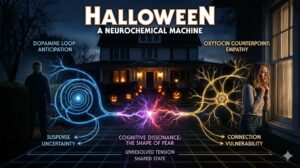
Part 7.2: Halloween — The Shape of Fear and the Mechanics of Anticipation
“It’s the boogeyman.”— Laurie Strode, Halloween (1978) Note: This is the second in many case studies on the Unified Theory of Narrative Engagement. Earlier essays
“It’s the boogeyman.”— Laurie Strode, Halloween (1978) Note: This is the second in many case studies on the Unified Theory of Narrative Engagement. Earlier essays
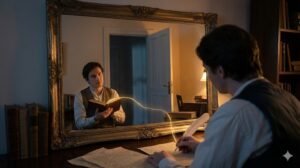
“The more you look, the more you see.” —Robert M. Pirsig, Zen and the Art of Motorcycle Maintenance. Note: This is the first in many case

“A person isn’t considered insane if there are a number of people who believe the same way. Insanity isn’t supposed to be a communicable disease.

“The voyage of discovery is not in seeking new landscapes, but in having new eyes.”— Marcel Proust Note: This is the fifth part of a series.

“Every now and then a man’s mind is stretched by a new idea or sensation, and never shrinks back to its former dimensions.”— Oliver Wendell

Note: This is the third part of a series. The prologue can be found here, with the previous chapters at the bottom of the page. The Neuroscience

“A story is an analogy to a single human mind trying to solve a problem.”— Chris Huntley and Melanie Anne Phillips, Dramatica: A New Theory

“The place to improve the world is first in one’s own heart and head and hands, and then work outward from there.”— Robert M. Pirsig

“Dude, you’re TOTALLY wrong. ‘Halloween’ (1978) NEVER sets out to prove if ‘the boogyman’ exists or not. Michael Myers is simply referred to as the