NOTE: This is the third of many case studies on the Unified Theory of Narrative Engagement, with emphasis on how it came to be. Earlier essays discussing the theory at length can be found here. This particular entry focuses on the theory, but a more plot-centric essay from 2014 that focuses on empathy can be found here.
If there was one film that had provided inspiration for The Fourth House, it was Alfred Hitchcock’s Vertigo. I found myself caught in its web within the first couple of years of college, later delving into its existential themes while in a senior seminar in Psychology. The story of Vertigo, to me, seemed like a ghost story, without the ghost. It was a simple “What if” question that eventually led to Nadir/The Fourth House as a screenplay: what if Vertigo’s conceit was a “haunting” and not just a plot twist to conceal a murder plot?
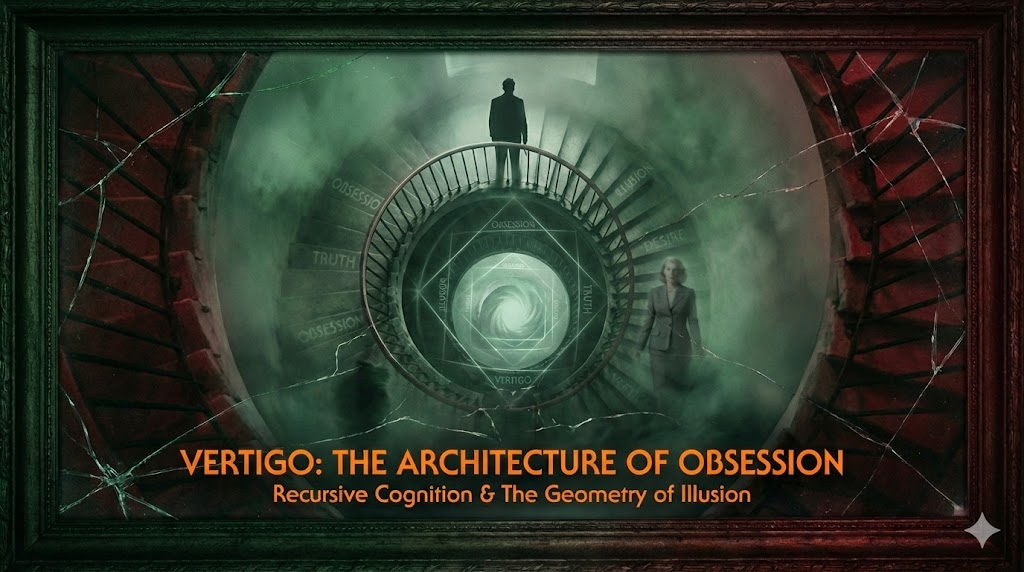
From that idea, the goal was to challenge the idea of what a “ghost” could be. Structurally, one can recognize the similarity with Vertigo, but the latter’s “architecture of obsession” is notably different. While The Fourth House and Halloween explore the tension between fear and truth, Alfred Hitchcock’s Vertigo turns that tension inward, transforming it into an obsession with perception itself. The film’s spiral motif, mirrored in its title sequence, camera movements, and psychological descent, is the purest visual metaphor for recursive cognition.
Each revolution brings Scottie Ferguson closer to revelation, yet further from reality. He is not simply haunted by a woman’s death; he is trapped in the circuitry of his own mind, where memory, desire, and illusion endlessly fold upon one another.
The Spiral as Schema: Dissonance in Motion
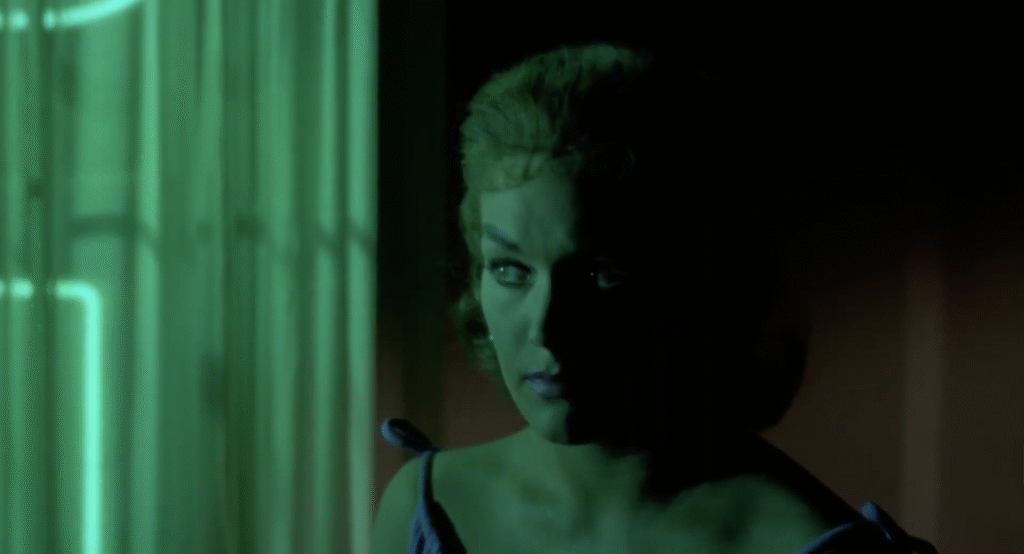
The opening rooftop chase sets the geometry of the entire narrative. Scottie’s acrophobia, a fear of falling, becomes the physical embodiment of cognitive dissonance: the pull between control and surrender, reason and vertigo. His fear of height is also a fear of depth and of the abyss of the unknown and the unseeable truth. After Madeleine enters his life, she ultimately becomes the externalized form of that vertigo: a beautiful paradox he cannot reconcile. She is both alive and dead, real and imagined — though ultimately an illusion.
In neuroscientific terms, Vertigo operates as an oscillation between dopaminergic pursuit and oxytocinic attachment. Scottie’s fascination with Madeleine stimulates the anticipation loop: the thrill of the chase and the mystery to be solved posed by old school chum, Galvin Elster. Yet the deeper he falls into obsession, the more empathy collapses into possession — an irony considering Elster’s “revelations” shared with Scottie. Dissonance escalates as dopamine’s drive for pattern and completion outpaces oxytocin’s stabilizing connection. The result is an unbalanced circuit, a recursive feedback loop of longing and loss.
Recursive Realization: Seeing and Unseeing
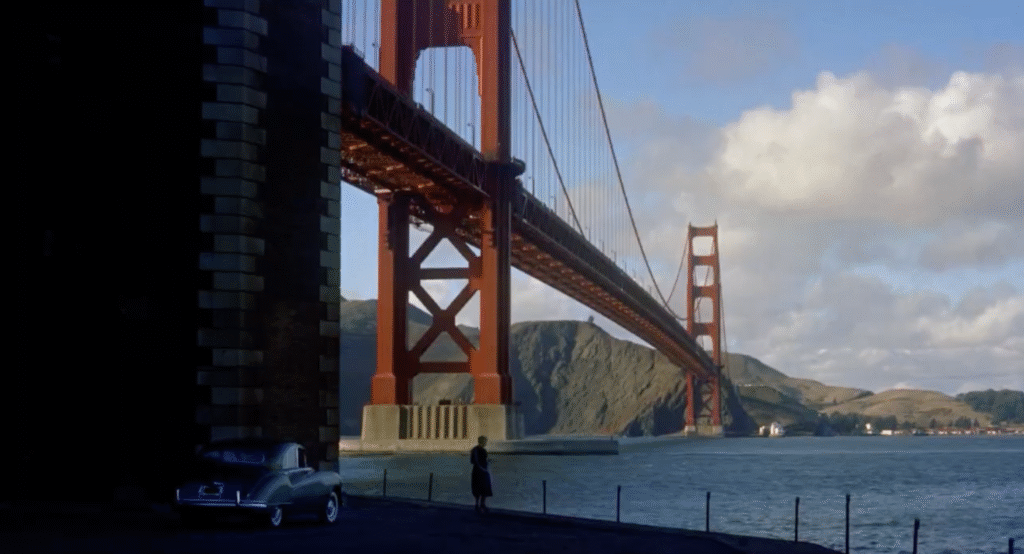
Hitchcock’s camera embodies this recursive process. The now-famous dolly-zoom, expanding and contracting space simultaneously, simulates the perceptual distortion of dissonance itself — the mind straining to integrate incompatible information. Every visual return, the same streets, the same flowers, the same mission tower, intensifies the recursion, inviting both Scottie and the audience to revisit the same stimuli with new, destabilizing awareness.
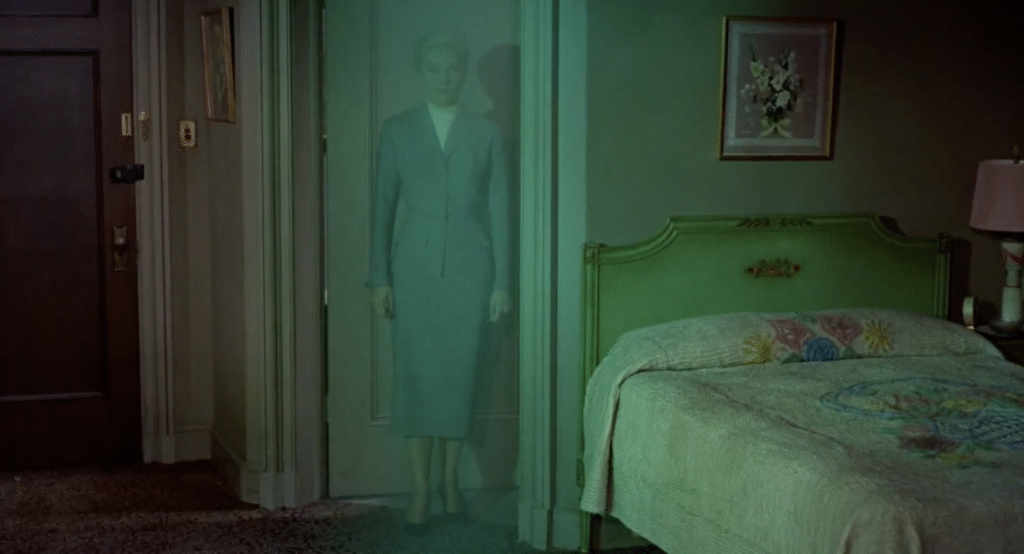
When Scottie remakes Judy in Madeleine’s image, the recursion reaches its apex. The audience, complicit in his desire, experiences the same sickening mix of anticipation and guilt. Hitchcock proceeds to weaponize empathy, forcing us to participate in Scottie’s delusion. This is the “co-authorship” principle at its most disturbing: our imaginative collaboration with the film becomes morally charged. We project our longing for closure onto Judy, only to discover that this act of imaginative control is itself the crime.
The Fall: Resolution as Collapse
The film’s final moment, Judy’s death and Scottie’s silent confrontation with the abyss, completes the spiral. The dissonance resolves only through annihilation. Having achieved perfect knowledge and understanding, having solved more than just the mystery of Madeline, Scottie finds it meaningless; the pattern he sought was an illusion all along. Like Pirsig’s Phaedrus, he has crossed beyond the mythos, into madness.
Yet this collapse is precisely what makes Vertigo so enduring: it leaves the viewer suspended, still spinning in the mental spiral Hitchcock constructed. There is no closure to the story; it loops. Every rewatch, every reinterpretation, is a reenactment of the same cognitive recursion: the desire to understand, the failure to do so, and the compulsion to try again.
Vertigo and The Fourth House: Parallel Architectures
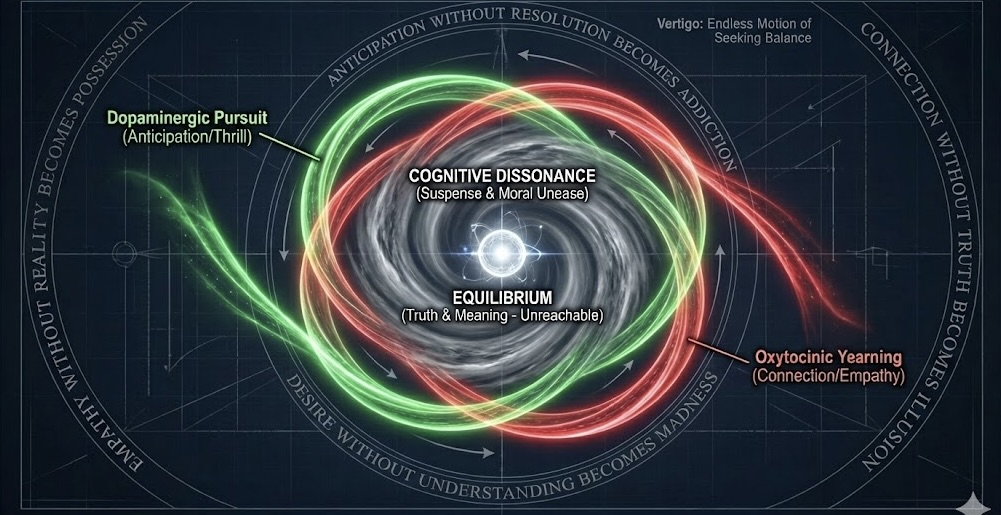
As mentioned earlier, Vertigo and The Fourth House share a similar structure. In The Fourth House, Sunny’s pursuit of truth mirrors Scottie’s pursuit of Madeleine. Both are driven by dissonance that creates an itch to reconcile the irreconcilable. Each seeks mastery over perception, only to discover that perception itself is the trap. The architecture of obsession, Scottie’s spiraling staircases vs. Sunny’s layered narratives, becomes a visual and structural analogue of the brain’s own search for coherence. Both end where they began: in awareness of the abyss.
In both narratives, truth is not a revelation but a rotation of consciousness upon itself. Hitchcock visualizes this through the spiral; The Fourth House expresses it through recursive perspective and pattern recognition. Each reveals that the human mind, when confronted with dissonance, does not seek peace but motion; a continual circling around the void that gives experience its shape.
The Double Helix of Perception
From The Fourth House to Vertigo, a clear pattern emerges: the story as a system of recursive seeing. Each protagonist becomes both observer and observed, trapped within the mirrored architecture of their own perception. In Vertigo, this mirroring is literalized through duplication: Madeleine becomes Judy; illusion becomes embodiment.
In The Fourth House, Sunny’s and Nadeen’s mirrored struggles unfold across generations, suggesting that perception itself may be hereditary and that consciousness is a story passed down, retold, and reinterpreted through time.
Ultimately, Vertigo doesn’t necessarily hold up to Dramatica’s notion of a complete story (though much of it may be related to defining whether an actual argument is being made); nevertheless, it’s a perfect demonstration of what results in the imbalance between empathy and logic.
NEXT: Part 7.4: The Other and The Others — The Haunted Self
This convergence points toward the next evolutionary step in the theory: the double. For if Vertigo represents the mind turning upon itself, then The Other and Thomas Tryon’s (and Robert Mulligan’s film adaptation) The Others externalize that turn, transforming internal recursion into literal reflection. These stories do not merely dramatize dissonance; they divide it, giving it form as twin selves, living and dead, and finally, conscious and unconscious.
In neuropsychological terms, these narratives explore split schema: the mind’s ability to sustain two competing self-models simultaneously. The audience, co-authoring the experience, is forced to inhabit both. The tension between what is known and what is felt sustains the engagement, mirroring the very structure of the brain’s hemispheric dialogue: one analytic, one empathic; one seeking order, and the other meaning.
What follows, then, is not just an exploration of story, but of self. In The Other and The Others, identity itself becomes the haunted house, where each room is a possibility, each corridor a contradiction. To understand these stories is to enter the architecture of divided consciousness, where the only way out is through the realization that the “other” is, and has always been, oneself.