


NOTE: This is a continuation of a series of essays comprising The Unified Theory of Narrative Engagement. Earlier essays discussing the theory at length can all be found here.
When Robert Pirsig ended Zen and the Art of Motorcycle Maintenance, he didn’t offer closure so much as a clearing—a moment of recognition that the journey toward understanding is itself the destination. This theory, too, finds its ending as an awakening to a new mode of seeing and understanding that the more we look, the more we see.
We began with a question that every artist eventually asks, in one form or another: What is the nature of story?
What began as an attempt to understand narrative structure and engagement grew into something far more encompassing: a meditation on consciousness itself. We discovered that story and mind share the same architecture — both driven by anticipation, tension, and resolution; both sustained by the dance between chaos and order, emotion and reason, the unknown and the known.
In Pirsig’s philosophy, Quality stands before definition, a pre-conscious moment of knowing that precedes thought. In neuroscience, the same moment is mirrored in dopaminergic anticipation: a gut feeling that meaning lies just ahead, waiting to be revealed. Between them stands the human impulse to bridge that gap and to create coherence where none yet exists.
Story is that bridge. It is the structured expression of our attempt to reconcile the dynamic with the static, intuition with logic, and chaos with form. And because the mind is recursive, forever looping between perception and reflection, so too must story be.
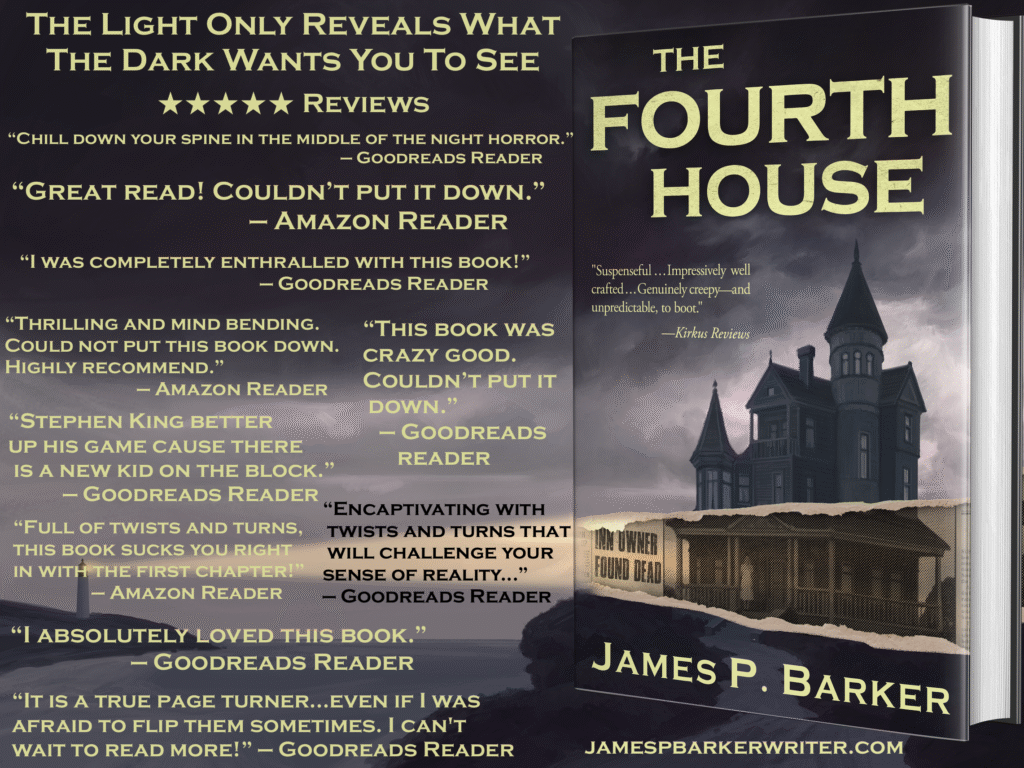
The recursive imagination is, as we have seen, a natural reflection of consciousness itself as opposed to being merely an artistic conceit. Every narrative that invites the audience to re-interpret what they’ve seen, whether it be Vertigo, Adaptation, or The Fourth House, mirrors the way we re-interpret memory, experience, and the self. The structure of story thus becomes the structure of awareness.
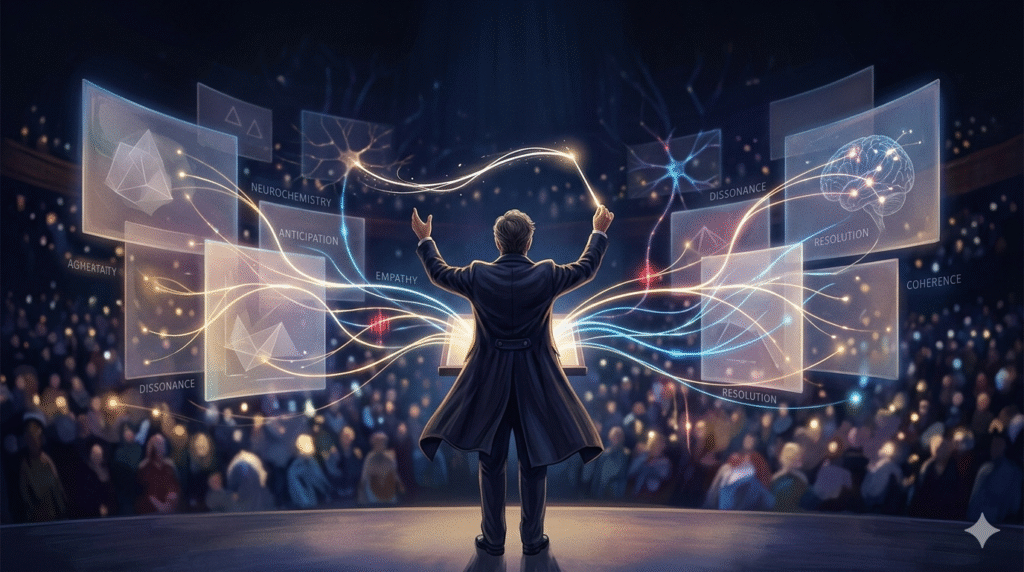
To write, then, is not to manipulate, as I had alluded to over a decade ago in an essay titled Machiavellianism and The Usual Suspects, but to mediate. The storyteller stands at the intersection of multiple fields, philosophy, psychology, and neuroscience, and tunes them into harmony. Like a conductor before an unseen orchestra, the writer guides the reader’s neurochemistry through crescendos of anticipation and empathy, dissonance and resolution, until both arrive at a state of balance.
This is the moral responsibility of art: not to instruct, but to awaken. A story achieves Quality not because it entertains or shocks or sells, but because it returns us to ourselves with new awareness. It restores coherence to the mind’s inner geometry.
In the end, all great stories, whether they unfold in film, literature, or the private theater of the mind, belong to the same continuum of consciousness. They are expressions of one unified field that encompasses multiple disciplines that should no longer be viewed as separate entities. The same field that gave rise to thought gives rise to narrative; the same forces that bind neurons bind ideas; and the same recursive rhythm that shapes life shapes art.
The storyteller, the scientist, the philosopher, and the dreamer are different voices in the same conversation: the ongoing dialogue between awareness and the world that awareness creates. And perhaps that is the truest meaning of this theory, that to understand story is to understand ourselves — and to create with consciousness is to participate in the unfolding of the fabric of reality.
The road does not end here; it only opens wider, inviting us to keep asking, keep reflecting, and keep writing. In doing so, we continue the most timeless recursion of all: the universe awakening to itself.
When I began adapting The Fourth House into novel form, I didn’t know I was walking into the foundation of a theory. When I began analyzing it, asking an untold number of questions, I was simply following a feeling; an intuition I couldn’t yet define, a pull toward something that seemed to exist just beyond language.
Later, I would understand that this was Pirsig’s “Dynamic Quality,” the unspoken recognition that something is true before we can explain why. At the time, I only knew that what I was writing felt alive with every choice, every image, every rhythm seeming to carry more meaning than I consciously intended — especially in retrospect of the analyses.
It was only then, while reflecting on the structure of that story, the psychological recursion, the symmetry between characters, the tension between logic and faith, that I began to see a pattern. It wasn’t just thematic; it was neurological. The same mechanisms that drive our need for coherence in life, dopamine’s pursuit of the next revelation, oxytocin’s empathy for others, and the cognitive dissonance that binds them in tension, were playing out in narrative form.
When I returned to my earlier essays, Zen and the Art of Exorcising Bad Story Analysis, Keeping Your Audience in Suspense, and many others, I realized that the seeds had been there all along. What began as literary mechanics had quietly evolved into cognitive architecture. Every story I had analyzed, from The Exorcist to The Innocents to The Shawshank Redemption, was pointing toward the same realization: that engagement arises not from what happens, but from the dissonance between what we expect and what we discover. And the bridge between those two is consciousness itself.
I think that’s what Pirsig meant when he said, “The place to improve the world is first in one’s own heart and head and hands.” Storytelling, like motorcycle maintenance, is an act of balance between precision and intuition, intellect and empathy, and logic and love. Writing became, for me, an act of alignment — a way to understand the world’s machinery while listening for the quiet hum of its unseen harmonies.
Looking back, I realize this theory was never constructed; it was revealed, one insight at a time, over decades of practice, reflection, and connection. It began in dissonance and found its resolution in synthesis . . . just as every good story should. It’s humbling to think that what started as an attempt to write a better story became a journey into the very nature of mind, meaning, and reality.
And maybe that’s what The Fourth House really represents: the home of the buried truth we uncover. Each story we write or read is another excavation, another step closer to understanding the architecture of our own mind at work. We don’t find the truth by reaching outward, but by circling inward, again and again, until the mirror clears and we recognize ourselves staring back.
That’s where this road has led me so far. And where it leads next . . . well, that’s the beauty of recursion: the story’s never really over. It only awaits its next reader, its next reflection, its next awakening.
Every unified field opens not an ending, but a horizon.
The Unified Theory of Immersive Storytelling is not meant as a closed system; it is a framework in motion — an architecture designed to evolve as new discoveries about mind, emotion, and technology emerge.
Just as Pirsig’s metaphysics of Quality bridged philosophy and lived experience, and Dramatica modeled the narrative mind in motion, this theory stands as a bridge between disciplines: literature, psychology, neuroscience, and the creative arts.
Recent research in neuroaesthetics and narrative cognition provides grounds for testing and refining the principles outlined here. How does cognitive dissonance manifest neurophysiologically during moments of narrative tension or revelation?
Can oxytocin and dopamine patterns be mapped to Dramatica’s four throughlines — showing, in measurable form, the story’s structural “chemistry”? Early fMRI studies suggest that emotionally resonant storytelling synchronizes neural activity between storyteller and listener, a biological signature of co-authorship.
The next step is to understand how to design stories that intentionally foster this neural alignment: to turn empathy and suspense into consciously tuned frequencies of engagement.
As AI evolves from content generator to co-creative partner, the principles of this theory offer a philosophical and ethical compass. If stories are cognitive fields, living expressions of awareness, then artificial storytellers must be designed not merely to imitate structure, but to understand resonance.
This means modeling not only language and logic, but the bio-emotional feedback loops that make story meaningful to consciousness.
Adaptive narrative systems could use real-time biometric or emotional data to modulate pacing, tone, or character focus — effectively mirroring the audience’s cognitive state. When guided by an understanding of Quality, such systems could elevate engagement beyond consumption, turning story into a participatory act of mutual awareness.
This also raises the need for the ethical responsibility of the “Conductor.” If stories can learn from and respond to the viewer in real time, the potential for Hyper-Engagement requires a new moral framework to ensure we are creating “Windows” for transformation rather than just “Dopamine Traps.”
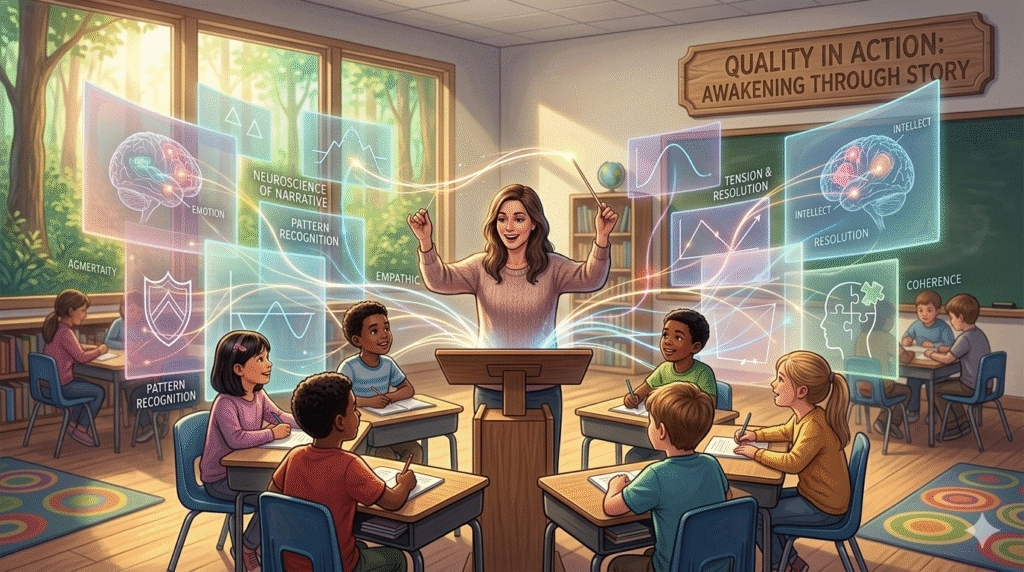
This framework also invites a reimagining of education; not as the transfer of information, but as the cultivation of coherence. Teaching story through the lenses of neuroscience and philosophy reveals to students that narrative is not only art; it is cognition, empathy, and pattern recognition at work. Understanding how tension and resolution operate within the brain provides a powerful way to teach writing, reading, and emotional intelligence simultaneously.
In the classroom, story becomes the meeting ground between intellect and emotion, between what we know and what we feel to be true. That is Quality in action.
Every organization, workplace or otherwise, has a narrative. It’s made up of the story it conveys through its own philosophy, mirrored in its directives, policies, procedures, and processes. The gap between these stated values, commandments, workers’ Bill of rights, etc., and the culture as it exists creates dissonance. Over time, these cracks in the narrative begin to form and the organization’s narrative loses coherence. In the final section, we’ll examine how a healthy, high-performance organization handles these issues through the lens of the Unified Theory, as well as a counterexample that demonstrates what happens when the story breaks. Both are based on real-world, lived experiences.
Building on the premise of the “Mirror of the Mind” and the “House of Buried Truth,” the theory has potential for how individuals process personal history. The Recursive Loop of a story can serve as a safe “crucible” for transforming “Distress” into “Eustress” or growth through the reconciliation of conflicting realities in cognitive-based therapies.
Ultimately, the integration of narrative theory, neuroscience, and AI may offer more than better stories. It may offer a clearer map of the mind itself. If story mirrors consciousness, and consciousness, in turn, organizes itself through narrative, then each new insight in one domain reflects back into the other. We may discover that the brain is, in essence, a storyteller: a dynamic field of recursive meaning-making, constantly balancing dissonance and harmony in its ongoing attempt to know itself.
In that realization lies the ultimate synthesis in the recognition that they were never separate to begin with.
Philosophy sought truth. Story gave it shape. Science gave it language. And now, through integration, they all return to their shared source: the living field of awareness, forever unfolding through pattern, emotion, and meaning.
“The story is not the machine,” Pirsig might have said. “It’s the act of seeing the machine run — and knowing you are part of its motion.”
And so, the theory ends where all great stories do: not with a period, but with an open door.
NEXT: Part 12 — Epilogue — Real World Experience: Why “Quiet Quitting” is a Management Narrative Failure.