
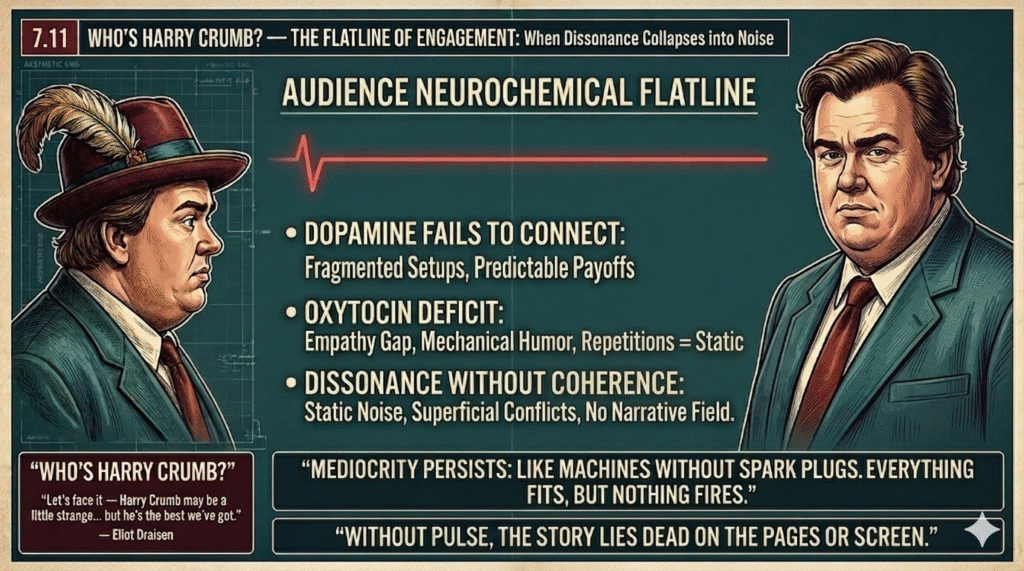
“Let’s face it — Harry Crumb may be a little strange… but he’s the best we’ve got.” — Eliot Draisen
NOTE: This is the tenth of many case studies from the Unified Theory of Narrative Engagement. Earlier essays discussing the theory at length can be found here.
Who’s Harry Crumb? was meant to be a star vehicle for John Candy as a detective comedy blending slapstick, parody, and mystery. On paper, it appears to have all the right ingredients for engagement: an underdog protagonist, a mystery to solve, disguises and reveals, and a clear moral world inhabited by greedy villains and a kidnapped heiress.
Yet despite this architecture, the film produces almost no narrative charge. It is neither thrilling nor emotionally moving; instead, it hovers in a tonal limbo of mediocrity and forgettability. The result is a perfect specimen for diagnosis with the Unified Theory, a story with structure but no pulse.
The question, then, is why doesn’t it work? The answer, through the theory’s lens, lies in neurochemical imbalance; specifically, the failure to maintain productive cognitive dissonance and to fuse anticipation with empathy.
From its opening scenes, the film signals a comic mystery, one in which the mystery never actually engages the viewers’ anticipatory circuitry. The stakes are too low, the clues too arbitrary, and the tone too inconsistent for the audience’s dopaminergic loop (anticipation, curiosity, pursuit) to activate in a meaningful way.
Each gag resets the story’s logic, rather than building upon it. Likewise, each scene functions as a self-contained sketch. This constant resetting short-circuits anticipation to the point where the mind cannot project forward because the film refuses to build tension in sequence.
In other words, dopamine fires but doesn’t connect. Every comedic setup promises discovery (“What’s Harry going to do next?”), but the payoffs are predictable (low prediction error) or disconnected from character logic. It’s the neurochemical equivalent of sugar without nutrition — a momentary stimulation without sustained engagement.
Comedy thrives when the absurd is anchored in empathy, as is the case with Tootsie, where we feel with the fool rather than merely at him. But Who’s Harry Crumb? keeps its audience emotionally distant. Harry is a caricature; his incompetence has no inner logic, and no vulnerability that makes us care.
Without oxytocin-driven empathic connection, the humor results in something that feels mechanical rather than authentic. Candy’s natural innate warmth fights to break through, but the writing unfortunately never gives him moments of genuine humanity. Even his small victories feel unearned because we’re not aligned with his emotional stakes, only his antics that plateau interest over time.
This creates an oxytocin void: the audience may laugh intermittently, but they never bond. And without bonding, there can be no transformation, only repetition, and repetition of anything for too long becomes achingly static.
As discussed earlier, in the Unified Theory, cognitive dissonance is the tent-pole of engagement; the “itch that must be scratched.” But in Who’s Harry Crumb?, dissonance is present yet unfocused. The audience senses absurdity but not contradiction as there’s no underlying perspective-driven tension between belief and revelation, or between self and shadow.
Meanwhile, every conflict is superficial: Harry vs. his boss, Harry vs. his disguises, Harry vs. himself; however, none of these conflicts reflect deeper thematic oppositions (truth vs. illusion, control vs. chaos, etc.) that could have naturally been explored with Dramatica.
In short:
The film has friction, but no field. It moves, but doesn’t resonate.
This is its fatal flaw: dissonance becomes static noise rather than dynamic energy. Without a unifying field of meaning, the dopamine (anticipation) and oxytocin (empathy) loops never converge. They operate in parallel, producing what the theory might call neurochemical dissonance decay: a complete flattening of engagement (more on this later).
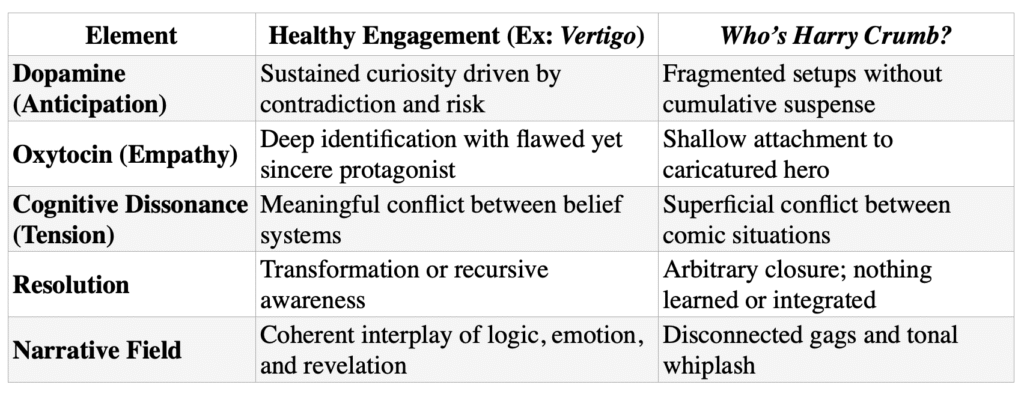
The result? A story that technically moves, but never develops. It oscillates horizontally (scene to scene) rather than vertically (depth to transformation). In Pirsig’s terms, Who’s Harry Crumb? is a narrative of Static Quality masquerading as Dynamic movement. In musical terms, it’s a sheet of music that plays the same notes over and over, never resonating.
Mediocre stories like Who’s Harry Crumb? persist because they mimic the surface features of successful ones, structure, rhythm, archetype, without activating their underlying field. They are, to borrow a metaphor, like machines without spark plugs: everything fits, but nothing fires.
This is where the Unified Theory has its diagnostic power: It can quantitatively identify what most critics describe vaguely as “flat,” “uneven,” or “average.”
In Harry Crumb, the failure is chemical, not conceptual: dopamine loops are initiated but never fulfilled, empathy is signaled but never earned, and dissonance, though present, remains unintegrated.
The result is equilibrium without energy, the precise inverse of Quality.
Ikiru represents arguably the apex of Quality, where dissonance transmuted into meaning. Who’s Harry Crumb? represents its vacuum. Where Watanabe dies to live, Harry bumbles to persist. There is no shift in awareness, no recursive realization, no transformation — just stumbling, bumbling Harry.
However unfulfilling an experience Who’s Harry Crumb? is, it still provides the opportunity to learn as the ultimate cautionary tale for storytellers: without dissonance, there is no discovery. Without empathy, there is no truth. Without anticipation, there is no pulse. Without pulse, the story lies dead on the page or screen.
Comedy, horror, drama, they all obey the same field. The only difference is which current you choose to electrify.
When a story feels flat, neither inspiring passion nor disgust, it isn’t because nothing happens, but because nothing moves. The Diagnostic Method provides a way to detect where the current has failed in the field of engagement. Like a cardiogram for consciousness, it measures the three core signals of narrative vitality: anticipation (dopamine), empathy (oxytocin), and contradiction (cognitive dissonance).
Ask these questions:
When all three lines pulse in rhythm, anticipation building, empathy anchoring, and contradiction oscillating, the story comes alive as a living field. When one falters, the story becomes static, mechanical, predictable.
A simple rule of thumb emerges: flat stories lack rhythm (pulse), not necessarily structure (bones).
If the Diagnostic Method tells us what to look for, the Quality Curve shows us when and how these forces interact. Every immersive story, whether an intimate drama like Ikiru or a tension-driven thriller like Halloween, operates not as a line of events but as a waveform: an evolving oscillation between anticipation, empathy, and contradiction.
This curve visualizes the dynamic field that Pirsig called “the living edge of reality”— the frontier where form meets perception. In narrative terms, it maps how the audience’s neurochemistry fluctuates as story, emotion, and meaning align.
The Quality Curve is a fingerprint as opposed to a formula. In Ikiru, the dissonance line begins flat and climbs slowly until it resolves into compassion; in The Fourth House, it loops recursively, each revelation reopening the previous contradiction. In Who’s Harry Crumb?, the three lines never converge; each exists independently, preventing resonance.
When properly orchestrated, these waves form what might be called the harmonic field of meaning:
Together, they generate the rhythm of consciousness that defines Quality.
In its simplest expression:
Quality (Q) = f (ΔD + ΔO) × ΔΨ
Where:
The greater the change across each vector, and the greater their alignment in time, the higher the perceived Quality of experience. A story is not powerful because it contains emotion or tension, but because these forces evolve in synchronous contrast.
While the field equation expresses the conditions under which Quality emerges, it does not yet account for how engagement unfolds over time, nor how it degrades, adapts, or collapses.
This extension emerged from examining contemporary viewing environments, particularly streaming platforms, where audience attention is fragmented and continuously contested. Unlike theatrical experiences, which benefit from temporal and situational commitment, home viewing introduces constant alternatives, increasing the risk of disengagement.
This raised a central question: what causes engagement to decay over time, even in structurally sound narratives?
To model immersive storytelling as a lived, temporal experience, the equation was extended into a dynamic system. This is how we calculate the ‘Pulse’ of a story — the sum of curiosity (Dopamine) and connection (Oxytocin), weighted by how much we care about the outcome over time.
Nₑ⁽ⁱ⁾ = ∫₀ᵗ (S_c · Eᵣ⁽ⁱ⁾ + f(D_k(t))) · e^(−λ(V)t) dt
This expanded formulation does not replace the original field equation; it operationalizes it.
Where the field equation describes the conditions of Quality, the temporal model describes the accumulation of engagement as those conditions fluctuate across time.
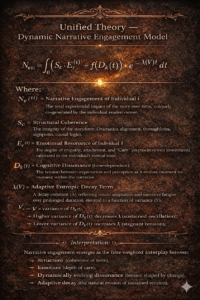
The variables correspond directly:
The term S_c (structural coherence) provides the necessary framework within which these changes can be perceived as meaningful rather than chaotic.
The exponential decay term, λ(V), introduces a critical dimension absent from the simpler model: the reality that sustained tension without variation leads to perceptual fatigue and disengagement.
In this sense, immersion is not merely generated—it must be sustained against decay.
A narrative that maintains constant tension without modulation does not intensify engagement; it accelerates its erosion. The mind adapts, prediction stabilizes, and dissonance loses its charge. What begins as suspense resolves into monotony.
The field equation captures the spark of Quality — the moment where anticipation, emotion, and dissonance converge.
The temporal model captures the flame — how that spark either grows, flickers, or fades across the duration of the experience.
Together, they describe not just what makes a story meaningful, but what allows that meaning to endure.
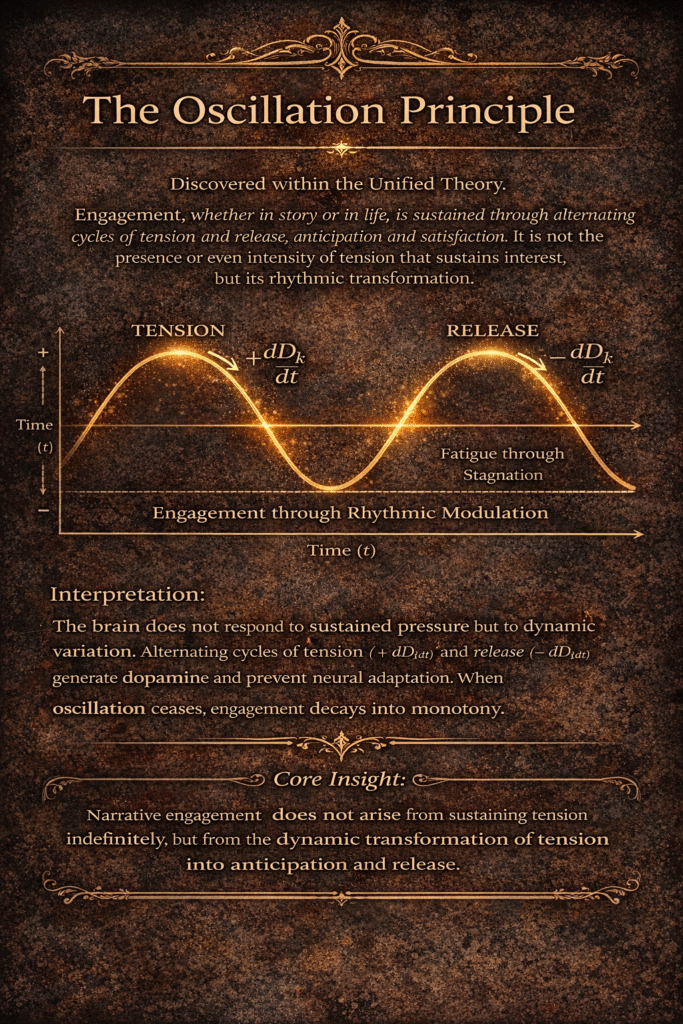
If Who’s Harry Crumb? is a flatline at the bottom of the Quality Curve (low tension, low variance), The Hateful Eight is a flatline at the top (high tension, low variance). Both lack the dynamic oscillation required to sustain the human nervous system, triggering the e−λ(V)t decay.
In The Hateful Eight, Quentin Tarantino traps the audience in a room with relentless, unvarying tension and despicable characters (low Oxytocin). Because the variance (V) of the dissonance is low (a constant, high-pitched hum of hostility), the brain adapts, and when the brain adapts, it gets bored. The decay rate (λ) accelerates, and the audience literally fatigues and turns off the television.
We often say we are “paying attention” to a story, but we rarely consider the actual “economy” of that transaction. In this model, think of your brain not just as a passive observer, but as an active investor in a high-stakes market.
The Currency of Curiosity
The “Free Energy” of a story, a concept rooted in Karl Friston’s Free Energy Principle, is its inherent Uncertainty. In any financial market, wealth isn’t generated in a flat line; it is generated through volatility. A story that is perfectly predictable is the equivalent of a stagnant market. If there is no “Prediction Error” to resolve, there is no reason for the brain to trade its finite metabolic energy, and the “profit” of dopamine or meaning is never realized.
The Cost of Internal Consistency
This brings us back to Leon Festinger’s Cognitive Dissonance. When a narrative introduces a mystery or a character action that contradicts our expectations, it creates a “Surprise Debt.” Just as an investor must reconcile a sudden shift in stock price, the reader must perform the “work” of resolving this dissonance.
Optimal Volatility
The most engaging stories manage what we might call Optimal Volatility. They keep the market “hot” enough with surprises to stay interesting, but they avoid the “market crash” that happens when the dissonance becomes so high that the reader can no longer afford the “Free Energy” required to make sense of it. And just like a market, if a story’s “currency” plateaus, engagement is lost.
In this interpretation, we’re doing more than just watching a story; we’re speculating on its meaning and hedging our bets against the next plot twist.
To maximize storytelling effectiveness and engagement using this analogy, create a scene that acts like a Narrative Options Market, a high-frequency trading floor where you issue “Surprise Debt” at a high rate by stacking ambiguities. In The Fourth House, I did this intentionally in one particular scene, where every character is misperceiving something — especially the main character. It’s a suspenseful scene that plants seeds of “false narratives” in the reader’s mind that are otherwise logically sound.
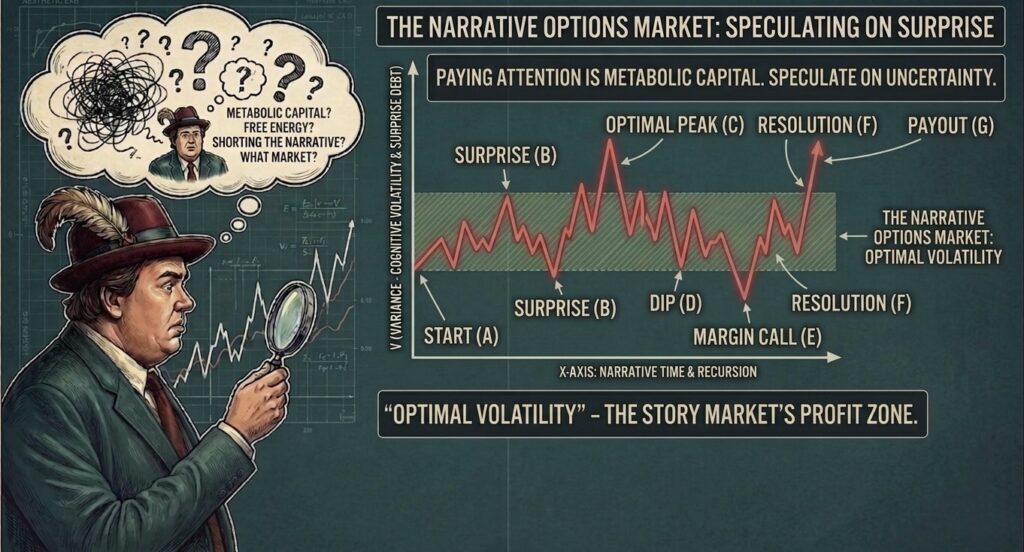
These misperceptions become “high-volatility stocks.” The reader “buys” into one interpretation of their meaning, but because they are “misinterpreted” within the narrative, the brain is actually holding a Short Position. In this introductory phase, the reader gets a “payout” of immediate engagement. The scene is “dynamic” because the V (Variance) is high. They are “paying” attention because the sensory details (the rain, the relics) have high Er (Emotional Resonance).
Later, when the truth of those items is revealed, the reader goes back to that earlier memory through recursion. This is a Margin Call. The brain realizes its initial “investment” in the meaning of the necklace, newspaper, or birthmark was wrong. Because the internal logic (Sc) holds up, the second “payout” is actually higher than the first. The reader feels a surge of “Quality” because they realize the author didn’t lie; the “Market” just moved in an unforeseen way. This is the “gap” that Robert McKee states opens between expectation and revelation.
If those elements were just “random things in a shop,” the reader would experience Entropic Decay (λ). They would think, “Why am I looking at this junk?” But because each item, the newspaper, the necklace, and the birthmark, is tied to the “Surprise Debt” of the larger mystery, the Gumption (Engagement) stays high, keeping the “Market” volatile enough that the reader can’t afford to stop “speculating” on what those items mean.
The end result isn’t just storytelling with setups and payoffs; it’s the audience unknowingly managing a portfolio of mysteries that continues to pay out dividends through recursion as the truth of each of those items comes to light, causing them to revisit and reinterpret. This is essentially where two stories are being told at once: the apparent story, that which is apparent to the reader as it’s unfolding, and then there is the real story, its current hidden until the right moment, when it becomes known and forces backward reflection. Both are logically sound, and need to be, both initially and recursively.
Imagine a graph where time flows along the x-axis and emotional engagement along the y-axis. The three lines weave in counterpoint — rising, dipping, and crossing in pattern.
This intersection—when all three curves momentarily align—is the moment of Quality recognition: the pre-conscious awareness that something true has occurred, before understanding why.
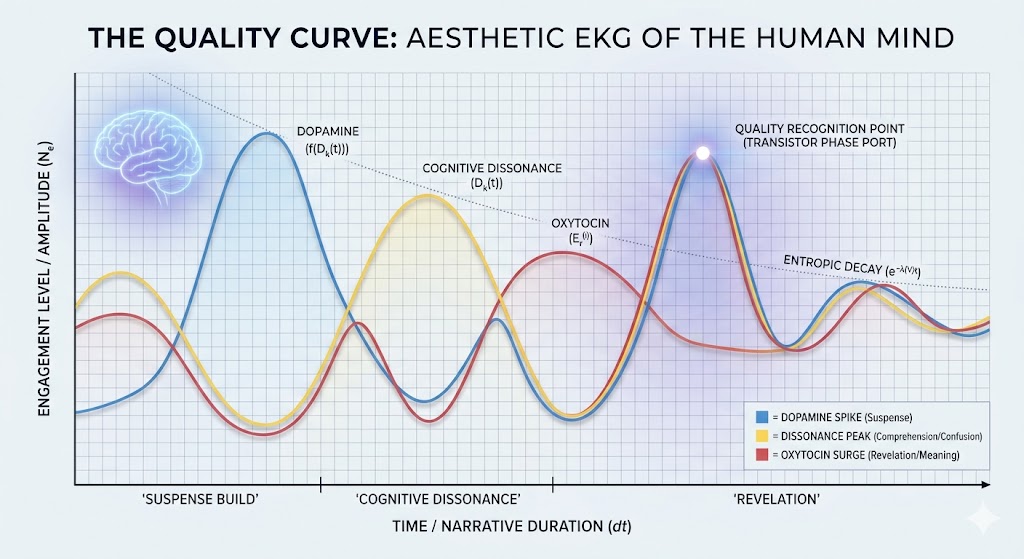
By mapping these oscillations, writers can see what readers feel. The Quality Curve transforms abstract intuition into an observable pattern. It allows creators to diagnose imbalance (a flat oxytocin line, erratic dopamine spikes) and to design for harmony—where curiosity, empathy, and contradiction pulse together in living rhythm.
In essence, the Quality Curve is the aesthetic EKG of the human mind. It charts not just what happens in a story, but what happens to us as we experience it. When the three waves synchronize, we call it engagement; when they transcend, we call it art.
NEXT: Part 7.12 — David Lynch & the Science of Narrative Engagement